
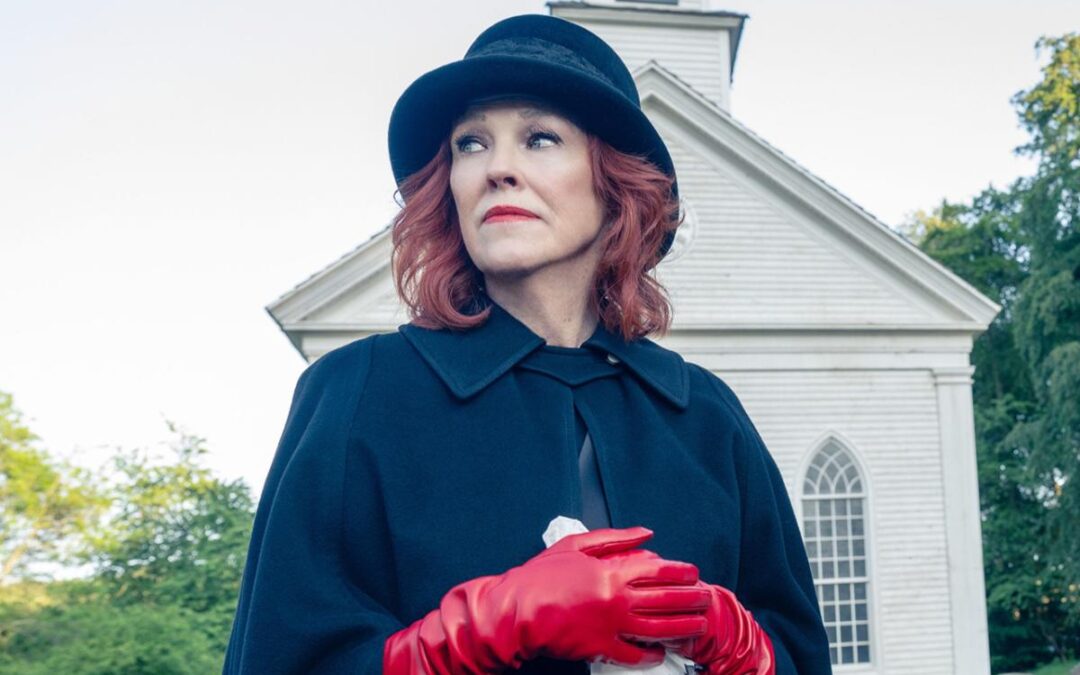
If you happened to be on the isle of Manhattan on the evening of September 12, 2005, you had the opportunity to visit Comedy Heaven, live and in person. The site was Makor, an offshoot of the venerable NYC arts venue the 92nd Street Y; Makor was situated in Midtown East, an unprepossessing building. But inside were Eugene Levy, Joe Flaherty, Andrea Martin, and Catherine O’Hara, the performing maestros of SCTV, the incredible, unique, showbiz sending-up program whose pratfalls, celebrity impressions, deeper-than-deep-cut in jokes and more cracked up and amazed my generation of boomer late-night layabouts. O’Hara’s death was announced Friday; she was only 71.
The SCTV program had been off the air for quite some time when this reunion was called, and all these cast members were, like their colleagues, enjoying busy solo careers. The occasion of a DVD release of SCTV’s run was the ostensible occasion to reminisce. And I was lucky enough to be asked to moderate the panel. How badly did I want the gig? The event fell smack dab in the middle of the Toronto International Film Festival, which I was attending on behalf of Premiere magazine. On my own dime, I booked a flight back down to NYC, then back up to the Great White North the next morning, so I wouldn’t miss the opportunity. It was so worth it. Not just because Eugene Levy complimented me on the choice of clips I put together. But because the whole bunch of them were such warm and genuine people who loved to talk about their time on the show, a show on which they created and wrote most of their own characters. Each one of them frankly allowed that they’d never enjoyed such creative freedom since, and probably never would again. (Happily, as we’ll see, the prediction turned out to be not quite true.)
O’Hara was, like her fellow cast members, a peerless impressionist, but her most indelible characters were the ones she created herself. Particularly Lola Heatherton, the borderline blowsy chanteuse who was the dictionary definition of “over demonstrative.” When accepting a compliment from hack talk-show host Sammy Maudlin (Flaherty) or uber hack “How ARE ya?” catchphrase comic Bobby Bittman (Levy), she’d respond “I love you Sammy Maudlin/Bobby Bittman! I wanna BEAR YOUR CHILDREN!” This was hilarious enough on its own, but O’Hara was a generous enough performer that she could drop her laugh line as a set up for a bigger laugh. On one of the Maudlin bits, a fellow guest was Andrea Martin doing Mother Teresa, and the look of confusion and distress on Martin’s face after a Lola outburst is the cherry on top of the outburst. Lola’s perpetually off-key singing was always a treat, especially belting out saucy lyrics in a promo for her Christmas special “The Love Spirit”: ”Gonna be your frosty snow girl/I’m gonna deck your halls/wait until I shake your tree boy/I’ll break those Christmas balls.” The Heatherton character reached its apotheosis when she was reported dead on the in-house news program, a hoax designed to boost ratings for her special. A special in which she performed, almost dead drunk, a tell-off to her former paramours in the SCTV multiverse. “You’re all just parasites/draining me of loooooooove,” O’Hara moans, indefatigably. “TRAMP! They called me a tramp!” She goes on to call out “Mr. Bobby ‘How WAS I?’ Bittman.”
Her comedic genius was appreciated by Martin Scorsese, who cast her as one of the many loco women in his 1985 nightmare comedy After Hours. The auteurs continued to call: she was in Mike Nichols’ Heartburn, then Tim Burton’s Beetlejuice, in the latter playing a parent who just didn’t understand. It was in the same year, 1990 that she played a parent who didn’t make a proper head count when herding her children off to Paris in Home Alone, the movie that defined her for mainstream audiences and reunited her with SCTV colleague John Candy. She proved an expert dramatic actress in the likes of The Paper and Kevin Costner’s Wyatt Earp. (And did so again more recently in a few episodes of the decidedly this-ain’t-no-party horror series The Last of Us.)
O’Hara became a mom herself a couple of years after marrying production designer Bo Welch in 1992. She discussed the challenges of being a working mom in showbiz in Rosanna Arquette’s 2002 documentary Searching For Debra Winger. (Arquette was also in After Hours, but she and O’Hara had no scenes together.) “Sometimes you think ‘well I want my child with me,’ and you drag them to a hotel room,” she observes. “So they can’t have their same toys and the same bed and the same friends. And they’re in the hotel room with you all day with your work. ‘Isn’t it great being in the same city as mummy?’”
IMDb Score: 7.5
Rotten Tomatoes Score: 95%
The oeuvre of director Christopher Guest forms the backbone of the entire mockumentary genre. Waiting For Guffman, A Mighty Wind, and the Netflix original Mascots all create excitement from mundanity and create characters so real you forget they’re Catherine O’Hara or Eugene Levy. Of all his films, Guest’s dog show documentary Best In Show is perhaps his best regarded-and rightly so. Adorable dogs and kooky owners hungry for first prize, what’s not to love?
[Where to stream Best In Show] ©Warner Bros/Courtesy Everett Collection
But in motherhood she did not miss a step, work-wise, and was able to bring the improvisational skills she honed at SCTV to four extraordinary films (“mockumentaries,” some call them) directed by and co-starring Spinal Tap co-creator Christopher Guest: In Waiting For Guffman she and Fred Willard are real-estate agents and amateur thespians; in Best In Show she and Levy are owners of a terrier who’s literally the child they never had; in A Mighty Wind she and Levy are a very estranged one-time folk singing duo; and in For Your Consideration she’s an Oscar-hungry actress with the too-memorable name Marilyn Hack. And again, while she’s unfailingly, hilariously virtuosic in each turn, the generosity she shows her co-performers, Levy especially, is genuinely heartwarming.
I mentioned above that the SCTV people, at the time I interviewed him, thought they’d never enjoy the freedom they had on that show again. It was more that no outside producer or production would give it to them. When Eugene Levy and his equally gifted son Dan Levy created the comedy series Schitt’s Creek, one could infer they did so in part to reclaim their liberty as comedic creators. O’Hara was clearly delighted to come along for the ride. Her character, Moira Rose, the matriarch of the real-estate-challenged Rose family, is a hair-raising inversion of Lola Heatherton. Imagine Heatherton fancying herself a Shakespearean player. Moira’s absolutely loopy self-dramatization and talent for malapropism were sources of endless comedic surprise on that show. What she does is not only lunatic but eruditely so. There’s nothing like it. And there was nothing like her. We were lucky to be able to experience her talent, and it’s a shame and a tragedy that the life she so clearly enjoyed was taken this soon.
Veteran critic Glenn Kenny reviews new releases at RogerEbert.com, the New York Times, and, as befits someone of his advanced age, the AARP magazine. He blogs, very occasionally, at Some Came Running and tweets, mostly in jest, at @glenn__kenny. He is the author of the The World Is Yours: The Story of Scarface, published by Hanover Square Press, and now available for at a bookstore near you.


