
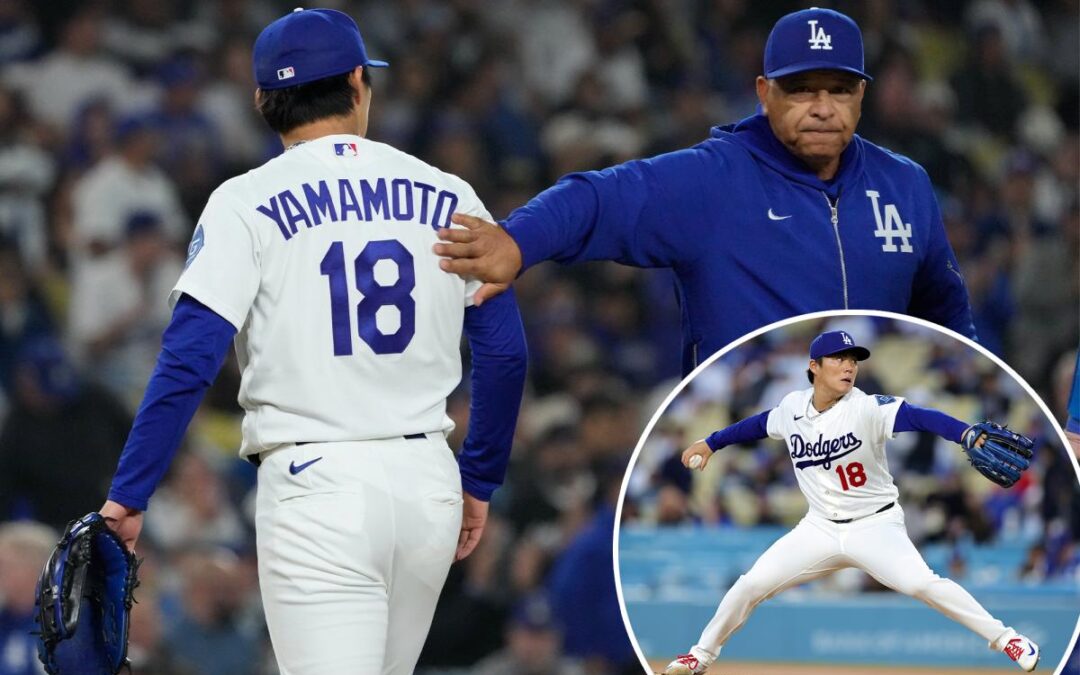
Yoshinobu Yamamoto will pitch a no-hitter this year.
In case you think I’m joking, I’ll write it again: Yoshinobu Yamamoto will pitch a no-hitter this year.
Don’t trust me?
Ask Dave Roberts.
“It wouldn’t surprise me,” the Dodgers’ manager said.
In the very next sentence, Roberts offered a more definitive answer:
“I do think so.”
Consider the weight of Roberts’ declaration.
Roberts thinks Yamamoto will do something that’s happened only 326 times in baseball history. On average, that comes to about two a season. Not a single no-hitter was thrown last year.
Pedro Martinez never pitched a no-hitter. Roger Clemens and Steve Carlton never did either.
But watching Yamamoto pitch this season, a no-hitter feels like an inevitability. The diminutive Japanese right-hander has flashed no-hit stuff in every one of his four starts, and he’s still in what his longtime trainer has described as the ramp-up stage of his season.
The trainer, Osamu Yada, said his offseason training program was designed so that he could peak at the end of the summer. If he’s already throwing the ball as well as he is now, how will he be pitching then?
I’m so convinced he’ll throw a no-hitter that I recently dropped by his locker to present him with an idea that would endear him to the media: Give up a hit to the leadoff batter in every one of his starts.
Here’s a little secret about sportswriters: We don’t like no-hitters.
A history-making pitching performance almost always results in more work for us. Depending on how close our deadline is, even the threat of a no-hitter can be nerve-racking.
Yamamoto laughed when I told him that a leadoff hit would put the reporters who cover him at ease.
I was kidding, of course. OK, maybe half-kidding.
Well, what was said in jest became a reality.
In the Dodgers’ 2-1 win over the Mets on Tuesday night, Yamamoto gave up a leadoff homer to Francisco Lindor and didn’t allow another baserunner until Bo Bichette doubled with two outs in the seventh inning.
Yamamoto ended up pitching 7 ⅔ innings, limiting the Mets to four hits and a walk. If not for Lindor’s blast, my tightly-wound colleagues in the Japanese media would have suffered nervous breakdowns.
Yamamoto found humor in how the game unfolded, saying in Japanese of Lindor’s homer, “You told me to give one up early, so that’s probably why that happened. The pitch went right down the middle.”
He could afford to laugh about the misplaced fastball to Lindor and not just because the Dodgers came back to win. In his heart of hearts, he has to know he will have better chances to throw a no-no.
“My feel is improving every week,” Yamamoto said. “My splitter was a lot better today and I was able to throw pitches out of the stretch that got swings and misses. I think this was the best I’ve felt this year. I’ll do my best in practice so that I can make comments like this again next week.”
Yamamoto has walked only three batters in 25 ⅔ innings, which the third-year pitcher said was indicative of his continued development.
“Starting around last summer, I figured out how to better start an at-bat and where to go from there,” Yamamoto said. “I’ve been getting strikes with different types of pitches, and I think I’m able to pitch in a way that’s closer to what I envision.”
His ability to quickly get through innings is why Roberts thinks he could pitch a no-hitter.
“You have to be efficient enough to be willing to get through nine innings with 110, 115 pitches,” Roberts said. “Yamamoto can do that.”
Yamamoto has done it before.
He pitched two no-hitters in the Japanese league with the Orix Buffaloes. And he nearly pitched one in the majors last year, his run at history against the Baltimore Orioles spoiled by a two-out homer by Jackson Holliday in the ninth inning.
Yamamoto’s interpreter, Yoshihiro Sonoda, blamed himself for Holliday’s homer.
Extremely superstitious, Sonoda wears what he considers to be his lucky underwear on days Yamamoto pitches. Sonoda has a small notebook in which he writes down the types of pitches Yamamoto throws in games, as well as their locations.
But when Holliday stepped into his batters box, he stopped taking notes, instead preparing to leap out of the dugout in celebration.
“If only I had taken notes on that at-bat …” Sonoda once told me.
Sonoda won’t have to live with that regret for much longer.
Yamamoto will get his no-hitter this year, with or without Sonoda’s lucky underwear or note-taking.

