
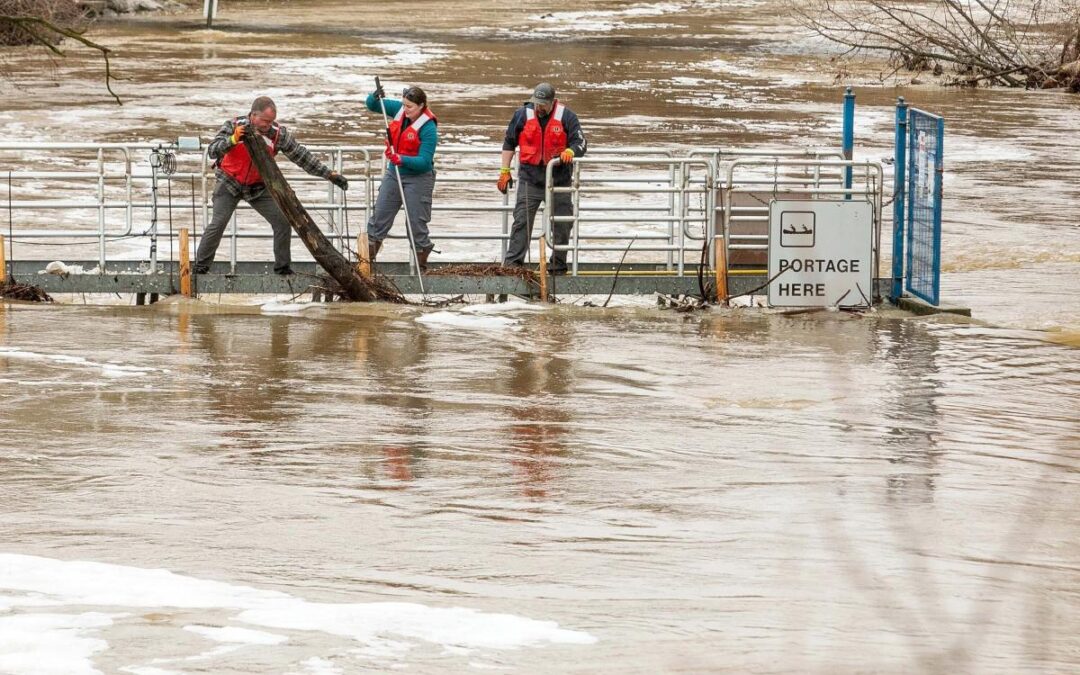
ANN ARBOR, Mich. — Floodwaters from record rainfall in Wisconsin inundated streets Wednesday, trapping drivers and forcing officials to close sections of a highway, as other Midwestern states worked to rebuild after storms.
Cars were stranded in high floodwater on a highway in Milwaukee, and video shared by the Milwaukee Journal Sentinel showed a woman and child being rescued from a vehicle.
The Milwaukee County Sheriff’s Office posted online to urge people not to drive in southeast Wisconsin.
Wisconsin Gov. Tony Evers declared a state of emergency after storms, which had started moving through the state Monday, brought strong winds, hail, and heavy rain.
At least three tornadoes were confirmed, and more severe weather was expected.
Meanwhile, communities in Michigan were recovering after powerful overnight storms damaged two ice arenas, flooded streets, and uprooted trees.
Wind gusts as strong as 70 mph (113 kph) were reported at the University of Michigan football stadium, with similarly strong gusts at the Willow Run Airport, meteorologist Sara Schultz said.
National Weather Service crews were surveying damage in places, including Ann Arbor, to determine whether one or more tornadoes touched down.
Another round of strong storms with potentially damaging winds was moving into the area on Wednesday from states to the west.
Schools and ice arenas damaged
Some public school buildings in Ann Arbor suffered structural damage, and many lost power. The district was closed because of a fiber outage impacting fire, phone, and camera systems, and building access.
Ann Arbor Mayor Christopher Taylor said structural engineers were assessing damage to a wall at the city’s Veterans Memorial Park Ice Arena. Part of the roof was torn from the university’s Yost Ice Arena.
The storm uprooted a hulking tree outside Seungjun Lee’s home in Ann Arbor, barely missing his upstairs bedroom.
“If the tree fell down a couple more feet, I would not be standing here,” said Lee, a 20-year-old junior at U-M.
Lee and his roommates were awakened by a siren, then an alert blasted from their phones between 1 a.m. and 2 a.m., urging them to take shelter.
More rain and dead fish
The storms dumped as much as 2.5 inches (6.3 centimeters) of rain across parts of southeastern Michigan by Wednesday morning, and more was expected across the Midwest, Great Lakes, and Ohio Valley regions.
Flood watches were issued for a big chunk of Michigan’s eastern Lower Peninsula, southeastern Michigan, northern Indiana, northwestern Ohio, the Chicago area, and Wisconsin.
In northern Michigan, a power outage during a storm killed 1,750 steelhead trout at a state facility where eggs and milt are collected to produce more fish. Scott Heintzelman of the state’s fisheries division said it was a “devastating event” involving “big, beautiful fish.”
Heintzelman said staff discovered Tuesday that a loss of electricity had stopped the flow of oxygenated water, dooming the fish.
Wisconsin’s Department of Natural Resources said it was watching levees around Portage, a city of about 10,000 people, as the Wisconsin River rises.
As of Wednesday morning, the river there swelled to nearly 19 feet (5.7 meters), about 2 feet (0.6 meters) over flood stage, and could rise to about 20 feet (6.1 meters), they said.
After days of rainfall and winter snow melt, a “significant influx of water” is also entering Black Lake, in northern Michigan, the sheriff’s office said.
The lake empties into the Black River and feeds the Cheboygan River, which flows through the city into Lake Huron. Officials have been managing that flow through the city’s Cheboygan Dam by raising gates, adding pumps, raising a bridge, and closing some riverfront to the public.
Flooding and unsafe travel forced Cheboygan Area Schools to cancel classes and athletic events for Thursday and Friday.
“Conditions are not improving significantly and, in some areas, continue to worsen,” the district said.
Where’s all this weather headed?
Bill Bunting, a meteorologist with the weather service’s Storm Prediction Center, described a “very dynamic weather pattern” that combines very moist air with a strong jet stream across the central United States and Great Lakes to create conditions for severe thunderstorms.
By Wednesday afternoon, the weather service had received more than 400 reports of hail, winds above 60 mph (96.5 kph) or tornadoes, he said.
The system was stretching northward Wednesday night from central Texas into Iowa and southern Wisconsin and then eastward across parts of Michigan, Illinois, northern Indiana, and Ohio on its way toward upper Pennsylvania and the Buffalo, New York, area, Bunting said.
Further east, it is expected to be as hot as a furnace, threatening record high temperatures in New York, Philadelphia, and Washington through the weekend, forecasters say.

