
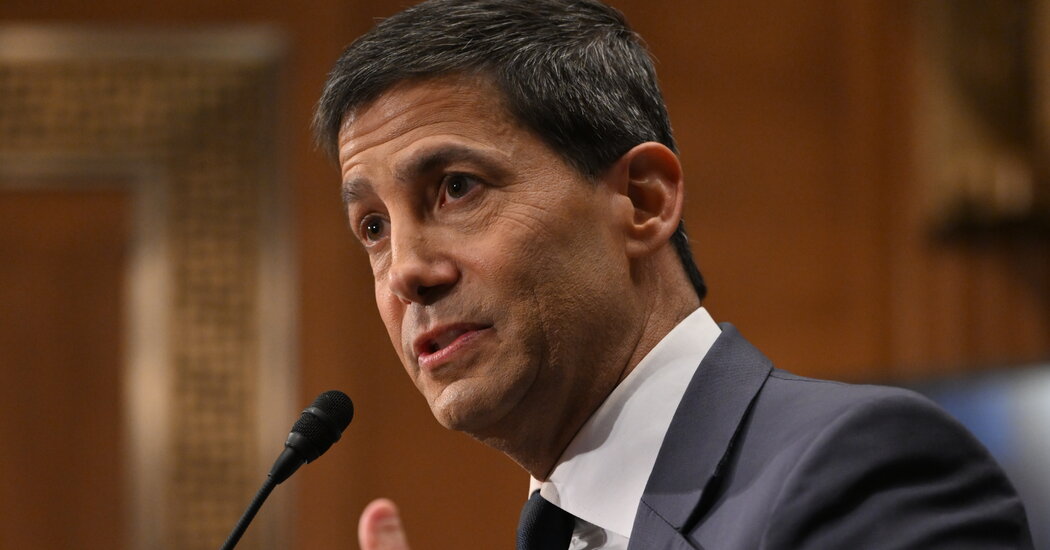
Kevin M. Warsh, President Trump’s pick to lead the Federal Reserve, asserted repeatedly at a combative confirmation hearing on Tuesday that he would not cut interest rates simply because President Trump wanted him to, pledging to be “strictly independent” if confirmed for one of the world’s most powerful economic positions.
In sometimes testy exchanges before the Senate Banking Committee, Mr. Warsh, 56, sought to dispel doubts around his credibility, saying Mr. Trump had “never asked me to predetermine, commit, fix, decide on any interest rate decision in any of our discussions, nor would I ever agree to do so.”
He was repeatedly asked if he would function as a “sock puppet” for Mr. Trump, who has demanded lower rates from the Fed and attacked the institution’s top leadership for failing to cut them aggressively enough. Just hours before the hearing, Mr. Trump said in an interview with CNBC that he would be “disappointed” if Mr. Warsh did not reduce borrowing costs once confirmed as Fed chair.
Mr. Warsh, who served as a Fed governor from 2006 to 2011, said he would remain independent. In his opening statement, he said that central bankers must be “strong enough to listen to a diversity of views from all corners, humble enough to be open-minded to new ideas and new economic developments, wise enough to translate imperfect data into meaningful insight and dedicated enough to make judgments faithfully and wisely.”
But as several lawmakers on Tuesday noted, Mr. Trump’s broadsides against the Fed have gone well beyond just verbal arguments. He is in the midst of trying to remove Lisa D. Cook, a governor appointed by the Biden administration, from her position over unsubstantiated allegations of mortgage fraud. The Supreme Court has yet to rule on the case, but so far the justices seem wary about allowing Ms. Cook’s ousting to hold given concerns about the Fed’s independence.
The Justice Department has also initiated a criminal investigation into Mr. Powell and his handling of renovations at the Fed’s headquarters in Washington, which has thrown a wrench into Mr. Warsh’s ability to get confirmed before Mr. Powell’s term as chair ends on May 15.
That’s because Senator Thom Tillis of North Carolina, a Republican on the Banking Committee, has vowed to block any attempt to confirm a new Fed chair until the legal threats against Mr. Powell are resolved.
While Mr. Tillis said he believed Mr. Warsh was qualified for the job, he has blasted the investigation as a blatant attempt to coerce Mr. Powell into lowering rates, undermining the Fed’s independence and confirming the politicization of the Justice Department.
“The problem that I have here is that we had some U.S. attorney with a dream, or assistant U.S. attorney, thinking it would be cute to bring chair Powell under an investigation just a few months before the position was going to be open,” Mr. Tillis said on Tuesday.
“Let’s get rid of this investigation so I can support your nomination,” he added.
Mr. Trump on Tuesday showed no indication that he wanted the Justice Department to drop the investigation, despite numerous legal setbacks. “You have to find out why a thing like that could happen,” he said of the central bank’s renovations. “I’m afraid Kevin will have to have an office next to me in the White House, because that building is not going to be done.”
Mr. Powell has said he will stay on as chair on a temporary basis if Mr. Warsh is not confirmed by May 15. He has yet to disclose whether he will stay on as a governor, as he can do until 2028.
Mr. Warsh also came under fire from Democrats, who questioned his shifting views on inflation. While at the Fed over a decade ago, Mr. Warsh was known as an inflation hawk, who often argued against lowering rates for fear that it could stoke price pressures.
While campaigning to be chair, Mr. Warsh embraced the need for rate cuts, arguing that there was a path for lower borrowing costs because of his plans to shrink the Fed’s holdings of Treasury bonds and mortgage-backed securities. That would likely lead to higher long-term rates that then could be offset by lowering the short-term rates that the Fed controls, he has said. Mr. Warsh also argued that higher productivity from the boom in artificial intelligence could unleash higher growth without stoking inflation, which could give the Fed more space to lower rates than otherwise would be the case.
Mr. Warsh reiterated those arguments on Tuesday, despite some pushback from lawmakers, including Senator John Kennedy, Republican from Louisiana, who described promises of A.I.-driven productivity gains as “hype” from people trying to drum up interest for their coming initial public offerings.
Mr. Warsh repeatedly made clear on Tuesday that he views any overshoot of inflation as the Fed’s fault, as he criticized the central bank for missing its 2 percent inflation target since the pandemic.
“That’s an indication that the Fed missed its mark, and we are still dealing with the legacy of the policy errors in 2021 and 2022,” said Mr. Warsh, referring to a period in which policymakers were slow to respond to mounting price pressure caused by gummed-up supply chains and a series of economic rescue packages from the government. “Once you let inflation take hold in the economy, it’s more expensive and harder to bring it down.”
On Tuesday, he pushed back on the idea that tariffs had worsened inflation and said that the Fed needed “regime change in the conduct of policy. It means a new and different inflation framework.”
Mr. Warsh touched on other changes he would support if confirmed, including how the Fed communicates around its policy decisions. Mr. Warsh criticized the amount of public forecasting the Fed does, suggesting that the institution should provide fewer hints about the future to avoid officials getting boxed in.
On Tuesday, he criticized the “dot plot” that the Fed releases four times a year, which most importantly conveys to Wall Street where the Fed sees rates in the future. “The Fed tells the whole world what their dots are doing to be, what their forecasts are going to be. Well, the Fed’s human and then they hold on to those forecasts longer than they should,” he said.
Mr. Warsh demurred when asked how many policy meetings a year there will be if he is confirmed as chair. He said that while the Federal Reserve Act requires a minimum of four interest rate meetings per year, that was too few. He did not provide an answer about whether he would continue to hold news conferences, which take place after each of the eight interest-rate meetings that are currently held.
If confirmed, Mr. Warsh’s ascent would mark a homecoming for the Wall Street financier.
The global financial crisis dominated Mr. Warsh’s first tenure at the Fed, thrusting him into the middle of discussions about how the central bank should respond to the threat of bank failures, turmoil in financial markets and the painful recession that followed. Mr. Warsh, then the youngest-ever member of the board of governors, was initially supportive of the Fed’s efforts to shore up financial markets by buying enormous quantities of government bonds and expanding its balance sheet to ease strains in financial markets and support growth by keeping market-based rates low.
But he soon soured on subsequent efforts to buy more bonds and resigned in protest, arguing at the time that the Fed was distorting financial markets and relying too much on a tool with uncertain economic implications.
Some of the most heated exchanges came during questioning by Senator Elizabeth Warren, a Massachusetts Democrat and the ranking member.
Mr. Warsh declined to directly answer when asked whether Mr. Trump had lost the 2020 election, a question Ms. Warren suggested was a factual test of his independence.
“We try to keep politics, if I’m confirmed, out of the Federal Reserve” Mr. Warsh said at one point during the exchange.
She, and other Democrats, also pressed Mr. Warsh about the more than $100 million in assets that he has agreed to divest if he is confirmed. His financial disclosures did not include specific details about several of his current holdings, including two roughly $50 million stakes in the Juggernaut Fund, which is tied to billionaire investor Stanley Druckenmiller, with whom Mr. Warsh was working closely before being nominated as chair.
Mr. Warsh said that confidentiality agreements had prevented him from providing those details, and that, if confirmed, his investments will be “as plain vanilla as possible” and “sitting in something like cash.”
Ms. Warren asked Mr. Warsh if his assets included entities involving the president and his family, Chinese-affiliated businesses or investments related to the convicted sex offender Jeffrey Epstein.
Mr. Warsh grew increasingly frustrated during the exchange, during which he only responded that he had agreed to “sell all of my financial assets.”

