
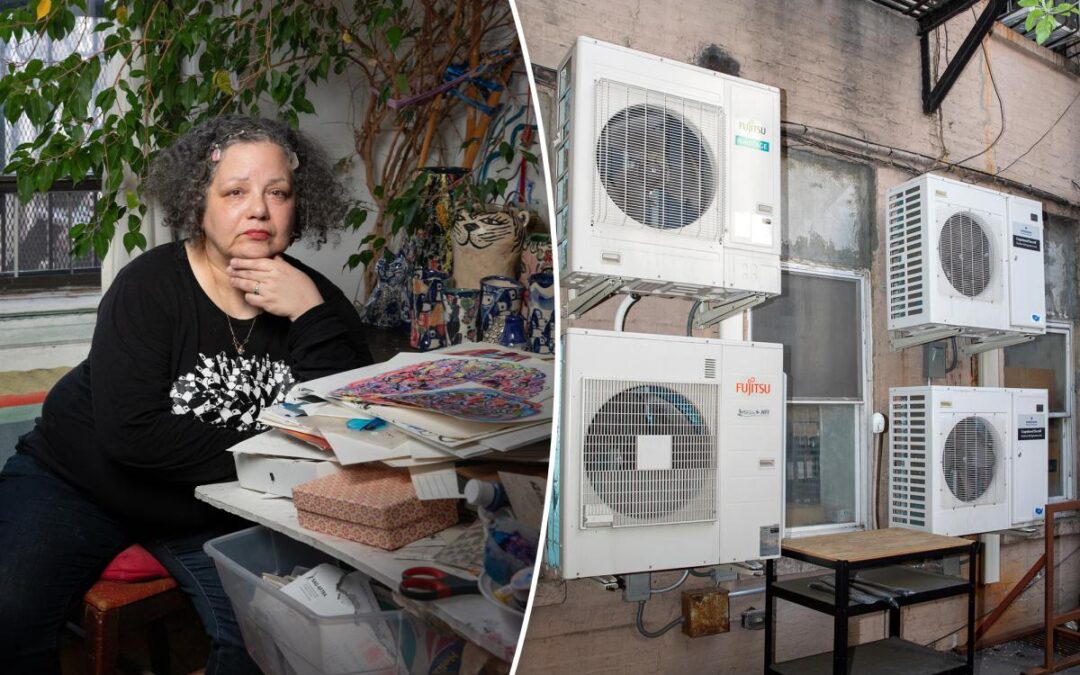
Nina Bovasso is an “exhausted” New Yorker.
A dozen years ago, a restaurant called Empire Biscuit moved into the ground floor of her building, 198 Ave. A, replacing an Italian deli. An exhaust fan was placed on the roof, roaring off and on — mostly on.
Bovasso, who lives on the top floor, was tormented.
“The ventilation fan has ruined my life,” she said.
Over the years, the industrial-style noise has sounded like “rocks spinning in a clothes dryer, a heliport on top of my head or multiple buses idling at Port Authority,” said Bovasso, 61, a New York City native and self-employed artist who works from home. “I feel like the noise will make my brain explode.”
Desperate for relief, she has been locked for years in a series of lawsuits with her landlord. And she has plenty of equally miserable company, as insufferable roof-level noise is the subject of several other recent lawsuits filed by fed-up residents. What’s more, in the most recent fiscal year, the Department of Environmental Protection responded to 4,444 complaints of ventilation fan noise, but issued just 213 violations — fewer than 5%.
Those numbers seriously downplay the problem.
“For these complaints, we first need access to the complainant’s home, and we also need the circulation device turned on and then off so we can take an accurate reading with the noise meter,” a DEP spokesman told The Post.
For Bovasso, the issues have persisted despite commercial turnover. Empire Biscuit closed after three years. The next tenant was also a restaurant — the equally noisy Auriga Cafe.
Bovasso said she even offered to pay for fan repairs, but her offer went nowhere. A week before a court date three years ago, the landlord removed the fan. Bovasso had a brief respite.
But then came a bakery called Oasis, with refrigeration equipment mounted on the side of the building. Last fall, that equipment started throbbing, Bovasso said.
At one point, she measured 97 decibels, the volume of a lawnmower, a motorcycle or a chainsaw. The city’s noise control code limits noise from circulation devices to 42 decibels when measured inside a home.
Bovasso, who has lived in her apartment for 30 years, can’t afford a lawyer, she said — and legal-aid lawyers have told her that her case is too complex and that no authority cares about noise.
In a precedent-setting noise case from 2010, however, an appeals court decided that noise could be ruled a nuisance even if no violation had been issued by a city agency.
“Just because the city doesn’t find a problem doesn’t mean there isn’t a problem,” said Steven Sladkus, the lawyer who won that case, which involved noise from a rooftop bar.
In his experience, ventilation noise can be caused by defective machinery, poor maintenance or some kind of recent damage, he told The Post.
In Bovasso’s building, the DEP has issued five noise violations, most recently in 2020, the spokesman said. Later visits have yielded no violations.
“Whenever they come for the inspection, it is miraculously quiet,” Bovasso said. She suspects that a landlord might get wind of an inspection and temporarily turn the equipment off.
Just before COVID hit, the city issued Bovasso’s landlord a violation for an immediately hazardous condition involving a part on a rooftop flue duct, with a fine of $1,250. The fine was paid, with the problem resolved a week later, according to city records.
Shortly thereafter, Bovasso started to withhold rent, which was then $1,796.01 for her rent-stabilized two-bedroom, because “I was paying for the privilege to be tortured in my home,” she said. Approximately half of the back rent was paid by pandemic rental subsidies. The landlord has sued her for the balance.
Over the past dozen years, Bovasso has emailed assorted city agencies, community boards, council members and state senators, begging for help.
“To add insult to injury, she insists on copying public officials, which we believe is an improper attempt to place political pressure on the Court,” wrote the landlord’s lawyer, Matthew Brett, in court papers. “Parties should not be permitted to engage in such conduct.”
Brett did not respond to requests for comment, nor did the landlord, Flavia Cesare, who also lives in the building.
After a decade of noise and vibration, her health has been destroyed, Bovasso said. She now suffers from tinnitus (ringing ears) and sound sensitivity, as well as vertigo. Hearing damage and long-term cardiovascular effects from cumulative noise exposure are well-documented in scientific literature.
The ordeal has “unreasonably interfered with all aspects of my life on an enduring basis,” Bovasso said. “If I could move, I would. But I have no place to go.”
A rooftop fan is a “classic problem” in the city, said Andy Morgan of Morgan Acoustics, an acoustical consultant.
Such noise, he said, is often “a multivariable problem with a combination of airborne noise and structural noise.”
A vibration often re-radiates into an apartment, he said, with walls and ceilings acting as a loudspeaker to amplify the sound.
“So much in New York City is complaint-based,” Morgan told The Post. “The city rarely looks at acoustics on the design side as part of a permit application. It comes into play only when there are complaints. The New York City code is underdeveloped when it comes to acoustics.”
Even some ears inside nearby luxury addresses aren’t spared. One of Morgan’s recent consulting jobs was at 150 Rivington St., a glassy condo opened in 2019.
The top-floor three-bedroom there has been plagued for more than three years by an HVAC system that “has flooded the Plaintiff’s unit with relentless, unreasonable, disturbing and oppressive noise at all hours,” according to a lawsuit filed in the winter by the owner of the 1,600-square-foot home that the family bought for $4.38 million.
To escape, the family rented elsewhere for several months, but later returned, burdened by additional housing costs.
The cyclical noise is a “deep, mechanical rumble with a sharp tonal pitch” that “makes normal living impossible,” according to court papers.
The condo board replaced the springs beneath the cycling compressors on the HVAC unit, but the noise persisted.
Morgan measured the exhaust noise at 83 decibels, adding that the “intermittent tonal noise” is “in excess of 58 decibels, lasting approximately thirty seconds and recurring approximately every four minutes throughout the day and night.”
He suggested elevating or relocating the equipment, adding flexible connections and installing a chimney pipe extension to redirect the exhaust. The dispute remains unresolved.
At the 76-story Frank Gehry building at 8 Spruce St., the top-floor tenants — who rent their three-bedroom for a cool $24,000 a month — complained for a year and a half before filing a lawsuit last fall, seeking relief from unrelenting rooftop noise.
Immediately after arrival, they experienced “excessive and unreasonable noise and vibration,” according to court papers, constituting “not just a minor annoyance” but a “severe intrusion.” The noise often exceeded 70 decibels.
Even a building handyman noted the problem and later “expressed astonishment that the noise still had not been resolved,” the plaintiff’s papers say.
“It is almost impossible to be in the apartment for any length of time, do work, sleep or even have a conversation, as the noise is so loud,” the tenant wrote in an affidavit. “My wife is suffering from severe headaches. We both are on edge, feeling ill more often than not, due to sleep deprivation. This is not what was anticipated or contracted for when we rented this luxury unit.”
The judge ordered the management to identify and abate the excessive noise.
It took six months, due to “the complexity of the remediation work” and “the coordination necessary with contractors and engineers to perform said work,” according to papers filed by the building’s lawyer.
An engineer identified the cause as the two 11,000-pound transformers on the 76th floor of the massive skyscraper, which includes a school, a hospital, retail stores, a parking garage and 899 apartments. The fix involved “coil spring isolators” that had to be fabricated by the manufacturer.
Remedying the condition was “a complex task” with “extensive scope,” requiring a shutdown of water, heat and electricity for the entire building for up to eight hours, according to court papers.
The court concluded that the management was acting in good faith. The repair was finally done earlier this month.
“Our focus is always on delivering an outstanding living experience,” a spokesperson for 8 Spruce wrote in a statement to The Post.
“We successfully completed necessary repair work to the transformer in a manner that minimized disruption for the 8 Spruce community. We continue to work with affected residents to address any outstanding concerns.”
As for Bovasso, she remains in limbo. The humming equipment is now below her, as are several other mechanical units from nearby restaurants that echo off the exterior walls, constituting the canyon effect.
“We’ve come full circle,” she said. “I live in the devil’s triangle, with three businesses pumping out noise.”
She fears that her options are homelessness, a shelter or an unlivable apartment that makes her sick.
“This is not a matter of ‘just get some earplugs or a white-noise machine,’” she said. “I have been blown off track of my life by this never-ending nightmare. Because I endured this does not mean I was left unscathed.”


