
The Venice Biennale will not give awards to artists from countries whose leaders are facing charges of crimes against humanity by the International Criminal Court, its jury said on Thursday in a statement apparently aimed at Israel and Russia.
Artists from those countries will still be permitted to participate in the Biennale, a prestigious international art fair showcasing contemporary works, when it opens on May 9. But the jury said that it would “refrain from considering those countries,” and that their artists would not be in contention for the Golden Lion and Silver Lion awards that recognize the top talents.
“We acknowledge the complex relationship between artistic practice and nation-state representation that provides a central structure for the Venice Biennale,” the five-member jury said in a statement. “As members of the jury, we also have a responsibility towards the historical role of the Biennale as a platform that connects art to the urgencies of its time.”
The jurors said they were committed to “the defense of human rights” and the spirit of the curatorial vision of Koyo Kouoh, the festival’s curator who died suddenly in October.
The International Criminal Court in The Hague, which investigates and tries people accused of grave offenses against entire populations, issued an arrest warrant in 2023 for President Vladimir V. Putin of Russia for war crimes in Ukraine. In 2024, it did so as well for Prime Minister Benjamin Netanyahu of Israel for war crimes and crimes against humanity in the Gaza Strip.
The Biennale’s jurors did not name a country in their statement.
Ms. Kouoh and her curatorial team selected 110 artists from around the world to represent their countries and create works of art, the festival’s organizers said in February.
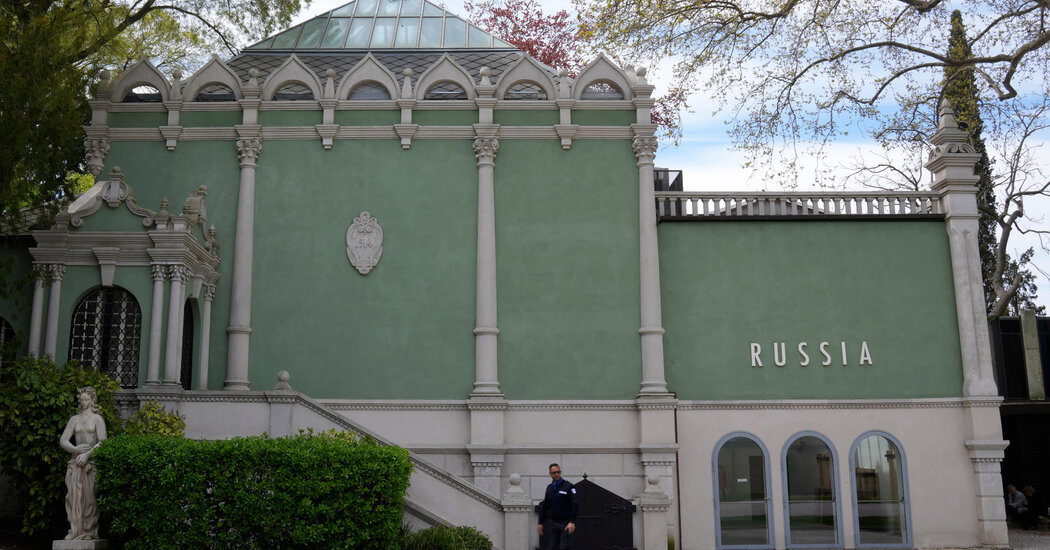
Russia and Israel are preparing to make a return to the art fair. Shortly after Russia invaded Ukraine in 2022, the two artists representing Russia that year withdrew. Russia did not participate in the 2024 Biennale either, and instead lent its large pavilion in the Biennale Gardens to Bolivia.
Israel’s pavilion was shuttered in 2024 at the behest of its artist, Ruth Patir. Facing pressure from pro-Palestinian activists, she refused to open her show until a cease-fire and hostage release agreement had been reached in the war in Gaza.
Italy’s culture minister, Alessandro Giuli, has criticized the Biennale’s inclusion of Russia, and said in a statement on Friday that he would not be attending.
The European Union foreign policy chief, Kaja Kallas, said this week that the bloc planned to cut funding for the festival — about $2 million over three years — over Russia’s inclusion this year.
“While Russia bombs museums, destroys churches and seeks to erase Ukrainian culture, it should not be allowed to exhibit its own,” Ms. Kallas said. “Russia’s return to the Venice Biennale is morally wrong, and the E.U. intends to cut its funding.”
Russia will return this year with an exhibit titled “The Tree Is Rooted in the Sky,” which will feature at least 38 artists and musicians.
Mikhail Shvydkoy, Mr. Putin’s special representative for international cultural cooperation, told ArtNews last month that Russia’s participation in the Biennale was “further proof that Russian culture is not isolated, and that attempts to ‘cancel’ it — undertaken for the past four years by Western political elites — have not succeeded.”
Ukraine’s exhibition, “Security Guarantees,” will include a deer sculpture that was removed from a public park in eastern Ukraine to prevent it from being damaged in the fighting, The Art Newspaper reported.
Activists and artists have tried to get the Venice Biennale to ban Israel over the war in Gaza, pointing to the ouster of South Africa over apartheid in the 1960s.
Belu-Simion Fainaru, the artist representing Israel this year, told Artnet that the jury’s decision had “created a hostile and degrading environment” and called the move discriminatory. His installation, called “Rose of Nothingness,” features a reflective pool filled with darkened liquid.
“I must mention that other states with serious violations are not excluded,” he said. “This statement is the violation of essential equality condition based on legally unstable and arbitrary basis.”


