
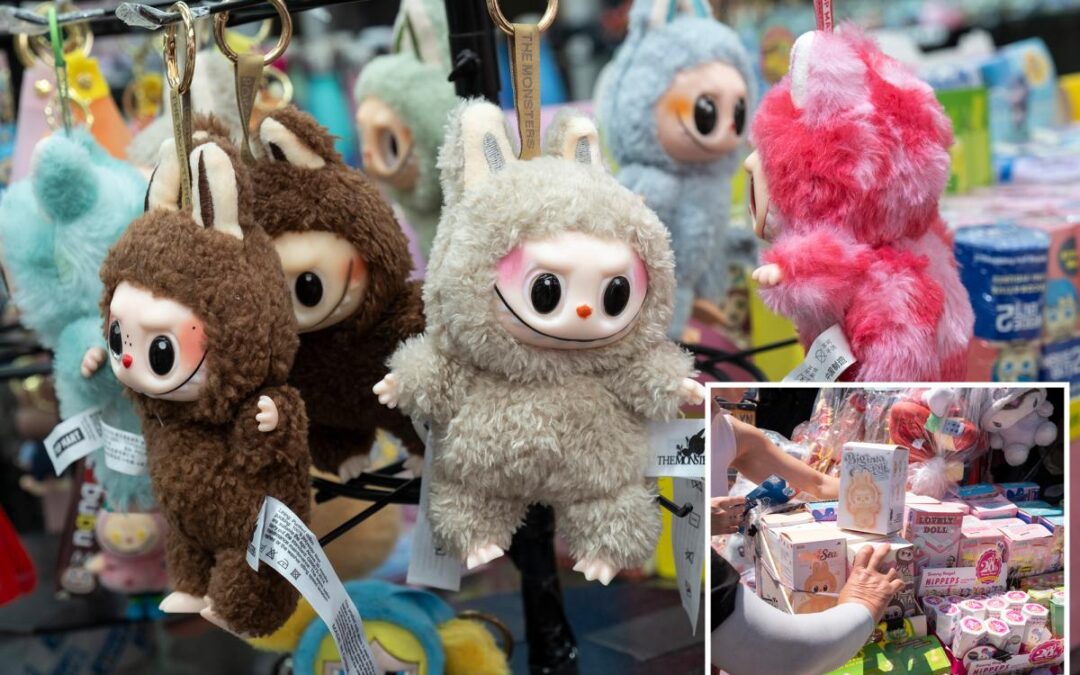
A new investigation found some Labubu dolls contain cotton that is banned in the US because it comes from a region in China known for its forced-labor laws.
The plush monster toys have enjoyed a Cabbage Patch Doll-like craze around the globe, seen hanging off the luxury bags of celebs like Rihanna and Kim Kardashian.
But an investigation commissioned last year by the Campaign for Uyghurs, a Washington, DC-based nonprofit, found that samples from Labubu dolls contained cotton grown in Xinjiang – despite a ban on imports from that region.
US lawmakers, journalists and human rights organizations have accused the Chinese government of forced labor, forced sterilization, surveillance, torture and the persecution of the Uyghurs, a mostly Muslim minority group, in Xinjiang.
The New York Times confirmed the results of the nonprofit’s investigation, with independent experts who found that 16 of 20 Labubus purchased by the news outlet contained cotton from the region, mainly in the dolls’ t-shirts.
Such imports would violate the Uyghur Forced Labor Prevention Act, which Congress passed in 2021 to ban any products made in Xinjiang. That could lead to punitive actions including bans on imports of the dolls.
Secretary of State Marco Rubio, spearheaded the bill when he was a senator, saying at the time that there was a “genocide against the Uyghur people” and other Muslim groups “at the hands of the Chinese Communist Party.”
The dolls containing the illicit cotton were bought from Amazon, eBay, Shein, AliExpress and directly from Pop Mart, the Chinese retailer behind the dolls, according to the Times. The dolls were from the Labubu lines “Fall in the Wild” and “Flip With Me.”
“The Trump administration continues to monitor for any violations of US law by importers, and has initiated a robust Section 301 investigation into the importation of forced-labor goods by our trading partners,” White House spokesman Kush Desai told The Post. He did not comment specifically on the Labubu allegations.
US Customs and Border Protection – which would be responsible for enforcing any bans on Pop Mart imports – declined to comment.
Several nonprofits have submitted information about the use of the banned cotton to the customs department, according to the report.
Pop Mart did not immediately respond to The Post’s request for comment.
A spokeswoman for Pop Mart told the Times it would conduct an investigation into the presence of Xinjiang cotton, adding that only a small percentage of its dolls use cotton and it is planning to switch over to alternative materials in its products for the US market.
The alleged illicit imports could be a test of the Trump administration’s relations with China, as the president is planning to visit Beijing next month.
Liu Pengyu, a spokesman for the Chinese Embassy in Washington, told the Times that the Uyghur Forced Labor Protection Act was “one of the most notorious and egregious laws in the 21st century,” calling it “a tool for US politicians to destabilize Xinjiang.”
The ugly-cute Labubu doll – created by Hong Kong-born artist Kasing Lung, who collaborated with Chinese toymaker Pop Mart – costs about $20 to $40.
Pop Mart’s move to package the collectibles in “blind boxes” – so shoppers don’t know the color of their doll until they purchase and open the toys – has helped fuel the trend.
Earlier this year, customers waited in hours-long lines to snap up the items, while resales fetched thousands of dollars – and one doll even sold for $150,000 at an auction in Beijing.
Pop Mart’s largest market is still China, but the Americas weren’t far behind last year, with revenue in the region rising more than 700% in the first half of 2025 – sending the stock high enough to dwarf Barbie-maker Mattel and Hello Kitty-owner Sanrio.
The Labubu train has started to slow down, though Sony is still planning a feature film starring the iconic doll, as Pop Mart has struggled to find its next hit toy.


