
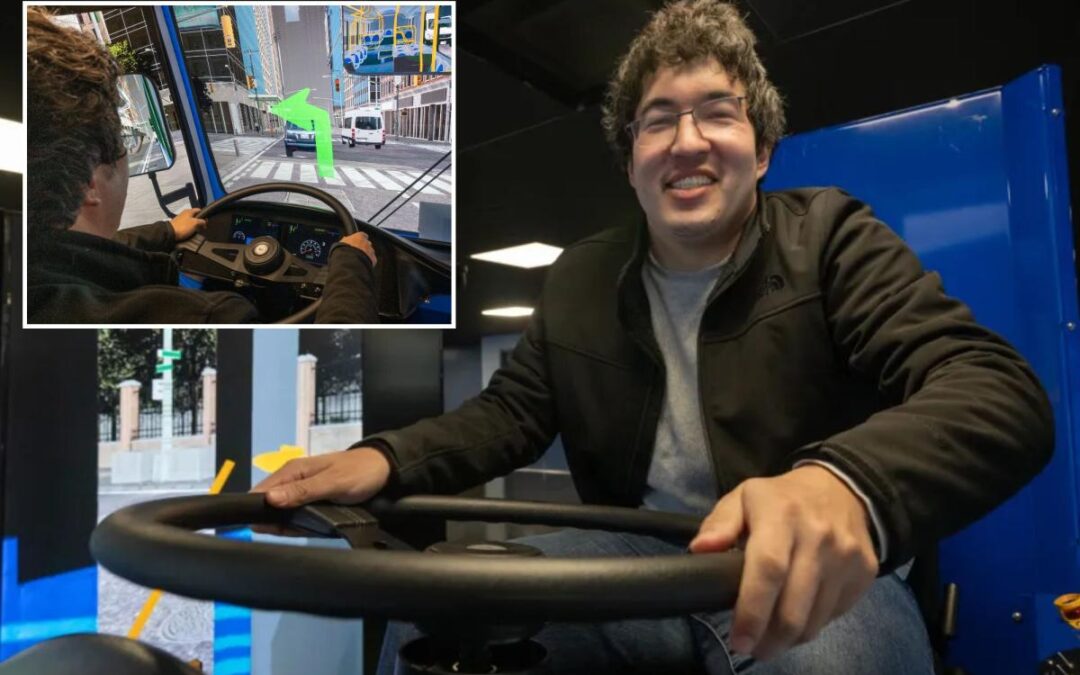
I’m driving an MTA bus down a busy New York City street, doing my best to stay in my lane — though I have to say I’m a little rattled, after my struggles with slowing the bus down in time to avoid running any red lights.
“If you keep turning the way you are, we’re going to hit the pole,” sighed my wingman, assigned by the agency to make sure a mild-mannered reporter like myself doesn’t cause any traffic accidents.
I manage to correct just in time — avoiding any tangles with city infrastructure, or for that matter, hapless pedestrians.
Fortunately for New Yorkers, my joyride in a nearly 17-ton piece of machinery isn’t real — I’m aboard the agency’s new bus simulator, a high-tech, virtual training tool that allows to navigate NYC’s 300 bus routes without the danger.
The man making sure I arrive back at the virtual depot in one piece is Alvaro Brandon, the MTA’s assistant chief training officer of safety operations — my shadow during a recent visit to the Zerega Avenue facility in The Bronx, where drivers come to train.
Costing the MTA approximately $1.4 million and taking four years to develop, the four hyperrealistic devices are being integrated into the MTA’s mandatory training curriculum as the agency looks to hire around 2,000 employees by year’s end.
The goal: to make training safer and speedier before the rubber hits the road.
To accomplish this, the immersive arcade game recreates real-world street conditions on a 4K, partially-panoramic screen — a major upgrade from the nearly 20-year-old system it’s replacing.
The simulation, which offers general training or specific routes, allows the user to navigate obstacles including e-scooters, oblivious pedestrians, and even slick roads, all from the safety of a stationary imitation bus.
“We can adjust anything on the fly,” boasted Brandon. “We could blow out your tires …. make your brakes fail.”
He continued, “We could have the traffic lights changing quickly, or we could make it at a regular timing.”
Instructors can customize everything from the number of cars on the road to pedestrian temperament, which ranges from mild to Gotham-level aggressive.
All the while, users control a full physical setup, complete with a steering wheel, gas and brake pedals, and other controls, while an aerial camera lets them monitor their blind spots from above so that they can gauge their distance from the curb and other vital info.
An integrated performance dashboard allows trainers to track operator performance and provide targeted feedback.
One can think of it like an educational version of the Grand Theft Auto games.
Gamifying bus training isn’t about appealing to youth, though; it’s about equipping drivers for an environment where one can get blindsided in a New York minute.
“New York City is one of the more challenging places to operate a bus, and so we want to use the technology to get our operators prepared,” explained Brandon. “We have operators that start working with us in the summertime, so they’ve never experienced driving a bus in the snow.
“This will allow us to train them as a new bus operator in the snow, so they have some feel for what the bus is going to handle like.”
More than 4,300 bus operators will train annually on the simulators, which are designed with the flexibility to incorporate potential future upgrades, including advancements in bus technology such as electric vehicle (EV) charging systems and e-mirrors.
Chester Francis, who’s been a bus operator for over 20 years, called the virtual training wheels a major upgrade from their predecessors.
“From when I started, [it’s] totally different,” he told The Post. “Everything was so mechanical. Now, you actually can see tears if you want. You can actually feel a bump, hear a horn, and the way they can zoom in from the top, the side, so you can actually see your mistakes.”
As he pointed out, it helps nip any “oh, s–t” moments in the bud.
Curious to see how a normal citizen would fare, I took the faux proletariat chariot for a digital spin around the fake Big Apple.
For someone who’s never driven a bus, the learning experience was slow-going. Compared to my Subaru Forester, which I regularly drive on the real streets of Gotham, the console seemed more riddled with buttons than the Batmobile.
One major adjustment is the transport’s response time — it responds with a delay due to its size.
That means braking and turning well in advance from the proper position — no “Fast & Furious”-style hairpin turns here. Before making a left turn, drivers must stop and align their left shoulder with the target street’s center line; for a right turn, they line up their shoulder with the curbside pole.
Turn signaling, for the uninitiated, is facilitated by stepping on designated left and right buttons with one’s left foot.
For a seasoned operator like Francis, these maneuvers are child’s play; to a civilian like me, the exercise seemed akin to driving a German Tiger tank on bath salts.
Despite my best efforts, I ran the course like the transit version of Mr. Toad’s Wild Ride, hopping a curb, nearly sideswiping a motorcycle, and running a red light.
At any second, I expected to be pulled over by a virtual NYPD cruiser.
Thankfully, my guardian angel Brandon helped us avert disaster, pumping the master brake before any digital collisions could occur and reducing the amount of traffic like the architect from the “Matrix.”
It’s safe to say I won’t be ferrying riders about anytime soon — but this experience gave me a newfound appreciation for what MTA operators do every day.
I’ll think twice before wishing the M4 would go a little faster.


