
Normally, the hotly anticipated installment in a cherished movie franchise coming in well under 40% on Rotten Tomatoes’ imperfect but useful survey of critical responses would be cause for alarm. Not necessarily panic – several Transformers movies have made a billion dollars or so with absolutely withering reviews – but certainly surprise, given how most blockbusters these days receive some degree of critical acceptance. Ah, but Michael is and is not a normal blockbuster. Some would probably even hesitate to call it a franchise. But this Michael Jackson biopic does feel like the latest chapter in Hollywood’s favorite non-superhero franchise – and that’s even before it ends with a genuine sequel tease about Jackson’s further, ah, adventures.
Yes, despite repeated critical complaints and a few outright box office bombs, the musician biopic is a crucial part of the Hollywood economy. At a time when it seems increasingly difficult to prod older adults off their couches and guide them back into the welcoming arms of their local multiplex, even for the awards-season fare that used to be a reliable grown-up magnet, the musician biopic is the rare mass-appeal movie that’s neither overtly family-friendly nor pure horror (at least probably not, depending on how you feel about biopics). Before Marty Supreme hit this Christmas, what was the sole non-fantastical hit on Timothée Chalamet’s filmography? A Complete Unknown, about the early career of Bob Dylan. Elsewhere that same year, what was one of just two 2024 movies that outgrossed A Complete Unknown and could be similarly classified as a drama, rather than action, adventure, fantasy, sci-fi, or horror? That would be Bob Marley: One Love. The other was a Colleen Hoover adaptation; doesn’t it make sense to consider pop biopics a similar unlinked, cross-studio franchise?

Michael makes an even stronger case, for broader reasons than its baffling inclusion of Mike Myers in a “special appearance” that recalls his cameo in Bohemian Rhapsody. For one thing, the box office expectations here are superhero-sized. Some have predicted a billion-dollar gross worldwide. (Michael grossed $217 million worldwide after just a single weekend in theaters, so it’s well on its way.) This would make it the first such release of 2026. It would also be the first movie to hit the billion without some kind of fantastical or action element… maybe ever, actually? Oppenheimer came very close, employing the services of the single most bankable director working today, a massive ensemble of stars, and rapturous reviews. Michael, meanwhile, employs the director of The Replacement Killers and the Equalizer movies, Michael Jackson’s nephew, and, well, see the aforementioned Rotten Tomatoes numbers.
To be clear, Michael doesn’t have to clear a billion dollars to count as a massive success. Nor is this its only shot at accumulating a billion for what could ultimately turn into a genuine, non-symbolic franchise: Owing to some legal blunders the production ran into when attempting to depict Jackson’s later years, the movie has been rejiggered to finish up with the release of the album Bad back in 1987. Multiple records, multiple charges of child abuse, and Jackson’s death in 2009 at the age of 50 still lay ahead of him, and the movie explicitly promises that his story will “continue” (whether, uh, in our hearts, or in a second film once they figure out the legal stuff). Maybe the gambit won’t pay off; maybe this one will hit and the second movie will attract far less attention. (After all, the Off the Wall and Thriller years cover a lot of the greatest actual hits.) Maybe this one won’t do the business people are expecting and a second movie won’t ever be made. But try to picture another movie attempting to set up a second installment of a story that will feature multiple trials for sexual abuse of a child. Suddenly making a whole movie out of the second act of Wicked doesn’t seem quite so audacious by comparison.

Or will the Jackson estate simply attempt to cut the story in half indefinitely, hoping to postpone the reckoning for as long as possible? (Probably not; word is, the earlier version of Michael had a whole bunch of material about how he was wrongfully accused.) That we’re getting this attempt at a feel-good Michael at all speaks to the power and popularity of the musician biopic as a cash cow for both movie studios and artists’ bank accounts or estates. As a lengthy recent New York Times Magazine piece concludes, when an artist can no longer make new music or (more importantly) tour, a biopic can help juice interest in their catalog like little else.
It’s both understandable and a little eerie. As popular as Michael Jackson was, at this point there are multiple generations who never had the chance to see him perform live, and though there’s plenty of footage of him available online, an IMAX-sized simulation, with high production values and booming sound, isn’t so common, and can offer a second chance for audiences who may regret whatever timing and/or scarcity kept them from seeing the artist during his lifetime. (Ask me how I feel now about blithely skipping some David Bowie shows across the New York City area in the early 2000s.)
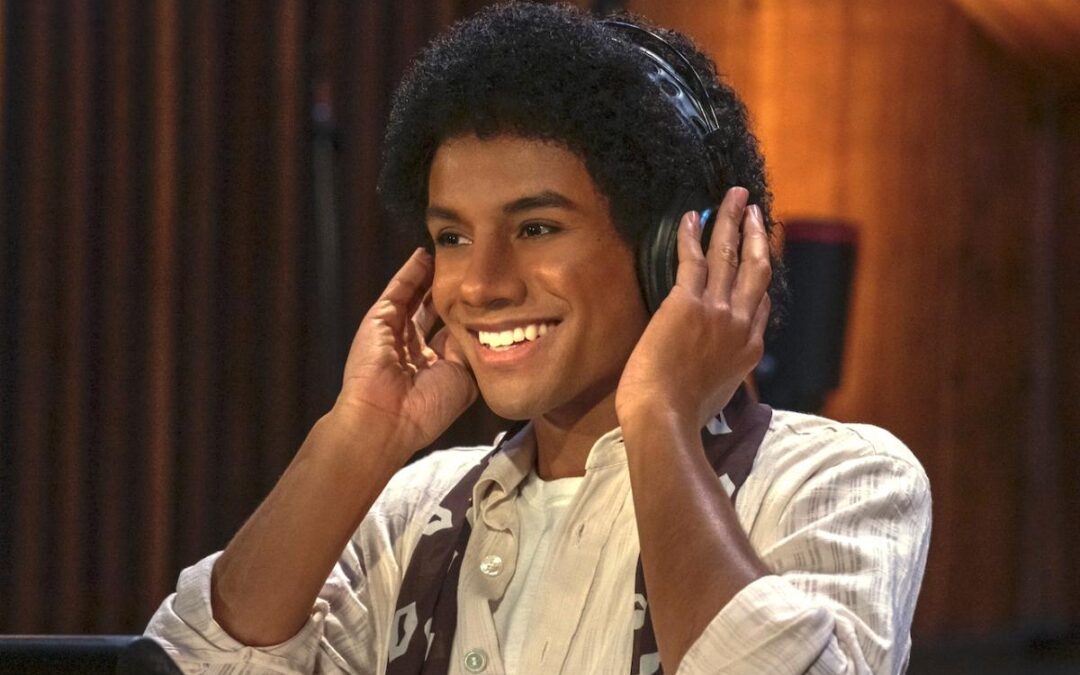
What Michael actually delivers on that count, though, is a little weird. As mentioned, MJ is played by his nephew Jafaar Jackson, who has certainly worked his ass off to learn the moves. He has not, however, bothered to sing like his uncle. “Who could?” seems to be the thinking, and fair enough. People aren’t ponying up for IMAX tickets to hear someone’s Jackson impression. They want to hear Michael in all his remastered glory, and that’s what they get, synced to footage of a guy capably imitating Jackson’s physical prime.
It’s sort of a reverse karaoke – the familiar voice is there, but another body jumps in to goose everyone’s honeyed memories of the real thing. It’s also a lot like a lot of stuff that other blockbuster franchises are accused of: an amusement park attraction (in this case a lifelike animatronic rather than a rollercoaster), a piece of merchandise (a Michael Jackson souvenir biography program that lasts for two hours!), and a simulacrum of the human experience. Maybe you could go further and say that plenty of other non-superhero-style movies are offering those things; the biggest film of the year so far is The Super Mario Galaxy Movie, after all. But the precise conditions creating demand for these Jackson simulations – the biopic, the stage musical that’s touring and still going on Broadway – has a ghoulish overtone. Michael Jackson, whatever his personal flaws and demons, is gone. Biopics have traditionally been one way to remember beloved figures, to be sure. But there’s a different dynamic at work when those movies become superhero stories by default.
Jesse Hassenger (@rockmarooned) is a writer living in Brooklyn. He’s a regular contributor to The A.V. Club, Polygon, and The Week, among others. He podcasts at www.sportsalcohol.com, too.


