
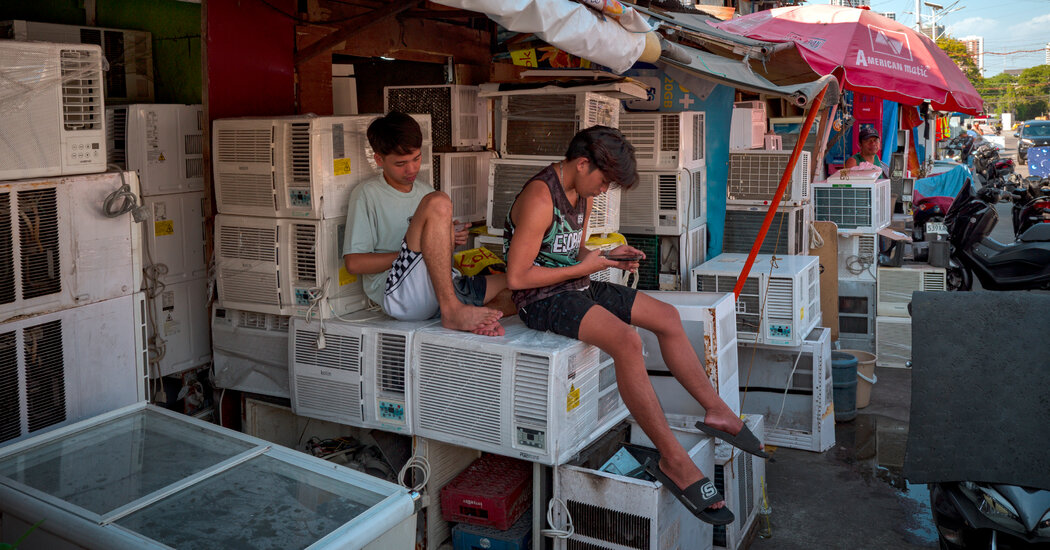
Gavianne Sommer Viar cranked her hand-held fan to its highest setting as she tried to listen to a university lecture. It was another sweltering morning in Manila, and her classroom’s air-conditioners were too weak to cool the 40 students inside.
“It’s like you absorb the heat more than what the professor is teaching,” Ms. Viar, 21, said recently in the Philippine capital.
Across South and Southeast Asia, an intense heat wave is colliding with an energy crunch linked to the war in Iran. Temperatures climbed throughout April and reached beyond 100 degrees Fahrenheit on some days, leaving millions struggling to stay cool as power was constrained.
But air conditioning — a common source of relief from the region’s blistering heat and stifling humidity — has become restricted or increasingly unaffordable.
The region depends heavily on imported oil and gas from the Middle East. About 80 percent of the oil that normally passes through the Strait of Hormuz goes to Asia. But its lower- and middle-income countries are particularly vulnerable to price shocks and supply disruptions, with fewer resources to cushion the impact than wealthier economies like Japan or South Korea. So as Iran and the United States continue to block the waterway, governments from Bangladesh to the Philippines have moved to conserve fuel and curb electricity use, just as demand for air conditioning is surging.
Officials have asked offices, homes and schools to turn off air-conditioning or set thermostats no lower than 24 degrees Celsius, or 75 degrees Fahrenheit. In some places, the measures have gone further.
Civil servants in Malaysia have been advised to wear lighter fabrics, while governments in Indonesia, Pakistan and Sri Lanka have declared four-day workweeks for the public sector. In Sri Lanka and Bangladesh, some universities have partially closed. Rural areas in Bangladesh have been hit by unannounced blackouts for more than 10 hours a day.
Faced with limits, people are adjusting as best they can.
Ms. Viar said her university in Manila relaxed its dress code in March, allowing students to swap uniforms for tank tops and shorts. Mini electric fans like hers have become an unofficial part of the uniform.
“It’s kind of a requirement now,” she said. “But sometimes, it’s so hot that the air from the fan feels like a blow dryer.”
In the Philippine House of Representatives, industrial fans now line the lobby and hallways where air-conditioning units once ran. Some lawmakers have ditched suit jackets for T-shirts and short-sleeved barongs, a lightweight traditional dress shirt.
“If it gets any hotter, I don’t think it would be easy to conduct business,” Representative Terry Ridon said.
In Bangkok, Thailand’s capital, Paipannee Chartsampan’s family has resorted to more frequent showers to cool down, making her concerned about higher water bills. Without an air-conditioner at home, they rely on a water fan filled with ice, she said.
In tropical cities like Bangkok, Manila and Singapore, malls and coffee shops remain some of the few consistently cooled public spaces.
Suwannee Jonyanata said she had an air-conditioner in her Bangkok home, but she sought relief from the afternoon heat at a mall instead. She carried a mini fan and a traditional ointment she rubs on her skin to feel cooler.
“The heat is crazy,” she said. “It’s like the sun is working extremely hard.”
The city has opened more than 200 cooling centers.
Because of the energy crunch, this year’s Thai new year festival, Songkran, took on added significance. About five million people participated in water fights in Bangkok streets in early April, armed with water guns, hoses and buckets of melted ice — nearly double last year’s turnout, the authorities said.
In Dhaka, Bangladesh, Kamrul Hasan Tamim said his only relief from the heat came when he arrived at the air-conditioned coffee shop where he works. His daily commute on a crowded bus with no air-conditioning was nearly unbearable.
More customers are lingering in the shop lately, Mr. Kamrul said, and staying longer than they did before the region’s hottest weather of the year kicked in last month.
To manage strained energy supplies, Bangladesh’s government has cut electricity to some areas.
Alamgir Hossain, who has been pedaling a rickshaw in Dhaka for more than 20 years, strained to transport passengers under a blazing sun. Lately, he has had little sleep in the garage he shares with his colleagues. Ceiling fans barely ventilate the tin-and-bamboo structure.
“That’s not enough to cool a facility that big at night,” Mr. Alamgir, 43, said. “But we have no other way to sleep than this.”
Extreme heat can cause heatstroke, which can be fatal, and worsen cardiovascular and respiratory diseases, according to the World Health Organization. High humidity can make the danger worse by limiting the body’s ability to cool itself through sweat.
Scientists have long warned about an “upper limit” of human survivability, reached when heat and humidity combine to produce what’s called a “wet-bulb temperature.”.
Studies suggest that, without large cuts in emissions, parts of Asia and the Persian Gulf could regularly approach those conditions later this century. Nearly two billion people could face temperatures the body cannot tolerate for long, with heat-related deaths potentially rivaling those from major diseases.
As temperatures rise, demand for air conditioning in the Southeast Asian region alone is expected to surge in the coming years, with the number of units projected to reach 186 million by 2035, a fivefold increase from 2023, according to the International Energy Agency.
Meynard Alvarez, an insurance analyst in the Philippines, said he and his wife bought an air-conditioner, but only after installing rooftop solar panels to offset rising electricity costs.
“Before we had solar, all our windows were open and we sat in front of the electric fan,” he said.
Mr. Alvarez, who works from home, said he and his wife can run their air-conditioner all day on solar power.
“We stay at home if we don’t have urgent errands or jobs to do,” he said. “It’s just too hot.”

