
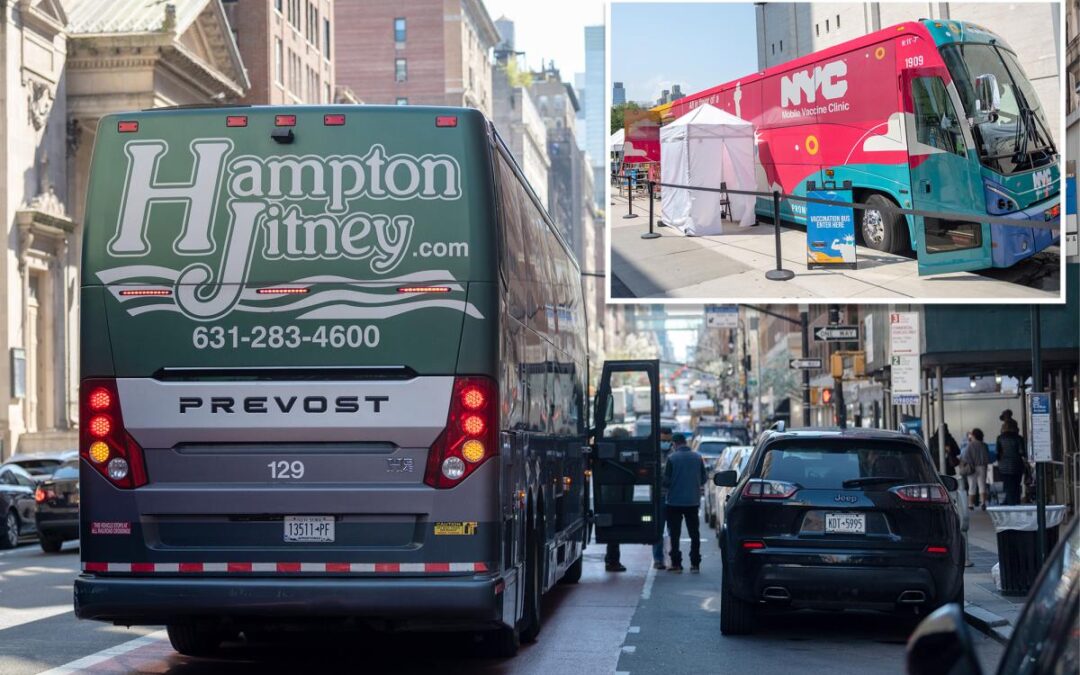
A coalition of private interstate bus companies is filing a federal lawsuit Monday alleging New York City unfairly hit them with a blizzard of tickets under the Big Apple’s “bounty hunter” idling law to curb pollution.
The American Bus Association contends that the idling law violates bus operators’ constitutional protections by imposing fines on their buses while exempting government vehicles such as MTA buses from enforcement, thus treating similar modes of transportation “unequally.”
According to the complaint obtained by The Post, private carriers have received more than 4,000 idling summonses since 2020, resulting in hundreds of thousands of dollars in fines and mounting legal costs.
The suit being filed in Manhattan federal court claims the policy unfairly burdens interstate commerce by increasing the cost and risk of entering and operating in the Big Apple and conflicts with federal safety rules that often require buses to idle to maintain critical systems such as air brakes, passenger safety equipment, cabin temperatures for passengers, wheelchair accessibility equipment and emissions-control technology.
The lawsuit also calls out the city’s “bounty-style” Citizens Air Complaint program, which offers 25% of collected ticket revenue to private individuals who filed complaints with the city Department of Environmental Protection — with some bounty hunters eligible to collect nearly $1 million, records show.
The Big Apple’s Citizen Idling Complaint Program was launched in 2019, with the city even recruiting 1980s punk rocker Billy Idol to promote the effort the next year.
“Billy never idles. Neither should you. Idling is polluting. Cut your engine off,” the rock star urged in an ad campaign.
With fines ranging from $350 to $2,000 for idling and 95% of the complaints substantiated, the rewards add up and have turned the streets into gold for the Big Apple’s citizen enforcers.
Under the program, citizen enforcers are awarded 25% of the fines pursued by the city Department of Environmental Protection (DEP) and substantiated by the New York City Office of Administrative Trials and Hearings (OATH).
If the tattletales go to OATH directly, they can receive 50% of any substantiated offense.
The ABA argues that this structure fosters a “predatory” enforcement environment driven by profit rather than environmental benefit.
“Private motorcoach operators help keep New York City moving by supporting tourism, conventions, student travel, and interstate transportation,” said Fred Ferguson, president and CEO of the American Bus Association.
“These operators generate significant economic activity while helping reduce congestion by removing dozens of cars from the road with every trip,” he added. “This lawsuit is about ensuring interstate bus operators are treated fairly under the law and that enforcement is applied consistently across all fleets. Modern motorcoaches combine low-emission transportation with advanced technologies designed to improve efficiency, reduce congestion, and support cleaner travel.”
In the city alone, the motorcoach industry claims it generates more than $12.7 billion in economic impact, supports 59,200 jobs, and drives visitor spending annually.
More than 40% of respondents to an ABA survey said they already reduced trips to the city or declined charters due to the current enforcement of the idling, and many warned they may further limit or end service to the city altogether if penalties continue to rise.
The ABA said that the lawsuit — which lists the city of New York and Department of Environmental Protection Commissioner Lisa Garcia as defendants — does not challenge clean air objectives or environmental progress. The DEP enforces the idling law.
Instead, the suit seeks equal enforcement, regulatory consistency, and policies that recognize the role motorcoaches already play in reducing congestion and transportation-related emissions.
It further argues that the city’s transportation policy should encourage group or mass travel transit to reduce traffic congestions, not disproportionately penalize the very operators helping reduce vehicle volume and emissions in New York City.
A city Law Department spokesman, responding to the suit said, “The idling law was designed to protect the health of New Yorkers. We’ll review the case when served.”
The American Bus Association represents bus operators including Academy Express LLC, Academy Lines LLC, Panorama Tours Inc, Peter Pan Bus Lines, Trans-Bridge Lines, Adirondack Trailways of New York, Hampton Jitney, Leprechaun Lines, Niagara Scenic Tours, Coach USA and Greyhouse Lines.


