
The biggest sporting event in world history might have a less-flattering title soon: the most expensive sporting event in world history.
The World Cup, which kicks off June 11 in Mexico City, has become a carnival for the rich so expensive it resembles a monthlong Met Gala. Just last Thursday, FIFA rolled out a $32,970 seat for the July 19 final at MetLife Stadium, triple the cost of its most expensive ticket before then.
Even in the group stage, tickets are priced in the hundreds of dollars. So is parking and, in some cities — including New York and Boston — so is public transit.
Want to take a family of four to Norway-Senegal, the cheapest game available in the New York area?
As of Saturday afternoon, there were four “Category Four” seats in Section 306, the upper corner of the stadium, available for $402.50 apiece on FIFA’s resale site, the cheapest option between the traditional secondary market (StubHub, SeatGeek, etc.), the official resale and what’s left at face value.
That’s $1,610 for tickets, plus if you’re coming in from the city, you’ll have to factor in the $105 NJ Transit ticket per person, which jacks up the total cost to $2,030, still before buying any food or beverages.
Or you could always park. That’ll require paying $225 for a space at American Dream and walking, though, since the general parking lots are being used for fan engagement and enhanced security.
For a 90-minute game, that comes out to $5.64 per person, per minute.
Tickets for the Mets-Cubs game at Citi Field the same night, by the way, can be had for less than $50 a pop. That does, however, require watching the Mets play baseball.
Pithiness aside, it’s worth understanding this is not traditionally how the World Cup has been run. It’s an extreme departure from how soccer, a sport that sees itself as global and working class, has ever been priced, and one that’s come under heavy criticism by everyone from fan groups to the President of the United States.
The one-sentence reason why it’s so expensive to go to a World Cup game, and the defense FIFA repeatedly has offered, is that it’s a function of the American market.
In Europe, for example, dynamic pricing — which FIFA has used to set the market — isn’t outright banned, but it’s uncommon for major sporting events. The secondary market, which is a fact of life here, often is banned, and tickets for soccer games tend to be allocated specifically to members of a team’s official supporters group, with even modest price hikes a subject of protest.
Sports, in short, are treated as a public good. That mindset played heavily into how World Cup tickets were priced in the past, even outside of Europe.
Four years ago in Qatar, for example, the most expensive Category 1 seat at the World Cup final was just $1,606 — which still represented a raise of $506 from 2018 in Russia, per data compiled by The World Cup Guide. In the group stage, tickets ranged from $69 in Category 3 to $220 in Category 1, and ticket holders also received free access to the Doha metro system during the tournament.
This time?
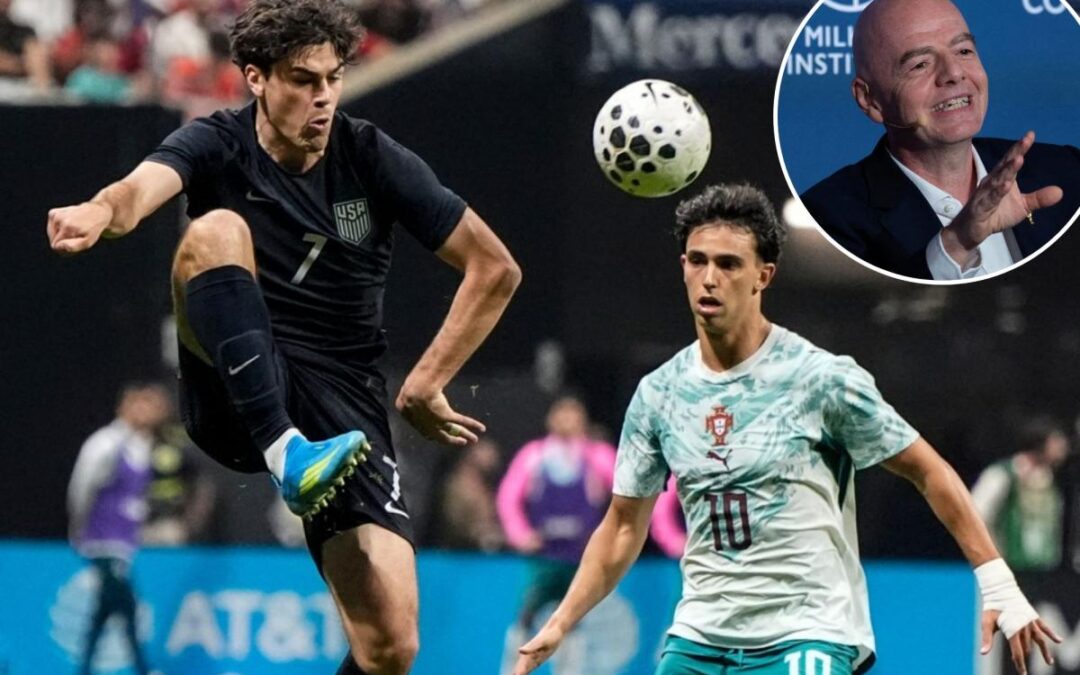
“We have to look at the market,” FIFA president Gianni Infantino said in an appearance last Tuesday at the Milken Institute Global Conference in Beverly Hills. “We are in the market in which entertainment is the most developed in the world, so if you were to sell tickets at the price which is too low, these tickets will be resold at a much higher price. And as a matter of fact, even though some people are saying that the ticket prices we have are high, they still end up on the resale market at an even higher price, more than double our price.”
He later added: “We have 25 percent of the group stage tickets which can be bought for less than $300. You cannot go to watch in the U.S. a college game, not even speaking about a top professional game of a certain level, for less than $300. And this is the World Cup.”
While that is flagrantly untrue — tickets to the Cotton Bowl just last year dropped below $50 after Texas A&M lost in the first round of the College Football Playoff, just to pick one example — there is at least some validity in the idea that the secondary market creates a stipulation FIFA doesn’t usually have to deal with.
The thing about capitalism that FIFA seems to have failed to understand, though, is that demand has to justify the price point. Based on what’s publicly available, it doesn’t seem to be doing so.
According to TicketData.com, which tracks the secondary market, the price to attend nearly every single one of the 91 World Cup matches played in the U.S. and Canada has fallen over the past 30 days, a huge majority by double-digit percentages. It’s unclear how many tickets remain unsold because FIFA has continued to release them even after Infantino claimed in February that all 104 matches were sold out, but depending on the match in question, it seems to be a significant number.
In particular, reporting from The Athletic has indicated that sales for the U.S. opener against Paraguay have lagged dramatically. That’s largely down to the higher pricing for host nation openers, a minimum of $1,120 for the USMNT compared to $302 four years ago to see Qatar take on Ecuador.
There was also a report from the American Hotel and Lodging Association released last Monday claiming underwhelming demand. Eighty percent of respondents in U.S. World Cup cities “say hotel bookings are tracking below initial forecasts.”
Locally, the sticker shock over NJ Transit pricing, as well as the fact that Penn Station will be closed to anyone not attending the World Cup on gamedays, has overshadowed the actual games for those who aren’t die-hard soccer fans.
The public transit cost, by the way, is a function of FIFA’s contracts with host cities, under which the organizing body takes nearly all the revenue, prevents cities from having any sponsors that conflict with their own and forces cities to bear the cost of security and infrastructure. Infantino has estimated FIFA — which, at least officially, is a registered non-profit under Swiss law — will leech at least $11 billion in revenue from the tournament off a $3.6 billion budget.
The organization claims to reinvest most of its revenue from the World Cup in developing soccer around the globe.
Whether it will ultimately be blamed for failing to develop soccer in the United States, though, is an open question.


