
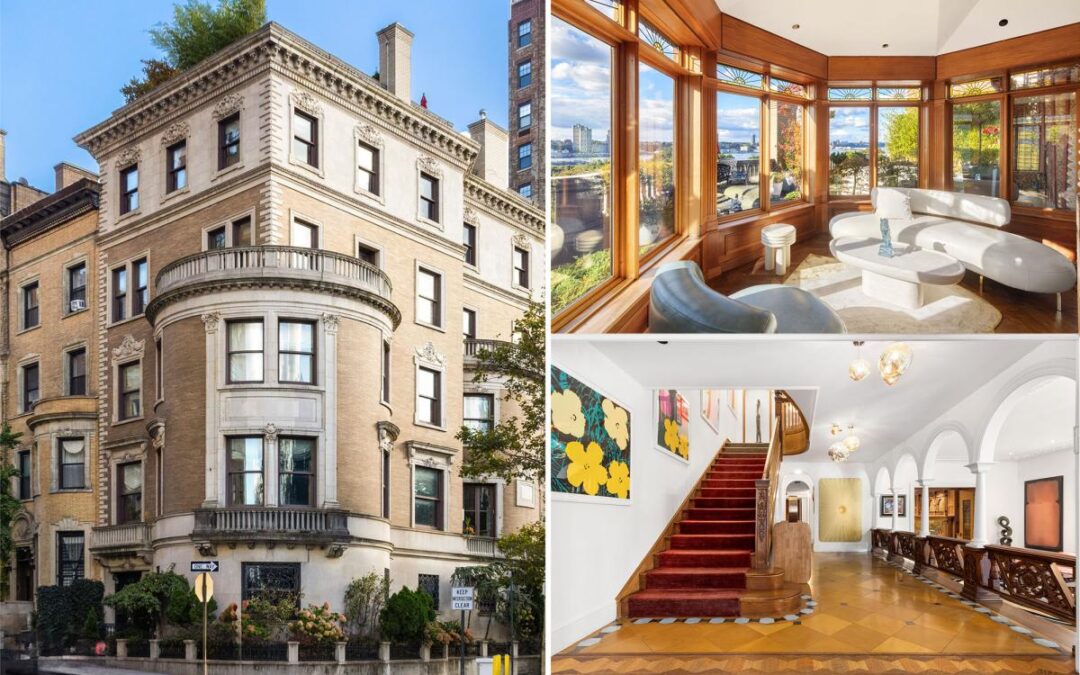
It has Tiffany & Co. stained glass, a mahogany theater, a glass conservatory with 180-degree Hudson River views and a rooftop terrace capacious enough to seat 100 for dinner.
And yet, this rare Gilded Age relic at 25 Riverside Drive still can’t sell.
The seven-story, roughly 12,000-square-foot freestanding mansion on the Upper West Side relisted Monday for a cool $65 million, returning to its original 2022 asking price after the seller briefly slashed it to $55 million in December.
The reversal signals either renewed seller confidence or a high-stakes gamble that the right buyer simply hadn’t materialized yet.
Real estate veterans are not surprised the property has lingered.
“Unique trophy properties like this move differently than the broader market. A Gilded Age mansion on Riverside Drive is a highly specific asset, and the buyer pool is naturally much smaller,” Michelle Griffith of Douglas Elliman, who has worked in high-end New York real estate for more than a decade, told The Post.
“Even with an exceptional location, scale and architectural significance, these homes can take time because they require the right buyer at the right moment.”
Built between 1895 and 1897, the 34-foot-wide residence stands as one of the last surviving single-family mansions from an era when Riverside Drive was lined with them.
The Gilded Age made this stretch of the Upper West Side a parade ground for plutocratic ambition, but the 20th century was not kind to those monuments.
Wartime labor shortages gutted the servant class that made such estates operable, and a broader cultural pivot toward apartment living rendered most of them obsolete. Developers demolished what families could no longer afford to maintain.
What remains at No. 25 is, by any architectural measure, exceptional.
The interiors were renovated in 2022 and showcase eight bedrooms, three kitchens equipped with copper sinks and professional-grade appliances, eight full bathrooms, six fireplaces with artistic mantels, a wine cellar, a gym and a private elevator.
More than 70 oversized curved windows draw light across three exposures. A landscaped garden planted with pear trees screens the property from the street with something approaching country estate tranquility, improbable for a block this close to Lincoln Center and the American Museum of Natural History.
The ownership history adds a layer of complication that no amount of architectural pedigree can entirely dissolve. The property is held in a trust benefitting Dina Wein Reis, once dubbed “the $100 million woman” by prosecutors, who pleaded guilty in 2011 to federal conspiracy to commit wire fraud charges after defrauding corporations out of millions.
She served seven months in prison. She and her husband David acquired the mansion in 1996 for $2.15 million.
Provenance aside, the challenge with a property like this has less to do with what’s wrong with it than with the arithmetic of the buyer pool at this price.
“Pricing is always part of the conversation, but it’s hardly ever the only factor with properties at this level,” Griffith said. “Today’s luxury buyers are extremely selective and are comparing opportunities globally, not just within New York City.”
That global competition is no small thing. The same buyer who might contemplate $65 million on the Upper West Side is simultaneously eyeing a triplex in a luxe Manhattan building overlooking Central Park with airtight security. Or perhaps a waterfront villa in the south of France, a penthouse in Monaco or a compound in Palm Beach. New York must make its case not just against itself but against the entire landscape of aspirational real estate.
Griffith argues the ask is defensible on its own terms.
“At the $65 million level, the buyer pool is obviously incredibly niche, but in the ultra-prime market, pricing often reflects uniqueness and long-term legacy value rather than direct comps. I don’t think the ask was unreasonable for a property of this stature, especially at a time when trophy assets across New York, Palm Beach, Miami and Los Angeles were achieving record pricing,” Griffith said.
“Whether it ultimately trades at ask is a different conversation, but landmark-quality homes with this kind of architectural presence and provenance tend to command a premium because there are simply so few of them left,” she said.
The problem, of course, is that “so few of them left” cuts both ways.
Scarcity can drive prices up, but it also means there are no recent comparable sales to validate the number. When a buyer’s broker sits down to justify $65 million to a client, there is no tidy comp sheet to fall back on. The property is, almost by definition, incomparable, which makes the pricing conversation more philosophical than mathematical.
What the listing has going for it beyond the architecture is location density.
Within walking distance sit Lincoln Center, the New York Philharmonic, the Metropolitan Opera, the American Ballet Theatre, the New York City Ballet and the Beacon Theater. The 79th Street Boat Basin, a short stroll away, holds the possibility of a private boat slip. Riverside Park runs along its western flank. Few addresses in this city stack cultural amenities this efficiently.
The marketing strategy, Griffith said, has to account for the patience such a sale demands.
“That’s why consistent, strategic marketing and PR exposure are so important. Our job as real estate agents is to keep the property in front of a broad audience through strategic storytelling and media visibility so that when the right buyer enters the market, the home remains top of mind. With such rare properties, persistence and visibility matter just as much as timing and pricing,” she said.

