
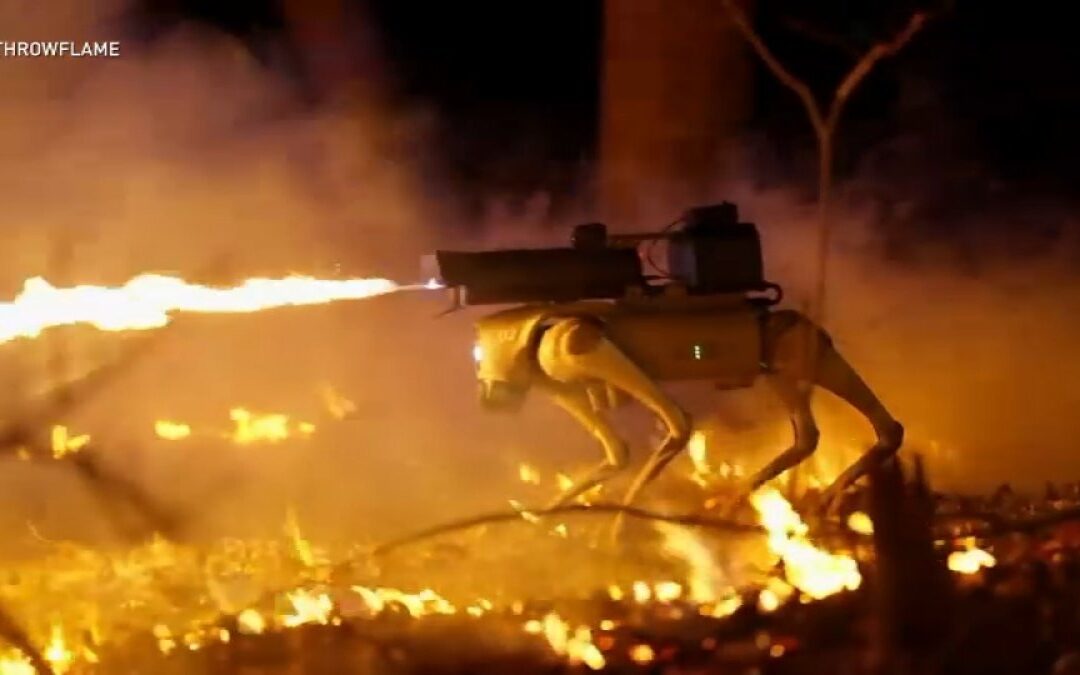
Clyde Vanel, a New York Assembly Member from Queens (D–Cambria Heights), could hardly believe his eyes when he watched a series of online videos depicting robots mounted with weapons.
“This is crazy. This has to be against the law,” he said. “And then I looked in our state, and I saw that it is not!”
Vanel said the videos prompted him to introduce legislation in the New York Assembly, that would outlaw people from weaponizing robots. But the bill, A399 – an act prohibiting robots and uncrewed aircraft equipped or mounted with weapons – has not advanced out of committee. The bill was first introduced in May of 2024.
“All I can tell you is we’re going to try hard to get this over the finish line,” Vanel said.
Along with firearms, the New York bill would specifically outlaw flamethrowers, chemical agents, stun guns, kinetic impact projectiles, and weaponized lasers as types of robotic attachments. The legislation does carve out an exception for robots that are used to disarm or dispose of explosives.
Throwflame, an Ohio company which sells a robot dog with a flamethrower on its back, criticized the legislation, arguing that it falsely equates flamethrowers with weapons.
“A commercial flamethrower is designed for land management and agricultural use, not to harm people,” read a statement from the company.
Throwflame also criticized the idea of banning robots from using traditional weapons like firearms.
“There is not a single documented case cited of a person being harmed by a civilian operated weaponized robot in New York. This is legislation in search of a problem that does not exist,” the statement continued.
But some of the world’s leading robotics companies have expressed deep concerns about arming their products, especially as AI technology allows robots to make more decisions autonomously. Robotics company Boston Dynamics lobbied in favor of the New York bill. The company also supports similar bills in Massachusetts and California.
“Robots walking around in communities and places where people work and live should not be weaponized. That is simply a risk that is not acceptable,” said Brendan Schulman, the Boston Dynamics Vice President of Policy and Government Relations.
In 2022, Boston Dynamics joined several other robotics companies in signing an open letter urging that “general purpose robots should not be weaponized.”
Despite support from industry players, none of the proposals to ban armed robots have made it onto the books. Last week, the Massachusetts bill restricting armed robots passed that state’s House of Representatives, but it would still need approval in the state’s Senate.
In California, the ban on weaponized robots passed both legislative chambers with near unanimous support, but Governor Gavin Newsom vetoed the bill. In his written explanation, Newsom said he supports restricting armed robots but believed the law would prohibit “beneficial law enforcement use” of robots which could be used “to deploy less-lethal force” against dangerous suspects.
The proposed New York ban on weaponizing robots does not address police use of armed machines.
There is currently a separate bill in New York City Council, that would ban the NYPD from equipping robots with weapons.
The NYPD has said it does not arm police robots with weapons, but the department has deployed robot dogs to help reduce human exposure to hazardous situations and to provide added visibility and communication.

