
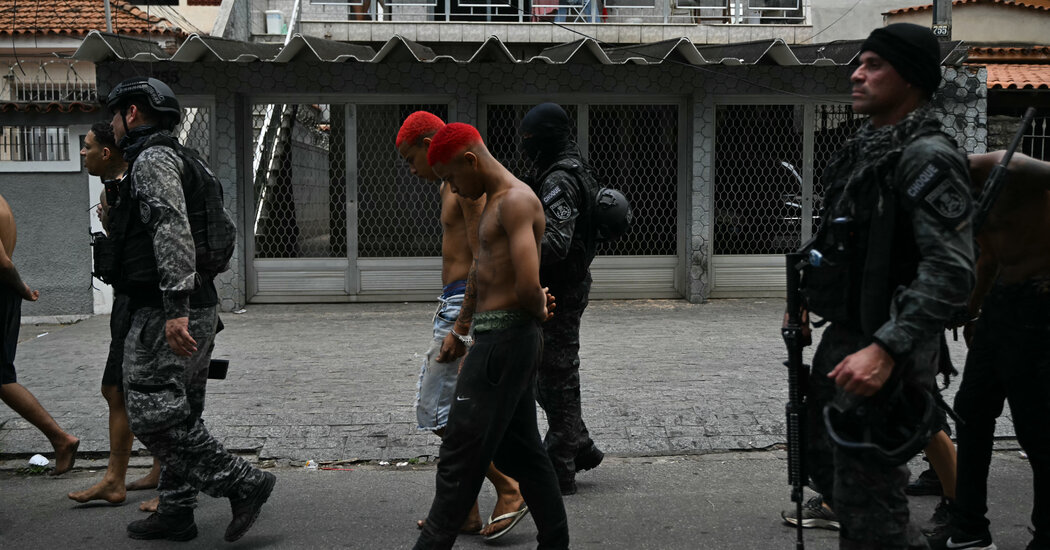
The United States designated Brazil’s two biggest drug gangs as terrorist groups on Thursday, after months of aggressive lobbying by the sons of the jailed former president, Jair Bolsonaro, a close ally of President Trump’s.
The move comes just days after two of Mr. Bolsonaro’s sons, one of whom plans to run for president later this year, visited Mr. Trump at the White House.
Following the meeting on Tuesday, Flávio Bolsonaro, who will seek the presidency in lieu of his father, told reporters that he had again asked Mr. Trump to label the Brazilian gangs as terrorist groups.
The Trump administration appeared to grant that request with the designation on Thursday. In a statement, the U.S. Department of State said that the Brazilian gangs, the First Capital Command and the Red Command, would be labeled terrorist groups effective June 5.
“Their influence and illicit networks extend far beyond Brazil’s borders, across our region and into our country,” the statement said.
The State Department did not answer emailed questions about the timing of the decision or Flávio Bolsonaro’s visit but said the Brazilian groups operated in over a dozen U.S. states and presented “a threat to our public safety.”
The terrorist designation threatens to once again strain ties between the Western Hemisphere’s two largest nations, which have only recently begun to repair relations.
It has raised concerns among Brazilian officials that the United States may be trying to sway its upcoming election by helping another Bolsonaro. Flávio Bolsonaro has said he will challenge President Luiz Inácio Lula da Silva, a leftist, in October and has accused Mr. Lula of being soft on crime.
On social media, Flávio Bolsonaro was quick to celebrate the terrorist designation, taking credit for influencing the Trump administration’s decision and sharply criticizing Mr. Lula’s handling of crime.
The Trump administration has labeled more than a dozen Latin American gangs terrorist organizations since last year, as part of a campaign to target criminal groups that American officials say threaten the United States. The designations mean the U.S. government can impose broad economic sanctions on the groups and entities linked to them.
The Brazilian gangs export large quantities of cocaine to Europe and other parts of the world, but experts say they do not play a major role in trafficking drugs to the United States.
Mr. Lula has opposed the designation, casting it as meddling in his country’s internal affairs and arguing that there are better ways to combat organized crime, such as empowering the police, better coordinating international operations and going after the financial assets of gangs.
Just before the designation, Celso Amorim, Mr. Lula’s chief foreign policy adviser, said the Brazilian government was working hard to dismantle organized criminal networks but again dismissed designations as a tool in that fight.
“Organized crime must be combated with the utmost energy and determination,” Mr. Amorim said at a security forum in Moscow. “Equating organized crime with terrorism, however, is not helpful.”
Criminal networks have become a major concern for Brazilian voters ahead of elections and the U.S. designation could put a spotlight on the issue of security. This could help Flávio Bolsonaro, just as voter support has appeared to waver on the heels of a scandal linking him to a disgraced banker who is under investigation in a huge corruption scheme.
The U.S. designation could cause a major headache for the banking sector because it could allow the United States to impose sanctions on Brazilian institutions that may have done business with the gangs.
Experts say this is a major risk because the Brazilian gangs have managed to infiltrate the formal economy, amassing stakes in gas distribution, real estate, commodities and cryptocurrency. This leaves Brazilian financial institutions vulnerable.
Last year, Mr. Trump used tariffs and sanctions to try to keep Jair Bolsonaro, the former president, out of prison on charges of overseeing a coup after losing the last election in 2022, to Mr. Lula. Mr. Bolsonaro was ultimately convicted and sentenced to prison. Mr. Trump later dropped many of the tariffs and sanctions, easing diplomatic tensions.
But the issue of organized crime has again strained relations in recent months, after Secretary of State Marco Rubio told Brazil’s foreign minister that the Trump administration planned to label the gangs as terrorist groups and asked Brazil to do the same, according to officials with knowledge of the conversation.
Mr. Lula visited Mr. Trump in Washington earlier this month, but the Brazilian leader said the issue of designations had not been discussed.
Adam B. Ellick contributed reporting.

