
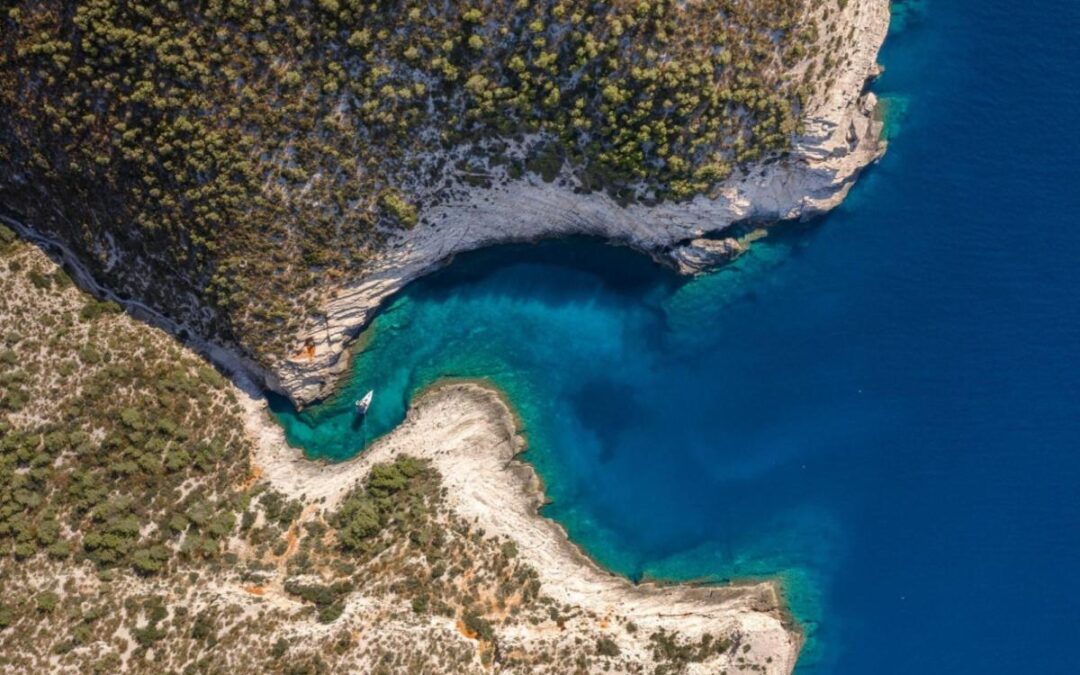
There is a stretch of Croatian coastline about 200 miles long where you can sail crystal-clear water in the morning, eat grilled fish caught the same day for lunch, hike a mountain with Adriatic views in the afternoon, and end the night in a Roman palace that people have been living inside for 1,700 years. The beaches are among the cleanest in Europe. The towns are made of white limestone that glows in the late afternoon sun. The food and wine are serious without being precious about it.
It is called Central Dalmatia. Most Americans have heard of it. So far, few have visited.
The flight that makes it easier
The trip is changing. A new nonstop service from Newark to Split started this spring, and the last logistical reason to choose somewhere else over Central Dalmatia is no longer in picture.
The case for going is not complicated. Every element of the classic Euro-summer exists here, compressed into a geography small enough to navigate without stress. The Amalfi Coast is gridlocked, the Greek islands are expensive, and Mykonos in August is a line just to get into a club. Dalmatia gives you the water, the history, the food, the sailing, and the warmth, all in a small stretch of land the size of Rhode Island.
Split: a real city, not a resort
The story of Split started when Roman Emperor Diocletian built his retirement palace here in the fourth century. People moved in after the empire fell and never left. Behind walls two meters thick, squeezed into spaces originally designed as imperial quarters, are apartments, restaurants, and a cathedral built into a mausoleum.
On summer nights, klapa singers gather under the open roof of the Vestibul, and the harmonics carry across the stone in a way that stops people mid-sentence to stand and watch. At night, the waterfront promenade–Riva fills back up, same tables, same people, just later and louder. Split is the kind of city where walking back home after a night out is a given. Croatia ranks 19th on the Global Peace Index, ahead of Italy, France, and Germany, and is rated Level 1 by the U.S. State Department, signifying the highest level of safety.
Fifteen minutes east, Bacvice beach is a sandy one in a city where most are pebble. Locals play picigin in the shallows, a ball game invented here, kept alive in summer and in a traditional New Year game in January. At the Pazar market outside the Silver Gate, women sell dried figs, honey, and carnations. The fish market nearby opens early. By mid-morning, all the stone slabs are picked clean.
Rising above it all is Marjan Hill. Hiking these paths leads you through trails that pass rock-cut churches before getting you to the best view stops in the region, looking over the Adriatic with an uninterrupted view of the Croatian islands.
Island Brac: 45 minutes by ferry
The ferry from Split crosses the Brac Channel in 45 minutes, and the water beneath it is among the cleanest in Europe. Brac Island has been quarrying white limestone for two thousand years. The same stone used in Diocletian’s palace traveled all the way to New York in an artwork now standing at the UN Headquarters building, made by Antun Augustincic, one of Croatia’s most prominent sculptors. This craft is still being practiced today in Pucisca, where a stonemasonry school, one of the last of its kind in Europe, still teaches students to cut and carve the same material by hand, for new sculptures that might reach even further than the ones before.
Coming to Brac, you see more than just heritage; the history is present all around you. The olive oil served in the restaurant most likely comes from the local olive groves, continuously cultivated for over two millennia, across countries and civilizations.
A short ride south brings you to a real attention grabber. Zlatni Rat on the southern shore is a narrow wedge that shifts shape with the current and extends into water the color of a shallow tropical sea. It’s been among the best beach in Europe consecutively for years, and is the meet point for windsurfing enthusiasts who spend hours on these waters.
The Makarska Riviera
An hour south of Split, the Makarska Riviera runs 60 kilometers along the coast with pine forests coming down to the water and the Biokovo mountain range rising directly behind them. The gap between beach and summit is a few kilometers wide. Biokovo’s highest peak, Sveti Jure, reaches 1,762 meters and on a clear day from the top, you can see Monte Gargano in Italy, 252 kilometers across the water. The mountain has a glass-floored skywalk cantilevered over the Adriatic at 1,228 meters for those who want the view without the full climb. For those who do climb, there are over 87 churches and chapels on the mountain, left by the people who lived on Biokovo’s slopes for centuries, sheltering from enemy attacks, while the coast below remained largely empty.
The coast they eventually came down to is where the beaches are now— long, pine-shaded, and facing the islands of Brac and Hvar across the channel. You swim in the morning. By afternoon, you are on a mountain trail. The restaurants in Makarska are waiting for you when you come back down.
When to go
American arrivals grew 16 percent in 2025, a result of Croatia joining Schengen in 2023, which means Americans can stay 90 days without a visa. The word is getting out. This is one of the most complete stretches of coastline in Europe. Ancient cities, mountain wilderness, clean water, serious food, and islands you can reach before your coffee gets cold, all packed into a geography that takes a week to understand and years to exhaust. The direct flight from Newark removes the last logistical reason to keep postponing the trip.
June through September is when the region is at its most vibrant. The water is warm, and Zlatni Rat has the golden hour California dreams of.
The Amalfi Coast will overwhelm you. Greece can get expensive. Dalmatia tends to avoid both. One of Europe’s most under-the-radar summer coastlines just got a nonstop flight from New York. The only question is how long it stays that way.

