
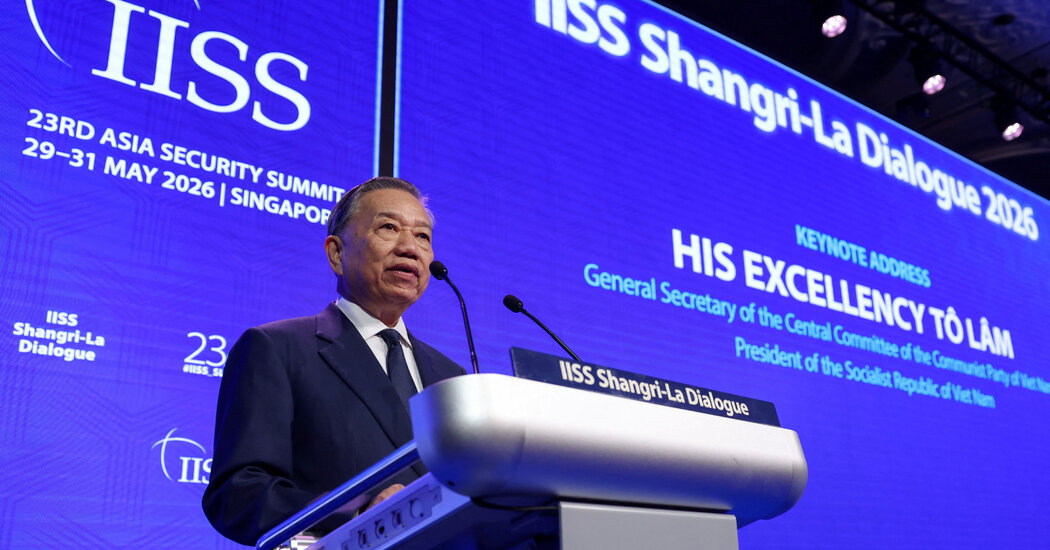
Vietnam’s most powerful and globally minded leader in decades, To Lam, warned Asia’s military leaders on Friday that peace and stability require a renewed focus on economic development, criticizing a world of unchecked competition where “might makes right.”
In his keynote address at the Shangri-La Dialogue, an annual security forum in Singapore, Mr. Lam stressed that “instability today comes not only from military conflict, but also from disruptions in development.”
Mr. Lam, while careful not to criticize the United States or China directly, acknowledged that a series of threats is making it harder for his country and the region to prosper.
A global arms race will not make countries more secure, he warned, as he sought to present Vietnam in a new light — not just as a nation of flexible foreign policy, but also as a proactive force in world affairs and a resilient manufacturing hub that aims to shape policy and partnerships across Southeast Asia.
“What we need is a development foundation with high resilience to shocks,” he said, adding, “When cooperation provides safety, livelihoods and better living standards for people, strategic trust will be strengthened and nurtured.”
Mr. Lam’s half-hour speech, just a few weeks after he officially took on dual roles as chief of Vietnam’s Communist Party and its head of state, marked a high point in his effort to project confidence and preserve the conditions required for what he has described as Vietnam’s “era of national rise.”
Vietnam needs a stable and peaceful external environment to meet its ambitious economic target of becoming a wealthy nation by 2045, with consistent double-digit rates of growth.
“Trade, finance, tariffs, energy, food, data and technology risk being used as tools of pressure,” he said. He stressed that distrust and a lack of respect for established rules has created a culture of “the big fish swallowing the small fish.”
The war in Iran and tensions along the Strait of Hormuz, he added, show how conflict in one hot spot can reshape and damage trade, energy and socioeconomic life in other countries far away.
He implied that something similar could happen in Asia, where Vietnam and many of its neighbors have expressed growing concern about escalating Chinese assertiveness in the South China Sea.
China, which claims most of the waterway as its own, has accelerated building artificial islands just beyond Vietnam’s exclusive economic zone. Vietnam is also expanding construction on reefs and outposts nearby.
Between a quarter and a third of global maritime commerce flows through the South China Sea’s choke points.
Vietnam has a dual challenge: It needs its own disputes with both superpowers to stay manageable, and for the United States and China to coexist without sudden moves — on trade or with threats from their powerful militaries — that could damage its economic trajectory.
So far, Vietnam is still benefiting from the global movement of manufacturers away from China, to protect exports to the United States from high tariffs.
But its position is precarious. China is its largest trading partner, an increasingly large foreign investor, and the United States is its main market for the exports that have pushed Vietnam’s growth rates higher than anywhere else in Southeast Asia.
Mr. Lam has sought to bolster relationships with both. But the White House has been more distant, with President Trump ignoring Vietnam’s repeated requests for a meeting, even after Mr. Lam visited Beijing this year, signing a series of agreements with China’s leader, Xi Jinping. Some observers believe Vietnam has tilted toward China under Mr. Lam.
Vietnamese officials and analysts insist that is only part of the story. Vietnam has also moved closer to countries that are wary of China, building economic and defense ties with South Korea, Japan, India and others, while also purchasing American military equipment, including C-130 transport planes.
Representative Gregory Meeks, a Democrat from New York and the ranking member on the House Foreign Affairs Committee, who was in Singapore Friday after visiting Vietnam, said Washington was still assessing whether more military sales to Hanoi are possible.
Analysts said Mr. Lam’s appearance at Shangri-La highlighted his desire for Vietnam to be seen as a pragmatic, neutral partner.
“He is trying to present himself as the leader of an emerging power, a power that needs to navigate in the time when neither of the major powers are reassuring, neither China nor U.S.,” said Huong Le Thu, deputy director of the Asia program at the International Crisis Group.
Vietnam, Ms. Huong added, joins a “league of countries in the region that are not passively waiting for the new regional or global order to be shaped — they want to take an active role.”
Tung Ngo contributed reporting from Singapore.

