
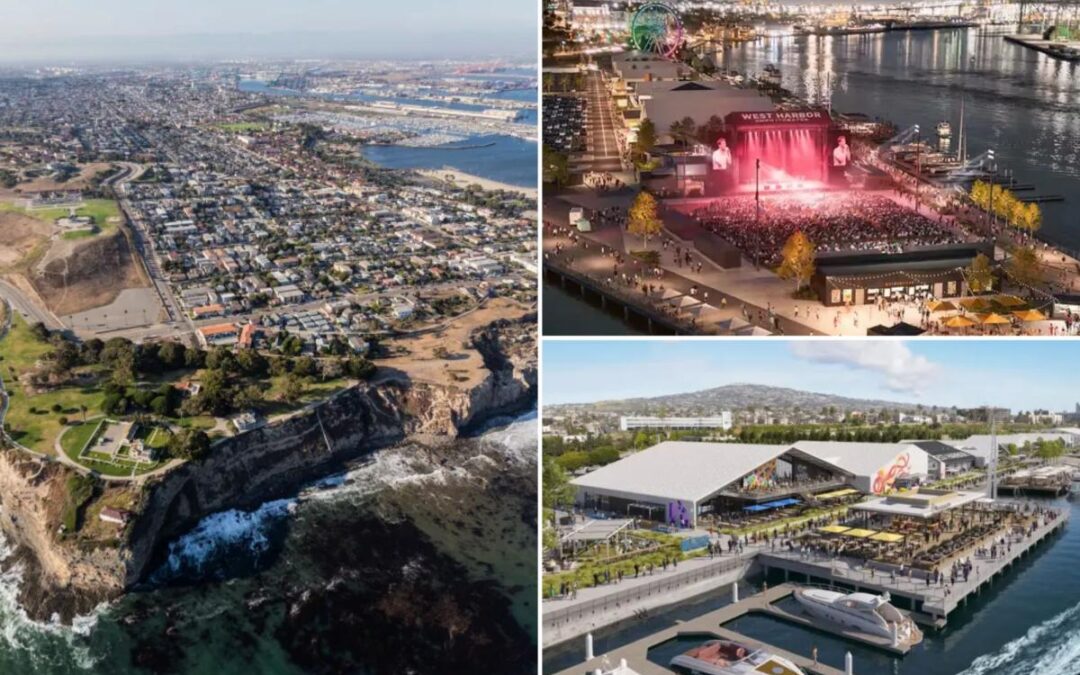
San Pedro was long Los Angeles’ rough-around-the-edges harbor town — a sleepy, blue-collar enclave better known for longshoremen, fishing boats rather than luxury apartments and waterfront dining.
For years, developers, investors and homebuyers have been betting that San Pedro’s long-awaited waterfront renaissance would eventually arrive.
That bet has already been priced into the market, according to real estate agent Gary Krill.
“People have been speculating — we’ve been talking about that waterfront — for more than 10 years,” Krill, of Selling San Pedro, told The California Post. “I feel like it’s already built into the values.”
But now with a new wave of mega-bucks investment, driven by a major waterfront redevelopment, pandemic-era migration and a tightening housing market in other coast parts of the city, one thing is clear: San Pedro is set to be the next big thing in LA real estate.
Over the past 10 years, average single-family home prices have climbed from roughly $700,000 to nearly $1 million, according to Krill. Meanwhile, public and private investment money is pouring into the South Bay.
“It’s one of the best-kept secrets in Los Angeles,” Eric Johnson, president of Jerico Development, the company behind the massive $500 million West Harbor project, told The Post.
But that secret is getting harder to keep, and the shift has fundamentally altered who is looking to live there.
“It’s absolutely changing,” Alex Valente, Principal at institutional development giant Trammell Crow Company, told The Post.
Valente’s firm has placed a massive bet on the neighborhood, launching construction on its first project in late 2022 and breaking ground on an additional 281-unit luxury waterfront building in early 2026.
“We see it in our buildings,” Valente said. “We’ve got people living here who work at SpaceX in Hawthorne, who are waiting on their trillion-dollar IPO. We have aerospace engineers from Boeing and Raytheon, Tesla employees, and military personnel from the two nearby Air Force bases. El Segundo is the heart and soul of aerospace defense, and we are only 20 minutes away.”
Despite rising prices, for these high-earning professionals, San Pedro offers a lifestyle hack that the Westside of LA can’t currently match. Residents can hike the rugged cliffs of neighboring Rancho Palos Verdes, visit the posh Terranea Resort, and buy or rent luxury housing right by the water for a fraction of what it costs in Santa Monica or Venice.
For example, a 2-bedroom, 1,200 square foot condo in Santa Monica can cost $1.4 million, whereas a comparable 2-bedroom condo near the waterfront in San Pedro is listed at $480,000.
For generations, San Pedro was defined by fishing fleets, canneries, and the Port of Los Angeles — the busiest container port in the country. The port remains the area’s economic backbone, but today it is also helping fuel a dramatic transformation by poring hundreds of millions of dollars into publicly accessible waterfront improvement.
That includes West Harbor, the 42-acre entertainment and dining district rising on the former Ports O’ Call Village site.
The project will eventually include restaurants, a 6,200-seat outdoor amphitheater, pickleball and paddle courts, parks, a marina, a 164-foot Ferris wheel and more.
West Harbor is expected to begin opening up for previews this summer, when it hosts an official FIFA World Cup fan zone. By fall, Johnson expects around a dozen tenants to be open, with the rest rolling out into next year.
Developer Valente said the company has one 137-unit apartment building currently being leased and another 281-unit project under construction — both near the water and across from West Harbor. The new project is expected to finish before the 2028 Olympics.
“We saw what was coming with West Harbor and all the investment into the publicly accessible waterfront,” Valente said.
Yet, Krill argues that much of the appreciation wasn’t driven solely by West Harbor. Instead, he points to the pandemic and remote work revolution. Once people no longer had to commute daily, many reportedly began looking south.
“They could get an ocean-view home in South Shores for a fraction of what they’d pay in Santa Monica or Marina del Rey,” Krill said.
San Pedro’s relative affordability compared with neighboring coastal communities continues to attract buyers.
“Affordable waterfront is kind of a unicorn that doesn’t exist,” Johnson said.
Historically, the area once had a “tough town reputation,” with smoke from shipyards and the smell of the cannery helping keep waterfront property values lower than in the hills.
“We had this weird inversion for generations where the closer you got to the water, the less the housing cost,” Johnson said.
With out of towner’s moving in and wanting to be in a “more urban environment,” prices in lower San Pedro have been driven up. Some describe it as “win-win gentrification,” arguing that many longtime families are benefitting from selling their properties that have gone up in value.
Krill said the change is most visible in the formerly industrial sections near downtown and the harbor.
The area’s economic identity is also evolving. AltaSea, the marine research and blue technology hub at the port, has transformed old industrial facilities into a campus focused on ocean innovation, science, aquaculture and marine technology.
The rapid transformation has raised the obvious question: Can San Pedro become a hot waterfront destination without losing the small-town grit that made it unique?
For now, San Pedro sits between its past and its future — still a working port community, but increasingly home to luxury apartments, waterfront restaurants, research campuses and destination entertainment.
Download The California Post App, follow us on social, and subscribe to our newsletters
California Post News: Facebook, Instagram, TikTok, X, YouTube, WhatsApp, LinkedIn
California Post Sports Facebook, Instagram, TikTok, YouTube, X
California Post Opinion
California Post Newsletters: Sign up here!
California Post App: Download here!
Home delivery: Sign up here!
Page Six Hollywood: Sign up here!

