
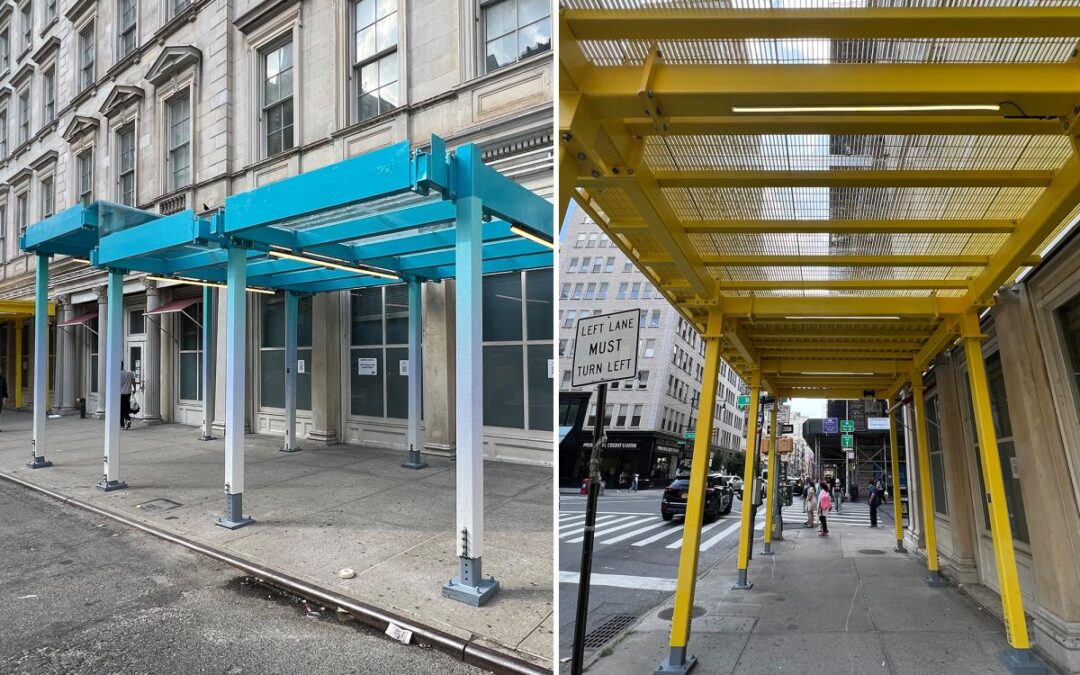
The Department of Buildings has unveiled two proposed new sidewalk shed designs that would replace the monstrosities that blight an incredible 360 miles of sidewalks in the city.
They’re less blatantly offensive than the familiar, hulking steel-and-green wood eyesores. But no one should mistake them for a real solution to the scaffold scourge.
Images of the prototype sheds were shown last year, but real ones are set up for the first time on the sidewalk outside DOB headquarters at 280 Broadway. According to Leila Bozorg, deputy mayor for housing and planning, the new designs “will help New Yorkers see the sky while still protecting people safe [sic] from danger overhead.”
The sheds on view are two of six proposed designs under city review. To be sure, the so-called “rigid” and “flex” sheds designed by architectural firm Arup are less oppressive than the kind everyone hates — and better, too, than the Urban Umbrella type with their tall, white, columns that branch at the top like trees.
The designs by Arup and another firm, Practice for Architecture and Urbanism, are a modest step in the right direction (the DOB expects to finalize the plans later this year, subject to City Council approval).
But light blue and yellow paint jobs and partly see-through roofs of artificial glass don’t come close to solving the underlying problem — notorious Local Law 11, which requires sheds for facade repair and maintenance work on a scale that exists in no other city in the world.
The 30-year-old law still stands, despite tweaks under former Mayor Eric Adams’ administration’s “Get Sheds Down” initiative. It slightly reduced the required frequency of periodic inspections and repairs — although final decisions at any particular building are still up to the DOB.

Nor do the new rules touch the law’s most pernicious provision — that scaffolds must extend 20 feet in either direction beyond the actual job site, thus ruining businesses and entrances that aren’t part of the work.
For a look at how much better our streets would look with many fewer sheds, city planners should have a look at Chicago and Philadelphia — both of which have many old and very large buildings but hardly any sidewalk eyesores of the kind New Yorkers hate.
New York’s shed laws were enacted in the name of protecting passers-by from falling debris. Yet, somehow, hospitals in Chicago and Philadelphia are not overwhelmed by victims of such rare accidents.
But neither city has laws which mainly were written to enrich scaffold rental companies — a scandal that’s Only in New York.


