
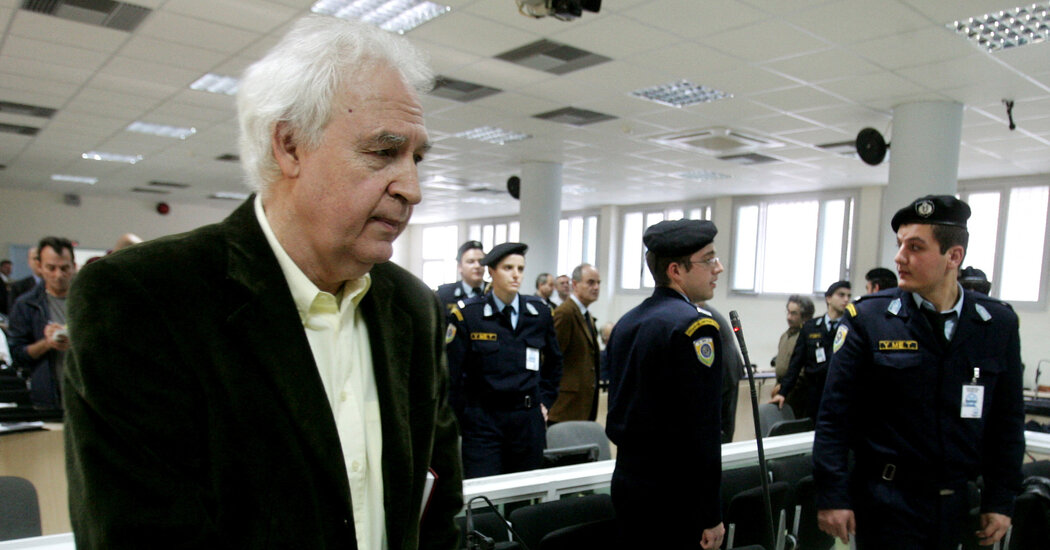
A man convicted of leading a notorious leftist militant group in Greece is headed back to prison, less than a month after his release, following a decision by the country’s Supreme Court on Friday.
Alexandros Giotopoulos, 82, had been serving 17 life sentences for leading November 17, a far-left armed group responsible for the deaths of 23 people, including a C.I.A. officer who was assassinated in 1975. A court ruled in 2003 that Mr. Giotopoulos was the mastermind behind the group, which was active in Greece from 1975 to 2002.
Mr. Giotopoulos had been free since May 21, after a judicial panel approved a petition for his release, citing his age, failing health and good behavior in prison. He has consistently denied that he led the group or was involved in its killings.
His release was challenged almost immediately by a Supreme Court prosecutor on the grounds that Mr. Giotopoulos had not completed 25 years in prison. In Greece, people sentenced to multiple, concurrent life terms in prison are generally released after about 25 years, and Mr. Giotopoulos had filed several petitions asking to be freed.
In its decision on Friday, the Supreme Court’s criminal section upheld the prosecutor’s argument. Before returning to prison, Mr. Giotopoulos is expected to spend a night in police custody ahead of a procedural review of the court’s decision.
Mr. Giotopoulos’s lawyer, Vasiliki Kamilari, said in a text message that her client would voluntarily present himself to the authorities to return to Korydallos, the high-security prison near Athens where he had been serving his sentence.
Families of the victims killed in attacks by November 17 had criticized the decision to release Mr. Giotopoulos. On May 29, the U.S. Embassy in Greece called for him to be returned to prison, in a statement that Greece’s association of prosecutors and judges condemned as an attempted intervention in their country’s judicial affairs.
November 17 took its name from the date in 1973 when a student uprising against Greece’s military dictatorship was violently repressed by the police and the army, killing more than 20 people.
The group carried out a spate of bombings and assassinations, as well as bank robberies that helped to finance its operations. Its victims included industrialists, politicians and foreign officials, including Richard Welch, a C.I.A. station chief in Athens who was gunned down in 1975.
The group eluded the authorities until 2002, when one of its members was injured by a bomb that went off prematurely. That led to a breakthrough in their investigation and the dismantling of the network.
Mr. Giotopoulos was arrested on the island of Lipsi, where he had been living under a false identity.
At a trial in 2003, 14 other members of November 17 were convicted various charges alongside him and sent to prison. Three are still in prison, including Dimitris Koufodinas, who was found by the court to be the group’s principal assassin.

