
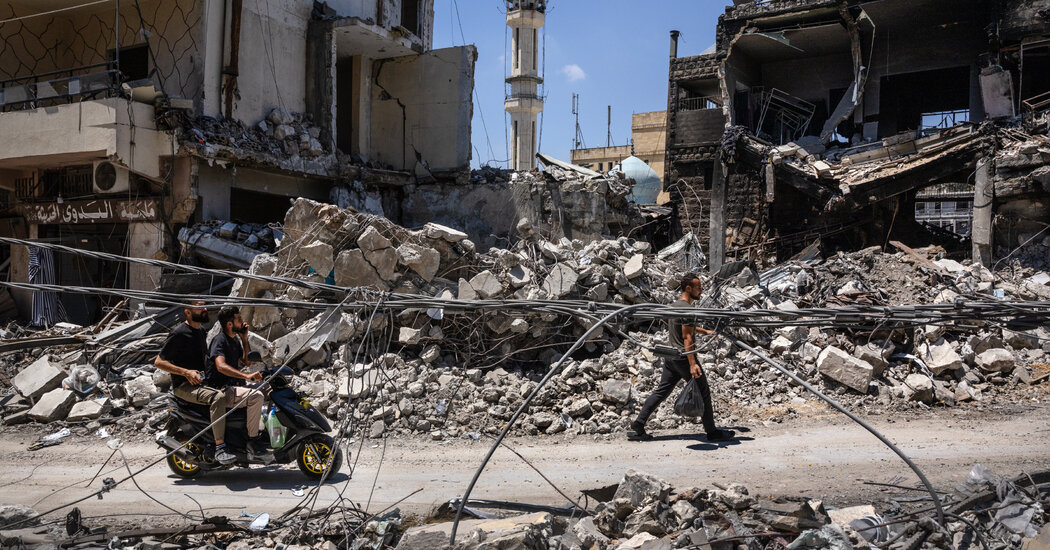
Israeli soldiers fatally shot two people in southern Lebanon on Tuesday, according to Lebanon’s health ministry, renewing fears that enduring fighting there could disrupt efforts to reach a peace deal between the United States and Iran.
The shooting came a day after Israeli troops began operating under new orders intended to reduce the risk of flare-ups in Lebanon, where the conflict with Hezbollah, the Iran-backed militant group, has been one of the main obstacles to a broader U.S.-Iran deal.
Though fighting has eased in recent days after the latest cease-fire, analysts have warned that any attack could set off another escalation.
In a statement following the deadly shooting on Tuesday, the Israeli military said several men riding a bulldozer had approached Israeli troops near the southern Lebanese city of Nabatieh. The Israeli soldiers first fired warning shots at the men, then acted to “remove the threat.” The statement said the men were “Hezbollah terrorists” pretending to be civilians, without offering evidence.
Hezbollah rejected Israel’s account, saying that the men killed were indeed civilians and accusing Israel of a “flagrant violation” of the cease-fire.
Lebanon’s state-run news agency reported that the two men who died had been working with emergency services to open roads and retrieve bodies from rubble left by past Israeli attacks. The shooting occurred near Ali al-Taher, a strategic ridge where Israeli troops have advanced in recent days.
Embedded in the ridge, around six miles from the Israeli border, Hezbollah has built one of its largest underground facilities, according to two senior Lebanese officials who spoke on condition of anonymity because of the sensitivity of the matter.
The Israeli military has said that the fortified stronghold serves as Hezbollah’s southern headquarters and that the group has used it to direct fire against Israeli forces and communities in northern Israel.
Israeli forces moved farther into southern Lebanon in early March after Hezbollah began firing rockets across the border in solidarity with Iran, which had been bombed by the United States and Israel. In recent days, Israeli officials have pledged that their troops will remain in what they call a “security zone,” an area stretching six miles into Lebanese territory.
Despite the shooting, there were signs that a fragile calm was taking hold in southern Lebanon. The U.N. peacekeeping force in Lebanon, or UNIFIL, said on Tuesday that it had not observed airstrikes or air-defense fire since Sunday.
It said, however, that “airspace violations, military activities and restrictions to freedom of movement” continued in the area.
Lebanese and Israeli officials were set to meet again on Tuesday for the latest round of U.S.-brokered talks in Washington. The negotiations have run for several weeks in parallel with the U.S.-Iran talks but have failed to stem the conflict. Hezbollah has not participated in the talks and has rejected their legitimacy, leaving Lebanon’s government with little leverage to force the armed group to comply with cease-fires.

