
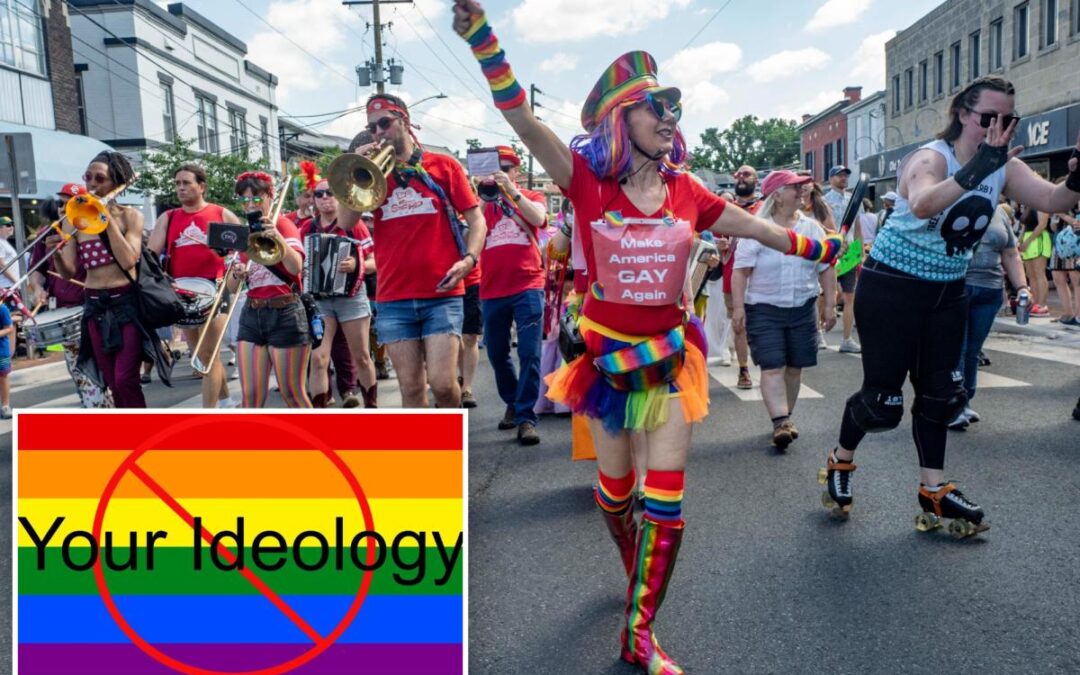
Almost a fifth of Americans would like Pride Month to be canceled, highlighting the deep divisions in how people feel toward the LGBTQ+ community.
A new survey of 2,000 general population Americans revealed that 17 percent don’t believe Pride Month should be celebrated “at all,” while others believe it’s “too much” and should be scaled back (eight percent).
On the other hand, 28 percent believe Pride Month is important and should be supported — and 21 percent support the idea of it, but admit they “don’t really care about it” in practice.
The survey, from Talker Research, found these divisions run parallel to political party ideologies.
Belief in the importance of Pride Month was more than twice as high among Democrats (44 percent vs. 17 percent of Republicans). Then, while a third (32 percent) of Republicans said Pride should be canceled, only six percent of Democrats said the same.
This is in line with recently released research from Gallup, which found that support for LGBTQ+ issues in the US has dropped slightly in recent years — with Republicans largely responsible for this change.
President and CEO of Stonewall National Museum Archives & Library, Robert Kesten, shared his opinion on Talker Research’s data and the changing statistics about LGBTQ+ issues.
“It’s no small wonder that, with an LGBTQ+ population that is a bit fearful at this moment, in places they don’t feel welcome, people hide,” Kesten said.
“People in those communities are not as out. People don’t want to be the outsiders in inhospitable communities, and few people feel comfortable being outsiders even when they are not under attack.
“If they’re able to protect themselves by covering up their identity, they will do so, especially if they do not have the resources or ability to move to a more inviting place to live,” Kesten continued.
“And that’s certainly what we’re seeing. So either people are moving, or people are going back into hiding. And with that, the amount of information that’s on social media [and] certainly in the right-leaning press is very homophobic.
“So the general population starts to believe what it reads because it doesn’t really have another reference point. Same-sex marriage was higher in how people viewed it; it has fallen. It hasn’t fallen tremendously. But the fact that it’s going down and not continuing to go up is an indication that the marketing strategy, the fear factor, all of those things work over time — and it doesn’t have to be a long time before people are impacted by it.”
Despite Gallup data showing that support for things like same-sex marriage has dropped slightly, there were still encouraging results.
In Talker Research’s survey, 44 percent of respondents believe support in general has increased for LGBTQ+ Americans over the past year — and this was higher among respondents who identify as LGBTQ+ (56 percent).
Many said support has neither increased nor decreased (39 percent of all respondents; 24 percent of LGBTQ+ respondents), while fewer said it’s actively decreased — 17 percent of everyone, and 20 percent of LGBTQ+ respondents.
On this topic, Kesten shared, “One thing that’s important is to recognize that we hear a lot of people talking about feeling like they’re being erased. The attacks on Pride are an example of that. It’s important for people to understand that only you can erase yourself. No one else can erase you. And that’s because if you know your history, if you know your culture, if you know why Pride exists, then it can’t be taken away.
“They can paint over rainbows on the sidewalks or on the streets. That they can do, but they can’t take away what’s in your head and what’s in your heart. And that means you can share it. And if you share it and that person shares it and you share it again, that means it’s alive and well.”
When it comes to learning about the history and culture of Pride, the survey also asked respondents about their plans for June and whether they’re personally attending any Pride events.
Respondents’ plans varied greatly based on whether they self-identified as LGBTQ+. Almost four in ten (39 percent) LGBTQ+ respondents will be attending a Pride event, compared to just nine percent of non–LGBTQ+ respondents.
Fifty-four percent of non–LGBTQ+ respondents said they would not be attending — and would not be interested in attending — any events for Pride, compared to just seven percent of LGBTQ+ Americans polled.
“Human beings need human relationships to be healthy,” added Kesten, highlighting the importance of having Pride Month and suggesting that people go “to [Pride] no matter who you are, because that’s when the hand is most outstretched to the greater community.”
Kesten added, “Go for the music. Go for the food. Go for the dancing. Go to have joy with people that you love.”
Research methodology:
Talker Research surveyed 2,000 general population Americans who have access to the internet; the survey was administered and conducted online by Talker Research between June 11–17, 2026.


