
Ground will be broken for Two World Trade Center on July 9. It’s appropriate that the final tower at the site once called “Ground Zero” is to be the new headquarters of the American Express Company. America, after all, is where skyscrapers were invented.
And although the iconic New York City cloudbusters, built mostly between the 1930s and 1950s, are no longer the world’s tallest, they remain the most beautiful, the most expressive of their times — and forever symbolic of Yankee Doodle aspiration and faith.
The earliest skyscrapers popped up in Chicago in the late 1800s, but Manhattan soon overtook that city, and our collection reigns supreme.
They fire the imaginations of our friends and enemies alike. A photo of Liverpool-born George Harrison, shot in 1963 when the Beatles weren’t yet a global phenomenon, captures him gazing in wonder at Lower Manhattan from Liberty Island.
Even the captain of Nazi Germany’s U-123 that sneaked into New York Harbor in winter 1942 said, after sighting the lit-up spires through a submarine periscope, “I cannot describe the feeling with words.”
Height in itself isn’t the only benchmark of a skyscraper. The 22-story Flatiron Building, completed in 1902, is regarded as one for its impressive height for its time, and for the way its triangular form, tapering to a point at its northern end, proclaims a relationship with the sky above and the city around it.
Our masterpieces include many from the era of masonry and brick, materials that gave structures a warmer look than modern steel and glass, and lent themselves to romantic ornamentation. They were built for companies like US Steel, the Chrysler Corporation and RCA, and by visionaries such as John D. Rockefeller and GM mogul John J. Raskob, the prime mover behind the Empire State Building. The latter went up in a mere 18 months during the depths of the Great Depression — a stirring affirmation of American resilience.
As skyscraper historian Carol Willis wrote in her preface to Daniel M. Abramson’s wonderful “Skyscraper Rivals,” about the race to build Jazz Age icons 70 Pine Street and 40 Wall Street, downtown Manhattan’s “skyline of stepped-back masses and slender spires established New York as the modern metropolis.”
Now a luxury apartment building, 70 Pine Street and its night-lit crown exudes quiet majesty in every nook of its Art Deco brick and stone. A short block away, 40 Wall Street (today the Trump Building), is equally handsome, even if its pyramid-shaped mansard roof lost illumination decades ago.
Another downtown masterwork, the Gothic-detailed, circa 1913 Woolworth Building was called “The Cathedral of Commerce” for good reason: Its contours embody the same heaven-ward thrust as the Duomo in Milan and the Cathedral of Chartes in France.
Other US cities took pride in their machine-age skyscrapers, such as Chicago’s Wrigley Building and Tribune Tower, Philadelphia’s City Hall and Kansas City’s Power and Light Building. But everything changed with the advent of glass curtain-wall construction on Park Avenue in the 1950s — a revolution led by Lever House and the Seagram Building.
Their design ethos yielded scores of copycat flat-topped glass boxes. But a new, austere beauty emerged at a handful of locations. The somber Financial District tower known as One Liberty, originally commissioned by US Steel, exposes the tower’s actual structural steel, which narrowly survived the 9/11 attack. And Architect Philip Johnson designed the Postmodern 550 Madison Avenue, with its famous “Chippendale” top, as a rebuke to International Style monotony.
Today, supertalls have become the international vernacular to show off a nation’s or a kingdom’s wealth.
New York developers, including Donald Trump in the far West 60s, have in more recent years toyed with erecting the world’s tallest towers, but given up when confronted with the political and engineering challenges such schemes faced. Of the world’s 11 tallest buildings, only one of our own, One World Trade Center, makes the cut. Previous champs such as the Empire State Building and the former Sears Tower in Chicago appear far down the list.
The newest one to enjoy a global mystique is also the tallest: Burj Khalifa in Dubai, more than twice as high as One World Trade Center. Its soaring verticality and needle apex suggest nothing less than the shoot-for-the-heavens iconography of classic old Manhattan towers.
But, surprise! Its architect is an American, Adrian Smith, who’s also credited with Nordstrom-based Central Park Tower on West 57th Street. And which other genius made Burj Khalifa and many giants possible? Another American. Pakistan-born structural engineer Fazlur Rahman Khan, the inventor of so-called “bundled tube design,” became a US citizen in 1967.
And NYC skyscraper fans who miss the early 20th-century style can rejoice over the re-emergence of viewer-friendly crowns, from Citicorp tower’s slanted rooftop to the wedge-topped giants in Hudson Yards. The mast atop One Bryant Park, with candy-cane night lighting, recalls earlier times. And newer One Vanderbilt wholeheartedly defers to the past with a profile that becomes more slender near the top and is punctuated by a true antenna-like pinnacle.
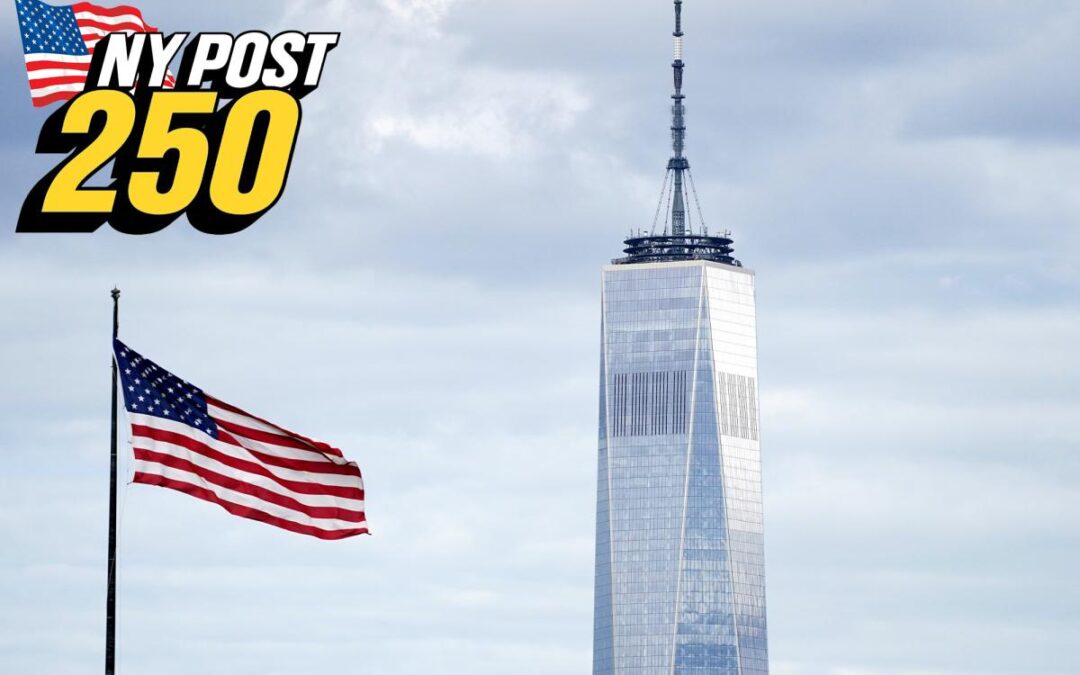
Our most emotionally charged skyscraper nexus, of course, is the World Trade Center. The four towers that bravely rose a few years after the carnage of 9/11 form an impressive ensemble. They’re thriving with commercial life in a way the original Twin Towers never really did.
But Two World Trade Center was the missing link for more than a quarter century. Architects Foster + Partners softened its 1226-foot-high glass facade with nine highly visible outdoor terraces and corner gardens.
Academic critics might complain the Amex tower isn’t creative enough, as they did of the earlier buildings. But everyone else will cheer its expression of American qualities born on July 4, 1776 — courage, faith and indomitable strength.
And let us all remember: Only a very few Americans can name a single one of Shanghai’s rainbow-lit skyline towers. But it’s near certain there’s no one in Shanghai who doesn’t recognize the Empire State Building.


