
New Jersey’s suburban gold rush has no ceiling in sight, and buyers are paying whatever it takes.
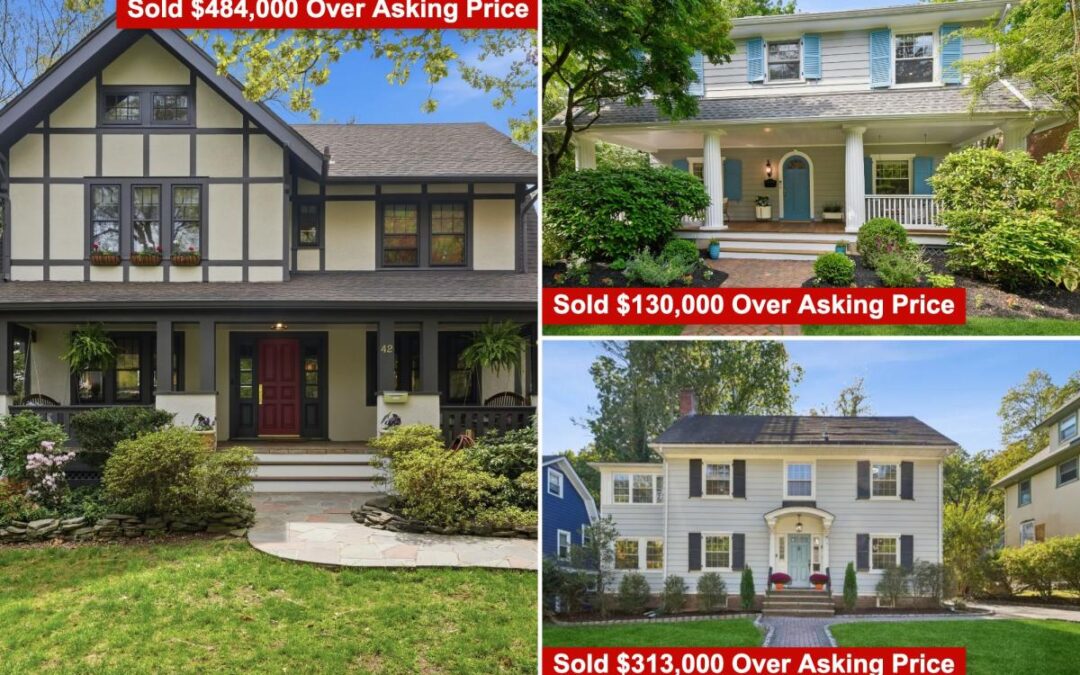
Forty-two Euclid Ave in Maplewood hit the market at $1,795,000. It sold for $2,279,000, a staggering 27% above ask. Down the road in South Orange, 376 Melrose Pl listed for $998,999 and closed at $1,332,200, a 33% premium.
These aren’t outliers. They’re the new normal across a stretch of Essex and Union County suburbs where inventory has all but evaporated and buyers are throwing caution, and hundreds of thousands of dollars, to the wind.
Maplewood, South Orange and Montclair are leading the charge, with homes across the region averaging double digit percentages over asking price and spending under two weeks on the market before going under contract.
The numbers, according to weekly market data compiled by Mark Slade of Keller Williams Midtown Direct Realty, tell the story clearly.
Maplewood’s average sale price sits at $1.34 million as of late June, with buyers paying 15.6% over ask. South Orange isn’t far behind at 16.2% over asking with an average sale price topping $1.27 million. Montclair, meanwhile, is running the hottest of the bunch, with buyers paying nearly 25% over list.
Slade, who has tracked these markets since becoming a realtor in 2009, says the upward march has been remarkably steady.
“I don’t think I’ve ever seen a down-trending year in Maplewood, South Orange or Montclair,” he told The Post, adding that the last several years in particular have brought “dramatic changes in the performance of the market.”
The pandemic supercharged an existing trend, according to Slade, who traces the appeal of these towns back to 1997, two years after Midtown Direct train service began running straight into Penn Station without a transfer in Hoboken.
“That’s when we started to see some movement, some significant movement and attraction to the area,” he said.
Slade has a name for what’s happening now. He calls it “value convergence equilibrium” — a theory built on the idea that Northern New Jersey buyers are catching up to what Westchester and Long Island commuters have paid for decades.
“What we now see is that more and more people as buyers, are recognizing that with their economics, they can afford more house for less money in Northern New Jersey,” he said.
The buyers driving this frenzy aren’t only fleeing Manhattan. Slade says most are also coming from Brooklyn, Hoboken and Queens, current apartment dwellers looking to trade up.
“Northern New Jersey offers some of the best values as much as it may seem crazy for someone like me watching these prices grow by leaps and bounds,” he said. “It’s still a better value if you’re looking for a 45 minute and under commute to the city.”
Basic economics explains the rest. Supply simply hasn’t kept pace. Slade points to Maplewood specifically, a town of 25,000 residents with more than 5,500 single family homes, yet only a couple dozen actively listed at any given time.
“I mean, that’s just ridiculous,” he said. He tracks a metric he calls a “hypermarket,” where the number of homes under contract nearly doubles the number of active listings, a ratio he considers more telling than the traditional six month absorption rate used across the industry.
The demand has changed the character of these towns, longtime residents complain.
Slade says he’s heard grumbling that the small town feel is being “supplanted by more New York, impatient, higher end buyers.”
He offered an only half joking anecdote about downtown Maplewood’s diagonal parking spots, where illegal U-turns into spaces happen constantly despite signage every 30 feet.
“I think that today’s buyers are much more affluent,” he said. “They’re even more time pressed, so to speak, which is why they’re choosing these areas to live for the more manageable commutes.”
Township meetings haven’t been immune to the anxiety. After a record breaking sale in Maplewood’s Hilton neighborhood last year, Slade recalls committee members raising concerns at the next public meeting about what runaway prices mean for longtime residents. Still, he sees the appreciation as a feature, not a bug, of homeownership.
“This is real estate,” he said. “This is what real estate is all about.”
Momentum tends to soften slightly as the year goes on, Slade says, a seasonal pattern he attributes half jokingly to what he calls “bonus baby syndrome,” when buyers flush with year end bonuses resolve to finally buy a house “so we don’t have to trip over the stroller.”
When buyers get priced out of one town, they simply move to the next rung down.
Montclair shoppers frustrated by bidding wars often land in Maplewood. Maplewood buyers priced out end up in West Orange, where the year to date average sits at $763,000 with a 10.7% premium over ask, or Union, averaging around $600,000.
Bidding wars, meanwhile, have become simply expected.
“Bidding wars are very much part of the current market scenario, given the limited number of homes for sale and the fact that the amount of buyers far outweighs the supply,” Slade said.
“Buyer’s should generally expect some type of bidding war.”
He uses an ice cream metaphor to describe buyer psychology, borrowed from a Cold Stone Creamery portion chart.
“There are three sizes of ice cream at Cold Stone Creamary, Like It, Love it and Gotta Have It!,” he said. “So, if a buyer is in the Gotta Have It mode, their offer could likely blow everyone else away.”
Homes that have recently traded well above ask include 8 Colony Dr in West Orange, which sold for $1,178,000 against an $865,000 list, a 36% jump, and 35 Porter Pl in Montclair, which closed at $1,525,000 on a $1,395,000 ask, pricing out at 30% higher per square foot than the town average.
Whether this run has a natural endpoint is another matter. Slade doesn’t see one coming, short of the state “building a wall around Manhattan.”
New Jersey remains the most densely populated state in the country, meaning new construction is largely limited to developers subdividing larger lots rather than building fresh inventory from scratch.
Relief in the form of significantly lower mortgage rates also seems unlikely anytime soon, Slade says, leaving buyers to keep competing for a shrinking pool of homes in towns that offer what he still considers, even amid the chaos, the better deal.


