
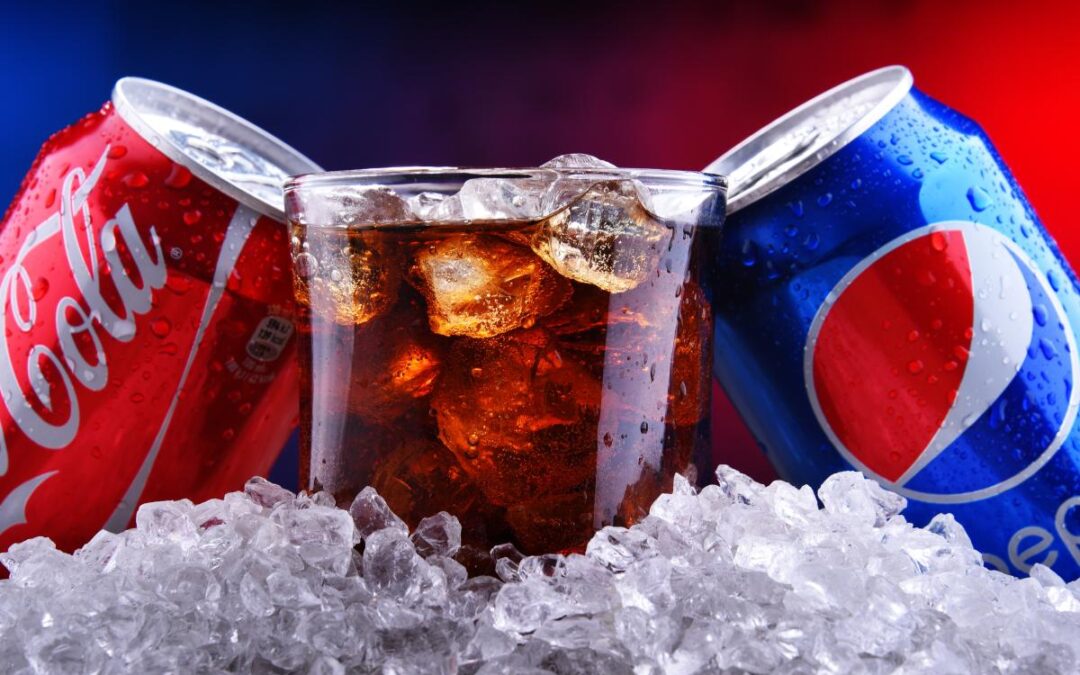
Coca-Cola is pounding Pepsi on Wall Street, riding a lean beverage strategy to near-record highs while its bloated rival chokes on a slumping snack business.
Coke shares are nearly the highest ever since the Atlanta-based drinks giant entered the stock market over a century ago. Meanwhile, PepsiCo’s stock has tumbled nearly 30% since peaking just below $200 in 2023.
Pepsi reported better-than-expected second-quarter earnings on Thursday, but the results failed to reassure investors as sales dropped in its core North American beverage division, Barron’s noted.
The company posted a 6.4% increase in overall net revenue to $24.2 billion, with North American beverage sales accounting for $7.2 billion of the total.
After years of rivalry featuring “Pepsi challenges,” ill-fated experiments like “New Coke” and relentless ad campaigns, Coke was widely seen as coming out on top some years ago. Investors are seconding that opinion, pointing to disparate financials.
The financial gap between the competitors is most evident in their profitability. Coca-Cola reported a 35% operating margin in the first quarter, up from about 33% a year earlier. PepsiCo’s operating margin hovered around 16.5% for the first half of the year, less than half of its rival’s.
“It’s becoming more obvious to the investor base that Coke has a superior business model,” Nik Modi, co-head of global consumer research at RBC Capital Markets, told Barron’s
PepsiCo’s challenges stem primarily from its snack division and its approach to bottling operations.
Packaged foods and snacks, including Lay’s, Doritos and Cheetos, generated 58% of PepsiCo’s revenue in 2025.
But aggressive price increases implemented during the COVID pandemic have hurt demand. Consumers have increasingly traded down to cheaper store brands to slash their grocery budgets.
In North America, snack food revenue fell 2% in the second quarter compared with a year ago, and unit sales remained flat.
PepsiCo CEO Ramon Laguarta attributed the slowing snack sales partly to high gasoline prices, which deter customers from making impulse buys at convenience stores.
“I think the consumer is worse than what we had anticipated and driven mainly by gas prices,” the exec said Thursday during a conference call with investors.
Citi analyst Filippo Falorni said the company faced “continued weakness in North America” in a note to clients on Friday, warning that the sales slump would persist for as long as inflationary pressures caused by the Iran war hit the US economy.
“This dynamic also creates carryover risk to numbers in 2027,” he added, “with still elevated cost inflation pressuring margins.”
Coca-Cola, by contrast, focuses almost exclusively on beverages. It has driven growth with products like Fairlife ultra-filtered milk and smaller, premium-priced soda cans.
Coca-Cola also keeps overhead costs low by franchising most of its bottling operations. PepsiCo still owns about 80% of its bottlers, creating higher structural costs that cut into its margins.
PepsiCo’s lagging performance recently drew the attention of activist investor Elliott Investment Management.
After disclosing a $4 billion stake in PepsiCo in September, the hedge fund pushed the company to streamline operations, lower prices, and consider refranchising its North American bottling network, similar to Coca-Cola’s model.
In response, Pepsi struck an agreement with Elliott late last year. The company agreed to a sweeping restructuring plan that includes cutting 20% of its US product lines by early 2026, lowering prices on core brands, and shuttering several manufacturing plants.
While PepsiCo has resisted a full refranchising of its bottling operations, it has begun testing the integration of its snack and beverage distribution systems to improve efficiency.
To improve profitability, RBC’s Modi suggested the company might need to rethink its heavy ownership of manufacturing and distribution facilities.
“They may have to make some tough choices,” he said.
Shares of Coca-Cola Co. rose in midday trading Friday, continuing to widen the financial gap with PepsiCo.
As of 2 p.m. EDT, Coca-Cola stock was trading at $83.34, up 71 cents, or nearly 1%, from Thursday’s close of $82.63. The stock continues to hover near its 52-week high of $85.68.
Meanwhile, shares of PepsiCo were down 56 cents, or 0.4%, trading at $137.30. The stock is lingering closer to its 52-week low of $133.75 after closing at $137.86 on Thursday.
Coca-Cola is set to report its second-quarter earnings July 28


