
It’s surprisingly emotional to get attacked by a godzilla. That’s more or less the premise of Monarch: Legacy of Monsters, a show that has a ton of fun with its creatures but wants to make it clear the experience of coming into contact with kaiju is dangerous and deadly. The trail of physical destruction the monsters leave behind is easy to see. The trail of emotional destruction? Making that debris and detritus as visible as the monsters is Monarch’s main task.

This episode continues the heroes’ and villains’ respective quests to find Titan X. Led by boss Brenda and her roguish henchman Jason, Apex Cybernetics has used Bill Randa’s old migration map to track the monster to its next destination, the now-abandoned village of Santa Soledad. Brenda, wearing a brown jumpsuit nearly as spectacular as the Titans, sees this as their golden opportunity to field-test May/Cora’s monster mind-control code. All they have to do is launch a drone that will fire a neural implant into the creature’s body. Then they can — theoretically — control a kaiju.
Our Monarch-affiliated heroes are understandably skeptical about the whole endeavor. As the captain of Monarch’s floating Outpost 18, Tim persuades Director Barris that Apex has been sending them on wild goose chases, and that they’re secretly pursuing their own agenda in Santa Soledad.
Lee has the same thought. If they’re working for the public good as they’ve claimed, why keep their activities a secret, even from their Monarch partners? He and the scrambled-together Randa family — Keiko, Hiroshi, Cate, and Kentaro — head to Santa Soledad themselves to investigate.
Along the way, they have plenty of time for recrimination and relitigation of the past. Having read his mother Kei’s Dear John letter to “Uncle Lee,” Hiroshi is furious, blaming her infidelity to his stepfather Bill Randa for Bill’s abandonment of him as a child. Never mind the fact that the first time he storms away after one of their painful conversations about this, he has to walk right past his two children from two separate, secret families to do so. Equally painful flashbacks reveal the ways in which a younger Hiroshi, torn between two loves and obsessed with Bill’s work, could never be fully present for anyone.
Lee’s the one who helps Hiroshi connect his mother’s plight with his own. Yes, she fell in love with two different people at the same time. It happens. “I’d expect you of all people might know a little something about that,” he tells Hiroshi. The line let me shouting THANK YOU! at the screen like that one gif of Michael Scott.
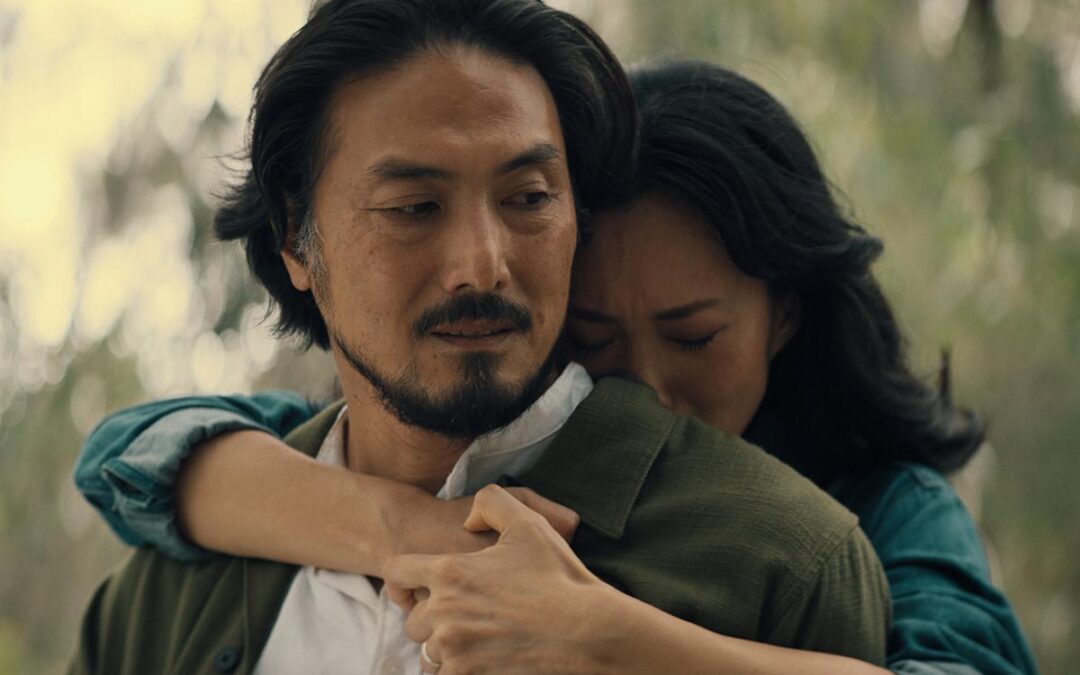
The resolution of this emotional storyline gives us one of the episode’s finest moments. Out in the forest, Hiroshi reflects that in a way, reading the letter was a relief. Yes, he was upset by its revelations, but it also meant that Bill’s discontent and wanderlust had their own cause, and had nothing to do with his feelings, or lack thereof, for his adoptive son Hiroshi. When he says this, both he and Kei, who has her arms slung around him from behind, smile, even laugh a little. Sometimes it takes a little pain to push you to a better place in life.

When Lee and the Randas stealth their way to the Apex campsite, they discover that Cora is a true believer in Apex’s project. It’s not that she trusts the company or her bosses, it’s that she trusts her own code to possibly prevent future G-Day–type mass casualty events.
But in classic “move fast and break things” tech-idiot mode, Brenda and Jason rush her. They launch the drone and implant the device in a surfacing Titan X before Cora can ensure that the code will scale up to a neural network as immense as the monster’s. The resulting systems crash costs Apex their implant, their outpost, and seemingly many of their lives when Titan X shakes free of their control — those scarabs completely sever the tentacle to which the implant is attached — and goes berserk. It also most likely costs Brenda her career, though Jason steals some equipment and escapes.
It’s our heroes who are hit hardest. In a gorgeous scene, Cate, who has been able to hear the vibrational “song” of Titan X from the depths of the ocean when no one else can, stands silent and still before the beast, silently communing with it. It’s the kind of scene that only works because you take one look at Anna Sawai’s face and think well yes, absolutely, this is a face that could make a Titan drop what it’s doing and pay attention.

When the neural implant is injected into the Titan, which the villagers once referred to as Co-Cai, Cate’s connection with it is short-circuited, causing her to collapse with a searing headache. Hiroshi rushes in to protect her. He is mortally injured in the ensuing melee, and he dies in the arms of his mother Kei and his daughter Cate while they whisper-sing “Furusato,”fco the Japanese children’s song all three were raised on.
That’s when I started tearing up. Over a goddamn Godzilla show! But of course that’s not impossible, as anyone who’s watched Godzilla Minus One could tell you. Big monsters open up space for big emotions, if you’re willing to put in the work to put them there.
Moreover, when you cast actors like Takehiro Hira, Anna Sawai, and Mari Yamamoto, you more or less have to give them material worth their time. It’s like how Kentaro explains to Cate that their father Takehiro’s bigamy was essentially an engineer’s solution to a problem: Overwhelmed by his abandonment issues, he ensured that he’d always have someone close to him. I similarly imagine that when presented with actors as beautiful and talented as Hira, Sawai, and Yamamoto, Monarch’s makers felt they had to give them something as spectacular — more spectacular, in its way — as those glory shots of Titan X.
Monarch is running a pretty sophisticated code, all things considered. It doesn’t work all the time, but when it locks into your synapses, it takes you on an emotional journey like nothing else on television.

Sean T. Collins (@seantcollins.com on Bluesky and theseantcollins on Patreon) has written about television for The New York Times, Vulture, Rolling Stone, and elsewhere. He is the author of Pain Don’t Hurt: Meditations on Road House. He lives with his family on Long Island.


