
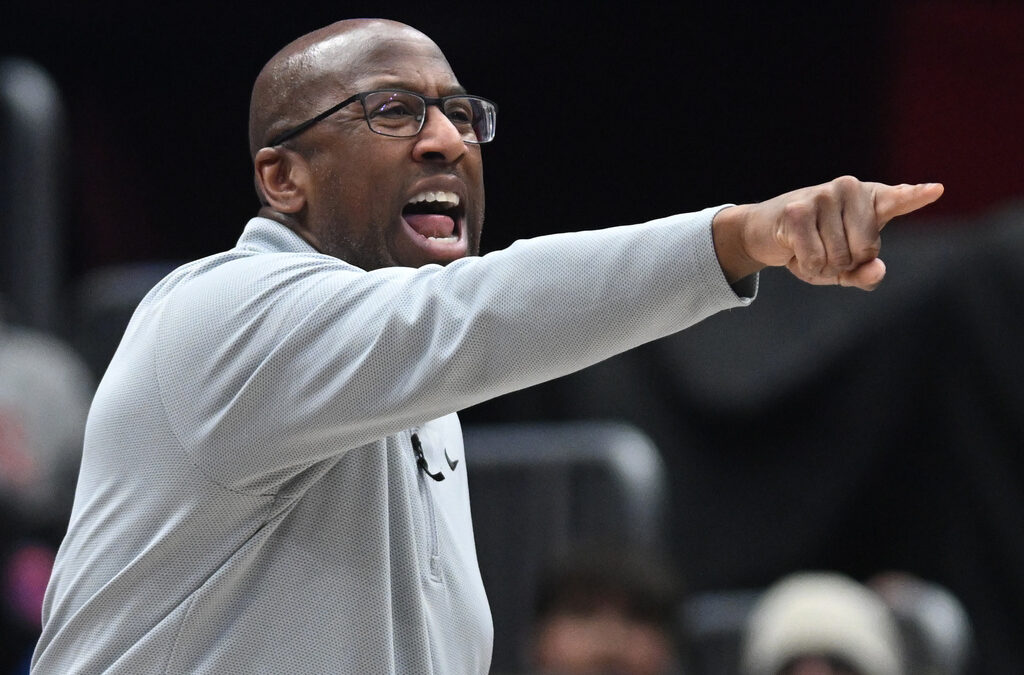
Mike Brown would like to play a 9.5 to 10-man rotation. His front office has given him eight and two fringe candidates.
It’s the one, glaring and ever-persistent area a Knicks team with championship aspirations needs to address ahead of Thursday’s 3 p.m. NBA Trade Deadline, particularly considering the top of the Eastern Conference has improved in real-time around the Knicks.
James Harden, Dennis Schroder and Keon Ellis to Cleveland. Another aggressive sharpshooter (Kevin Huerter) to the No. 1-seeded Detroit Pistons. And a big swing by the Boston Celtics, who moved on from a dynamic scoring guard for their center of the future.
Now, it’s the Knicks’ turn to make their marginal improvement. No, not a Giannis Antetokounmpo trade — as enticing as it sounds — given the cost of acquiring him and the time needed to build championship chemistry.
The Knicks merely need to right their wrongs. Because Guerschon Yabusele and Jordan Clarkson were big-time whiffs in free agency last summer, plus Pacome Dadiet is taking up valuable cap space for a player who isn’t seeing the floor while prospects drafted after him have carved out roles under Brown’s leadership.
The Knicks signed Yabusele using their mid-level exception to a deal that pays $5.5M this season with a $5.8M player option for next year. They signed Clarkson to a minimum deal after he agreed to a buyout with the Utah Jazz. And up against the second apron, New York selected Dadiet 25th overall in the 2024 NBA Draft because they knew he’d take less than the rookie scale salary, which gave them just a tiny bit more flexibility under their hard cap.
Those players now combine for a valuable $10 million on the payroll — yet as the Knicks approach the All-Star break, none of them are part of Brown’s dedicated rotation. That’s a bad use of company funds. Yabusele, the French standout from the 2024 Paris Olympics, was expected to elevate Precious Achiuwa’s role but fallen even deeper into the bench than his predecessor. Clarkson was benched, in large part, due to his shot selection, and Dadiet hasn’t looked like an impact player in any of his limited minutes on the floor.
Meanwhile, the talent gap between New York’s stacked starting five and the field is closing. The Cavaliers traded the oft-injured Darius Garland to form a Big Three of Harden, Donovan Mitchell and Evan Mobley. The Celtics, even without Jayson Tatum, are all about execution, still as competitive as ever after trading away Kristaps Porzingis and Jrue Holiday over the summer. And the Pistons handed the Knicks a 31-point beatdown when the two teams played in early January. They — and, suddenly, the Cavaliers, not the Knicks — are co-favorites to win the East this season.
When healthy, the Knicks have eight veteran players they can rely on — the starting unit of Jalen Brunson, Karl-Anthony Towns, OG Anunoby, Mikal Bridges and Josh Hart, plus Miles McBride, Mitchell Robinson and Landry Shamet off the bench. They also have two young players who’ve separated themselves from New York’s prospect pool: Tyler Kolek and rookie Mohamed Diawara.
Kolek and Diawara, though, are unproven in the playoffs, where the Knicks will need more than eight players if they hope to survive three rounds of teams attempting to wear them down. With Ellis and Schroder, the Cavs have an 11-man rotation. The Celtics, too, play 11, and can make it 12 should Tatum return from his Achilles injury, and the Pistons are designed to play the very brand of physical, call it smash-mouth basketball the Knicks have struggled against in recent seasons.
So the Knicks have looked good–at times, really good–over the life of their seven-game winning streak, but the results have come against mixed competition that, when combined, boasts a losing record. The schedule only gets more difficult from here, and in the playoffs, series are less about talent and more about matchups, matchups the Knicks need to get ahead of by making the moves their Eastern Conference counterparts have already executed pre-deadline.

