
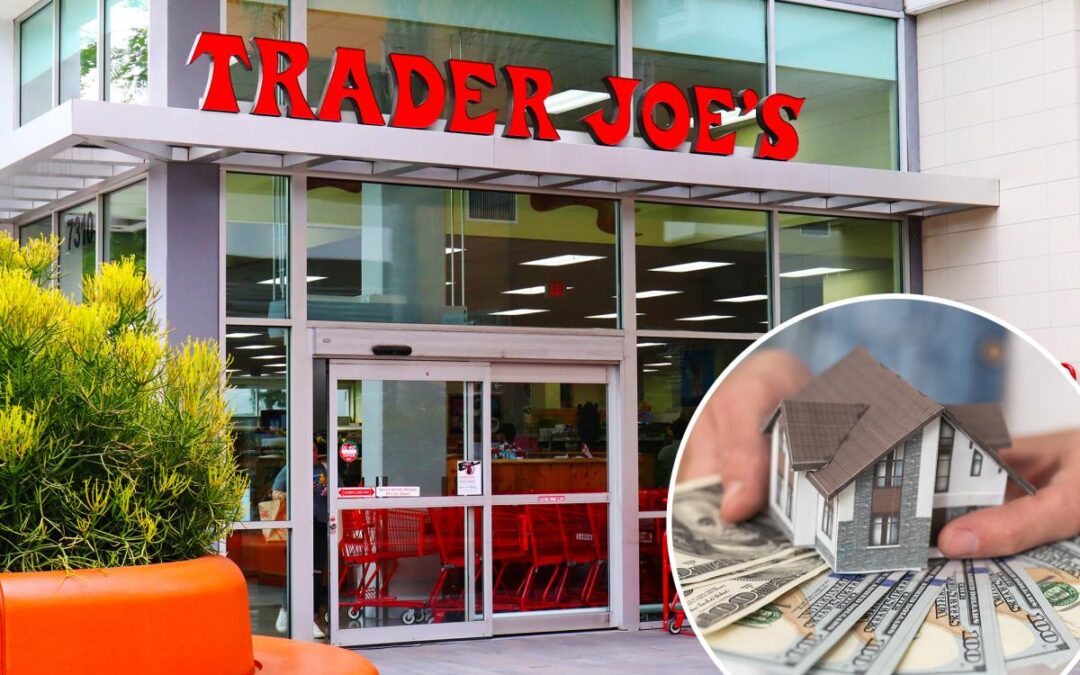
While most homeowners appreciate having a nearby grocery store, the store’s true value may depend on which chain runs it.
In neighborhoods where a Trader Joe’s opens, home prices outperform the national average by 6% over the following three years, according to a new analysis from Aziz Sunderji, a housing market strategist and founder of Home Economics.
On the other hand, Sunderji found that in neighborhoods where a new Walmart opens, home prices underperform the national average by 4%.
Sunderji conducted his analysis by cataloging more than 32,000 grocery store openings from federal SNAP retailer authorizations dating back to 1975, and comparing them with home price data at the ZIP code level from the Federal Housing Finance Agency.
The analysis found that the grocery chain associated with the highest home price performance was Sprouts, the natural and organic food retailer that is primarily found in major cities in the Sun Belt.
Like Trader Joe’s, Sprouts is known to target areas with highly educated, upwardly mobile populations, making them ripe for future home price appreciation.
“What seems to be happening is that Trader Joe’s and Sprouts tend to open in ZIPs where home prices are rising fast—and they continue to rise fast after opening,” Sunderji tells Realtor.com®.
In other words, a new store is likely not the main reason that home prices rise in the surrounding areas, but rather these retailers excel at scouting new locations with strong upside for price appreciation.
Sprouts targets neighborhoods where at least 40% of residents are college-educated, with a high share of them holding white-collar jobs, according to planning documents published by Prince George’s County in Maryland.
The documents show Trader Joe’s is even more specific, targeting new store openings in neighborhoods with a median age of 44, where there are at least 36,000 college-educated residents within five miles, and at least 60% of residents are homeowners.
A spokeswoman for Trader Joe’s declined to comment on the company’s specific criteria for selecting new store locations, but pointed to a company podcast that described the logistics of store openings.
“We are actively looking at hundreds of neighborhoods across the country as we hope to open more new neighborhood stores each year,” the spokeswoman said. “Every neighborhood store is truly unique.”
On the other end of the spectrum, budget retailers like Walmart and Dollar General may be selecting sites in more rural areas that are struggling economically, making them more prone to home price depreciation.
“The big takeaway is that these large companies choose their locations very carefully,” says Realtor.com senior economist Jake Krimmel. “When it comes to grocery store openings, correlation is not causation. Instead, particular stores choose their location where their particular customer base is likely to grow.”
For example, Walmart may be choosing to open its new stores in ZIP codes where home prices, and possibly incomes, are likely to fall or already falling.
“This likely aligns with their business model of being a one-stop shop for good value on all types of consumer goods,” says Krimmel. “The opposite is true for stores like Trader Joe’s, which markets itself as a slightly more specialized grocery store.”
As well, retailers that simply target the richest neighborhoods may tend to underperform on home price growth, as values in those areas have little room to run.
Sunderji notes that Costco and Target both target wealthy neighborhoods, with Target neighborhoods having the highest median home values of any chain at $481,000. Yet in the three years after opening, home price growth in Costco ZIPs is roughly the same as nationally, while Target neighborhoods underperform.
In terms of a grocery chain’s direct impact on home prices, Dollar General may be the exception to the rule. Sunderji says there is evidence that the discount chain actually benefits home values after opening.
In the three years before a Dollar General opening, area home prices typically underperform the national average by 6.6%, improving to 2% underperformance in the three years after the opening, says Sunderji.
Dollar General is often associated with rural areas that are either too impoverished or sparsely populated for a Walmart, making the store’s arrival a potentially welcome amenity providing commerce and employment.

