
The busiest commuter rail system in North America will have all service suspended indefinitely as union workers for Long Island Rail Road walked off the job after an agreement with the MTA on a new contract could not be reached.
Negotiations took place right up to the last minute Friday, with both sides hoping to reach a deal to avert a walkout by locomotive engineers, machinists, signalmen and other train workers. But with no deal in place by the 12:01 a.m. deadline Saturday, the union left the negotiating table and workers went on strike.
“Late in the eleventh hour, the railroad decided to throw healthcare contributions for new employees, which was never discussed in bargaining. There were things that we had tried to talk about that they had previously discussed, and they flat out said they weren’t interested,” said Kevin Sexton, BLET Union National Vice President. “We’re far apart at this point, and we feel it’s unnecessary because we went through the process.”
Union officials said picket lines would be out in force starting at 7 a.m. Saturday.
Any trains set to depart after midnight were canceled. Trains that were already in service would continue to make all stops to their final destination before going out of service.
It marks the first strike in nearly more than 30 years for LIRR. Workers last went on strike in 1994, for about two days. They nearly walked out in 2014 before then-Gov. Andrew Cuomo reached a deal with unions.
If the strike were to last into Monday and beyond, it would force roughly 250,000 people who ride the system each weekday to either work from home or find alternative routes into New York City from the Long Island suburbs. That means more cars on traffic-choked highways and longer work commutes.
A strike was temporarily averted in September when President Donald Trump’s administration agreed to help. Those efforts ended without a deal, leaving the Saturday deadline to try and resolve the disagreements before the union was legally allowed to go on strike or the agency could lock out workers.
Five labor unions representing about half the train system’s 7,000-person workforce gave warning during the week about the approaching deadline. Neither the unions nor the MTA shared details about the status of negotiations Friday, but officials briefed on the transit agency’s preparations said they had begun “laying up” trains after 6 p.m. — essentially meaning they were repositioning the locomotives in anticipation of a strike.
Both sides had remained at the negotiating table well into the evening. Discussions were still ongoing as of 9 p.m. with lots of back and forth, a union spokesperson said — with talks getting heated at times. The spokesperson said union leaders received a new proposal from the MTA just before 7 p.m., and needed time to review it.
Long Island ↔ New York City travel alternatives
The MTA, which oversees the LIRR and other area transit systems, has said it will provide free but limited shuttle buses during the morning and afternoon rush hours. The agency says the shuttles will depart from six designated LIRR train stations to subway stops in Queens.
See below for a map of what the shuttle bus service will look like:
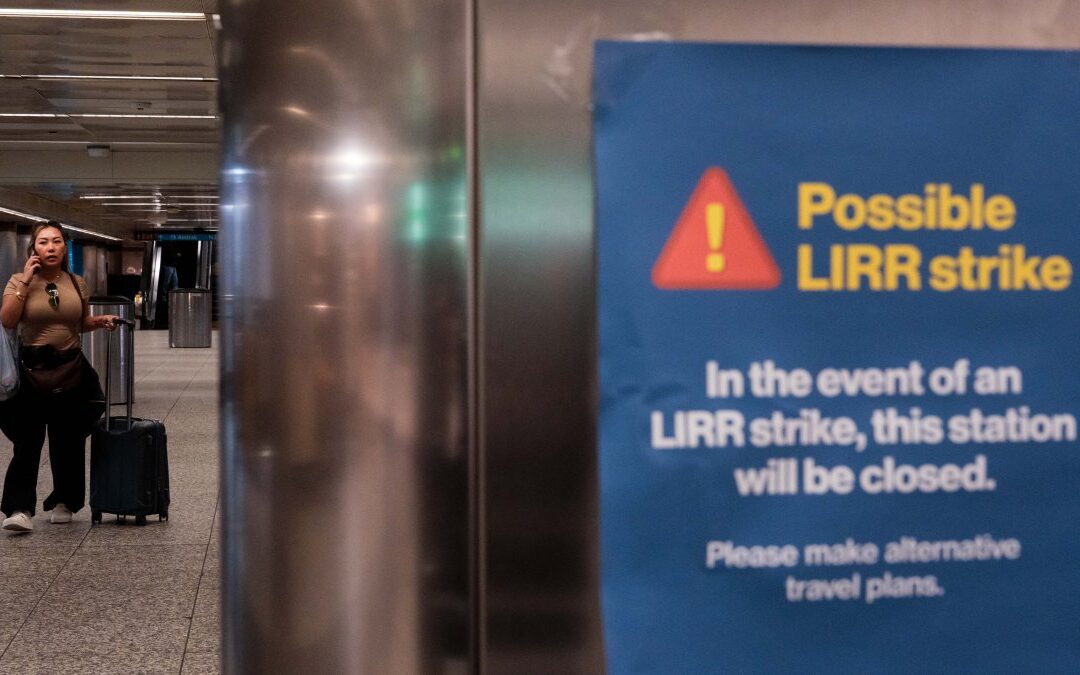
The MTA started messaging customers who use the Train Time app, encouraging them to complete all travel before midnight Saturday. Posters warning of a strike have been posted above Long Island roadways and at LIRR stations for much of the week.
Gov. Kathy Hochul has urged LIRR riders to work from home, if possible, as the free shuttles are meant for essential workers and those who cannot telecommute. The Democrat, months earlier, slammed the LIRR unions for “greedy asks” that threaten to “destabilize the local economy.”
Hochul called into the negotiations over the phone on Friday. According to a spokesperson, the governor said “getting a deal requires both sides to work together, including labor. Nobody wins in a strike – riders will suffer and thousands of workers will lose out on wages they need.”
The state comptroller’s office estimated that a strike would cost $61 million a day in economic impact, especially with Memorial Day weekend approaching.
The timing of the potential strike would also impact fans getting to and from weekend events like Bruce Springsteen at Madison Square Garden, or the Yankees-Mets Subway Series at Citi Field (both events are scheduled to end with some time to spare, but extra innings in the latter could complicate matters). It also could affect fans looking to watch the Knicks continue their playoff run at MSG.
While LIRR President Rob Free at a Friday press conference urged riders to make backup travel plans, there have been signs of progress in negotiations this week, even with just hours remaining until the deadline.
What are unions hoping to get?
Months ago, the MTA had proposed to the unions a 9.5% wage increase over three years, in line with what the system’s other unionized workers have already agreed to. The unions, however, held out for another yearly salary increase of 6.5%, for a total raise of 16% over four years.
But following Wednesday’s closed door meetings, Gary Dellaverson, the MTA’s chief negotiator, said the agency offered the unions what it said would effectively amount to a 4.5% raise in the fourth year of the contract. That offer, he said, was in line with what federal officials had recommended and would come in the form of lump sum payments rather than wage increases, as the union sought.
However, the union has remained steadfast in getting 5% in that fourth and final year.
“The difference between those two positions is not unbridgeable,” Dellaverson said in a news conference. “It is describable simply in terms of money. There are no longer any complexities involved with the parties.”
Kevin Sexton, a spokesperson for the unions, acknowledged earlier in the week that there was “positive movement” toward a settlement but dismissed the notion that a deal was close as “far-fetched.”
“We would like to reach an agreement that reflects the rising cost of living,” he said. “Anything short of that amounts to a cut in real wages.”


