
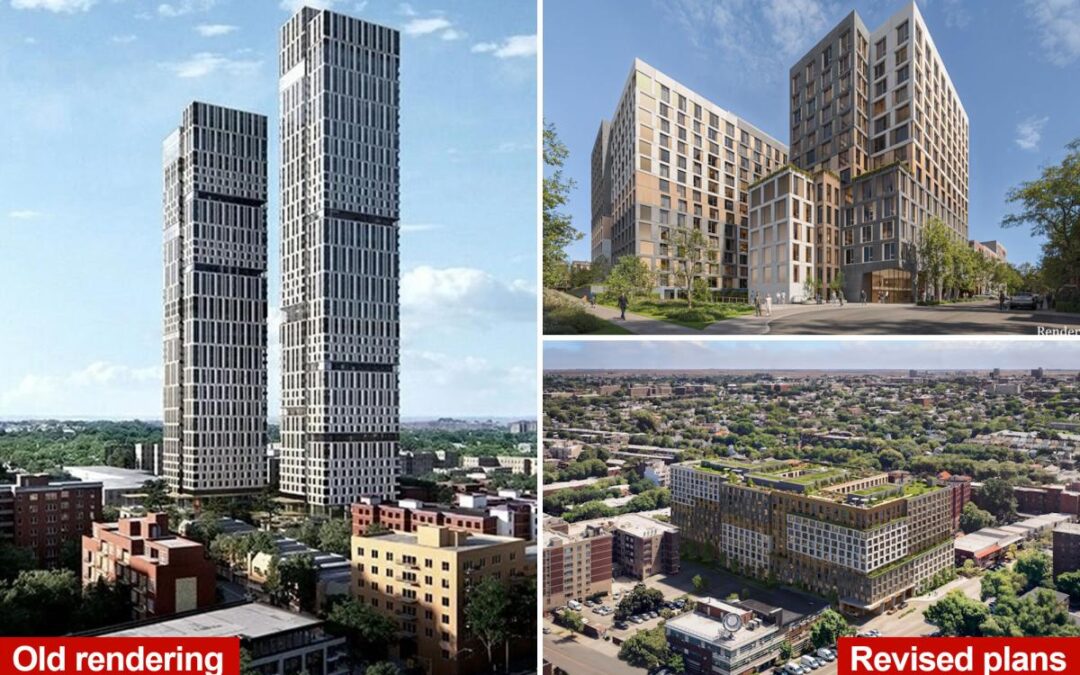
For years, developers pitched it as the project that would finally drag Central Queens into the skyscraper era. Now it barely rises above the surrounding rooftops.
A controversial proposal for two soaring residential towers in Kew Gardens Hills has been dramatically scaled back after years of neighborhood backlash, ballooning construction costs and growing pressure surrounding the project’s financing structure.
Marx Development Center’s planned development at 71-12 Park Ave., known as Utopia Living, was originally envisioned as a pair of towers reaching 50 and 42 stories tall. Early plans called for roughly 1.28 million square feet, 850 apartments, luxury-style amenities, landscaped plazas, executive office space and private shuttle service to nearby subway stations.
The latest redesign unveiled this month looks nothing like the original pitch.
Instead of skyline-defining towers, the project has been reduced to a single 13-story residential building totaling roughly 784,000 square feet with about 800 rental units.
The apartment count barely changed, but the ambition did.
The downsizing underscores the brutal financial reality now reshaping major development projects across New York City, where developers are increasingly abandoning glass supertowers in favor of cheaper, lower-rise construction that is faster and less risky to build.
Construction costs in New York remain among the highest anywhere in the world. Industry estimates now place many high-rise residential projects well above $500 per square foot before financing costs are even fully factored in. Steel prices have surged since the pandemic, labor expenses continue climbing across unionized trades and insurance premiums have become one of the most painful pressure points for developers.
New York’s controversial Scaffold Law, which places broad liability on contractors and property owners for gravity-related construction injuries, has also driven insurance costs sharply higher over the last decade.
At the same time, high interest rates have made large-scale borrowing dramatically more expensive, especially for projects requiring years of construction before apartments can begin generating revenue.
And skyscrapers are uniquely expensive to build.
High-rise towers require deeper foundations, more complex structural systems, larger elevator cores, sophisticated fire suppression systems and significantly more steel and concrete than mid-rise buildings. Research from the Brookings Institution has found that high-rise concrete construction can cost substantially more per square foot than mid-rise structures.
That math increasingly matters in Queens.
When renderings of the original towers surfaced last fall, local opposition erupted almost immediately in Kew Gardens Hills, a largely low-rise residential neighborhood dominated by modest apartment buildings and suburban-style side streets.
Residents argued the towers would overwhelm local infrastructure, worsen congestion and fundamentally alter the character of the area.
“It will be a disaster,” local Jewish leader and community board member Sorolle Idels told the Queens Eagle in 2024. “It’s a congested area, making it unbelievably more congested…This is a big fat mess.”
The anger intensified because the project qualified as an as-of-right development under existing zoning rules, allowing the developer to avoid the lengthy rezoning and public review process that normally accompanies projects of that scale.
To many locals, the towers appeared to materialize without meaningful input.
“This absolutely went under the radar with no input from the community board or the community,” Idels said. “No one discussed it with anybody, and that’s not right. How do you build a skyscraper and not get the community input?”
The proposed towers would have risen roughly 572 feet between Parsons Boulevard and Park Avenue, towering above nearby two- and three-story buildings and directly adjacent to an assisted living facility, office buildings and the NYPD’s 107th Precinct.
As preliminary site work moved forward, tensions escalated further.
Department of Buildings records show multiple complaints from neighbors who alleged nearby homes shook during excavation work.
“Excavation is causing the entire building to shake like an earthquake,” one complaint filed with the city stated. “In our apartment we feel shaking, pictures are falling off the wall and cracks are appearing around the windows, air conditioning and walls.”
Political pressure soon followed.
City Councilmember Jim Gennaro publicly signaled he intended to push the developer to address neighborhood concerns before the project advanced further.
“My job is to bring the community and the developer together to work out common sense accommodations, common sense mitigations, work on people’s concerns and expect some consideration and some acquiescence to the community’s concern,” Gennaro told the Eagle.
“I think it’s in the developer’s best interest to be neighborly and be attentive to community concerns,” he added. “Nothing has been approved by the DOB as of this date, but we’re not going to wait. We’re going to get out there and we’re going to mix it up.”
The project also faced criticism because it relied on the EB-5 immigrant investor program, a federal visa initiative that grants permanent residency to foreign nationals who invest in American development projects.
For decades, EB-5 financing has served as a major funding source for large New York real estate projects, particularly luxury developments that struggled to secure traditional financing. But the program has also generated backlash from critics who argue it primarily benefits wealthy developers while offering little direct value to surrounding communities.
In Kew Gardens Hills, some residents viewed the use of EB-5 financing as symbolic of a project driven more by outside capital than neighborhood demand.
The towers were being developed through Manhattan Regional Center, an EB-5 entity tied to Marx Development Group itself.
Now the project’s revised design reflects a far more cautious approach.
New renderings show a bulky mid-rise complex wrapped around a central courtyard with rooftop terraces and green space instead of two reflective skyscrapers dominating the skyline. The redesigned development will still include amenities such as a fitness center, a swimming pool, an underground parking garage, bike storage and outdoor lounge areas, but the scale has been dramatically reduced.
Plans call for 61 studios, 378 one-bedroom apartments and 361 two-bedroom units.
The Post has reached out to Marx Development for comment.

