
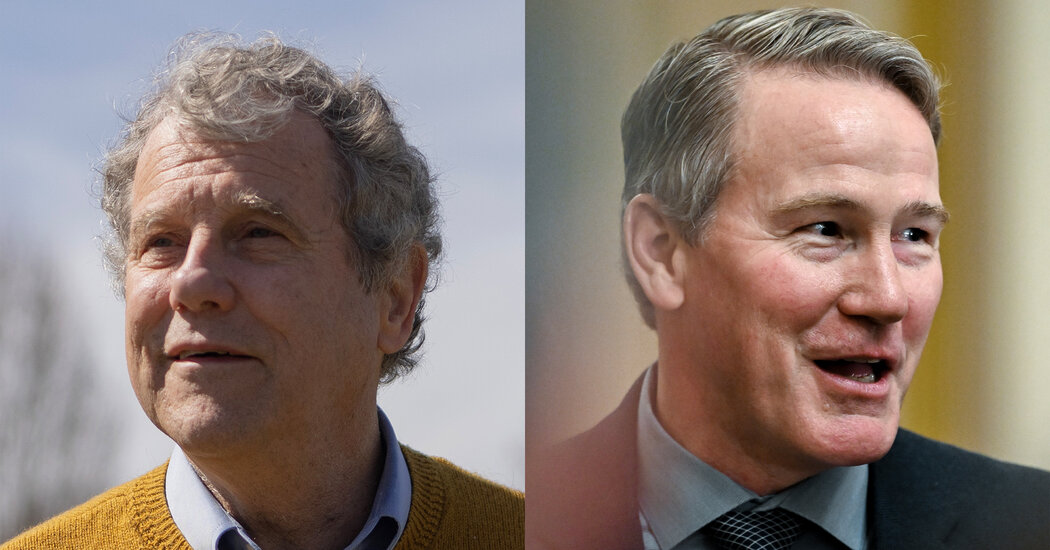
One of this year’s top Senate contests is something of a bizarro-world race.
The Republican candidate, despite being the incumbent, is little known and still trying to introduce himself to voters. He used his first ad to talk about starting his life in a foster home.
The Democratic candidate, despite being out of office, is a household name after spending half a century in politics. His first ad was very different — a scathing attack aiming to define his rival by tying him to Jeffrey Epstein, the disgraced financier.
This is the upside-down picture in Ohio, where Senator Jon Husted, a Republican appointed last year to replace Vice President JD Vance, is hoping to fend off former Senator Sherrod Brown, a three-term Democrat who was unseated in 2024.
The race is central to determining which party controls the Senate in 2027. Democrats need to flip at least four Republican-held seats in November, and Ohio is widely seen as one of the most competitive contests.
The election is a test of how far even a Republican-dominated state has swung left during President Trump’s second term and of whether Mr. Brown, as he has done in the past, can outperform his party in a state where Democrats have been trounced in the last three presidential elections.
Now, as the general election begins — Mr. Brown faces only token opposition in the primary contest on Tuesday and Mr. Husted is unopposed — both sides are beginning an advertising war expected to exceed the $550 million spent on Ohio’s 2024 Senate race. The winner will serve the final two years of Mr. Vance’s term and then face re-election again in 2028.
Mr. Brown’s opening salvo last week sought to capitalize on Mr. Husted’s relatively low profile by highlighting $116,000 in campaign contributions he received in the past from Leslie Wexner, an Ohio billionaire who was the source of much of Mr. Epstein’s wealth. The ad was an attempt to both depress Republican turnout and hammer Mr. Husted as tied to corruption in Washington and Columbus, Ohio’s capital.
“Of all 535 members of Congress, who’s taken the most money from associates of Jeffrey Epstein?” the narrator asks in Mr. Brown’s first TV ad, which began airing on Friday. “Jon Husted, that’s who.”
Mr. Husted’s campaign manager, Drew Thompson, argued that Mr. Brown had Epstein ties, too, pointing to his past acceptance of campaign donations from Mr. Wexner’s wife — $12,700 in increments between 2011 and 2017.
“Who knows what that paid for?” Mr. Thompson said. “That’s why Ohioans voted him out after 32 years in Washington.”
National party leaders are watching the Ohio race closely.
Senator Chuck Schumer of New York, the Democratic minority leader, spent months urging Mr. Brown, 73, to attempt a comeback. Part of Mr. Schumer’s appeal to Mr. Brown was that he was the only Ohio Democrat who could win in an increasingly red state.
Mr. Trump carried Ohio by 11 percentage points in 2024 as Mr. Brown lost by three points, a gap that has encouraged Democrats to think that a better political environment will help the famously rumpled senator return to Washington.
The Ohio Senate race is expected to be one of the nation’s most expensive contests.
The main super PAC for Senate Republicans, the Senate Leadership Fund, has already earmarked at least $79 million for television and digital advertising, mail and get-out-the-vote efforts. Its Democratic counterpart, Senate Majority PAC, will reserve about $40 million just on television advertising, according to a spokeswoman, Lauren French.
“Sherrod is doing it because he knows he’s probably the only one who can prevail,” said Aaron Pickrell, a Columbus-based Democratic strategist who ran the Ohio re-election campaign for President Barack Obama in 2012, the last time the state was truly a presidential battleground. “A lot of people don’t think we can win. To have Sherrod run ensures that there’s a level of resources commitment.”
Though he has been in office since the turn of the millennium, Mr. Husted has rarely been in a hard-fought general election.
He served for years in the State House representing a Republican-leaning district near Dayton, where he attended college and was a cornerback on a national championship football team. He became speaker of the Ohio House and briefly served in the State Senate before coasting to victory in statewide campaigns for secretary of state. Then he became the running mate and lieutenant governor to Gov. Mike DeWine, who appointed him to replace Mr. Vance last year.
Now Mr. Husted is a sitting senator who lacks the usual advantages of incumbency in a year when an unpopular Mr. Trump is forecast to be a drag on all Republicans. He has long presented himself as a business-friendly Republican in the style of Mr. DeWine and former Gov. John Kasich of Ohio, though since entering the Senate he has adopted a more Trump-friendly demeanor.
Mr. Brown, on the other hand, is a challenger with 50 years in elected office at a time when Democrats across the country are looking for fresh faces.
“The only challenge for Sherrod is that he’s an older guy,” said Nan Whaley, a former mayor of Dayton, Ohio, who was the Democratic nominee for governor in 2022. But she added: “In Ohio, that’s handy. Our voters are older here in Ohio.”
Ohio Republicans expect to paint Mr. Brown, long an economic populist, as a left-winger out of touch with normal Americans.
“This is not J.F.K.’s Democrat Party,” said former Representative Brad Wenstrup of Ohio, a Republican who spent a dozen years in Congress. “It’s pretty far left.”
If Mr. Husted is known for anything in Ohio, it is for being placed in the awkward position of having to testify for the defense in a major corruption trial involving top energy executives in the state. Mr. Husted already testified once in a related case that resulted in a mistrial. He is expected to be called to testify again in October — timing that Ohio Democrats hope will lead to a pre-election news cycle that will lift Mr. Brown’s chances in November.
Available polling suggests that the race is either a dead heat or that Mr. Husted is narrowly ahead, but even in conservative Ohio, the political environment is shifting against Republicans.
“I tell everybody I think every Republican is going to have a tough time because you’re running into a headwind,” said former Representative Jim Renacci, an Ohio Republican who lost a Senate race to Mr. Brown in 2018. “It’s almost a match of where I was in 2018.”

