
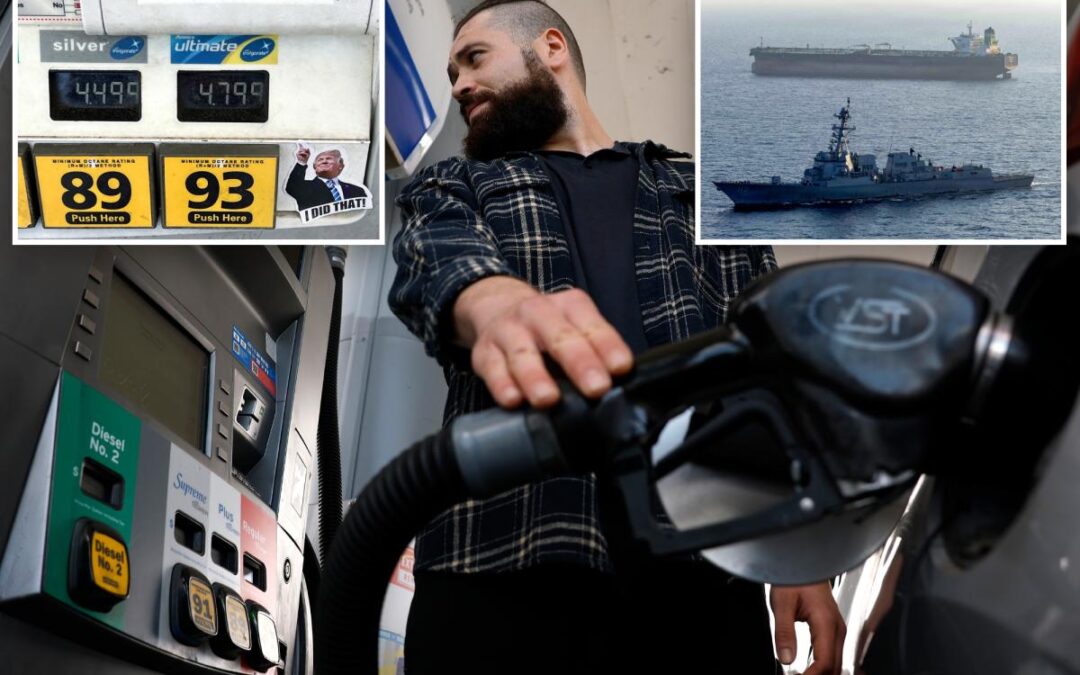
Researchers say Americans have shelled out nearly $45 billion in extra fuel costs since the US and Israel launched their war on Iran in late February — and drivers are now staring down the barrel of $5-a-gallon gasoline heading into Memorial Day weekend.
A Brown University tracker estimating the consumer impact of the conflict pegged the added burden on Americans at $44.9 billion as of Friday, reflecting soaring gas and diesel prices triggered by the disruption of global oil supplies and the blockade of the Strait of Hormuz.
At the same time, the national average for regular gasoline climbed to $4.55 a gallon on Friday — up more than 50% since the war began on Feb. 28 and the highest pre-Memorial Day price since 2022, according to CNBC.
Analysts warn the worst may still lie ahead.
GasBuddy petroleum analyst Patrick De Haan told CNBC that gasoline could surge past $5 a gallon sometime in June if shipping through the Strait of Hormuz remains frozen.
The mounting fuel costs have become one of the clearest economic consequences of the widening Middle East conflict.
Brown University’s “Iran War Energy Cost Tracker” estimates Americans have spent about $24.97 billion extra on gasoline alone since the fighting erupted, while diesel accounts for another roughly $19.85 billion in higher costs.
The surge has been driven largely by turmoil surrounding the Strait of Hormuz — the narrow Persian Gulf shipping lane through which a massive share of the world’s crude oil supply flowed prior to the war.
Iran’s blockade and repeated attacks on regional energy infrastructure have rattled global markets and sent crude oil prices soaring more than 40% above pre-war levels.
As crude prices jumped, the pain rapidly spread to US consumers filling up their cars and trucks.
The national average for gasoline briefly touched levels not seen since July 2022 this week before easing slightly when President Trump signaled potential diplomatic progress with Tehran.
But traders and energy analysts remain skeptical that any breakthrough is imminent.
“The president implies that there’s a lot of progress, but I don’t know how many more head fakes we’re going to see,” De Haan told CNBC.
Diesel prices have surged even faster than gasoline, with some experts warning diesel could soon top $6 or even $7 a gallon as Europe and Asia scramble to replace lost Middle Eastern fuel supplies with American exports.
Unlike gasoline, soaring diesel costs often ripple through the entire economy because trucking, shipping and industrial sectors rely heavily on the fuel.
“I think the $44 billion figure probably understates the real impact because consumers are paying for this well beyond the gas station,” Scott Martin, a partner at Kingsview Wealth Management, told The Post.
“When diesel and fuel costs jump this quickly, it raises transportation and shipping costs across the board, and eventually that works its way into grocery prices, retail goods, airfare, deliveries — pretty much everything tied to moving products around the economy.”
Martin said consumers are particularly vulnerable because many households are already stretched by debt and lingering inflation.
“A lot of households are carrying higher credit card balances, paying more on mortgages and auto loans, and still dealing with lingering inflation from the last few years,” the expert said.
“The longer fuel stays elevated, the bigger the risk that this starts affecting consumer behavior more broadly,” he added.
“At some point people cut back on discretionary spending, travel less, or delay purchases, and that’s when it can start weighing on economic growth overall.”
The Post has sought comment from the White House.


