
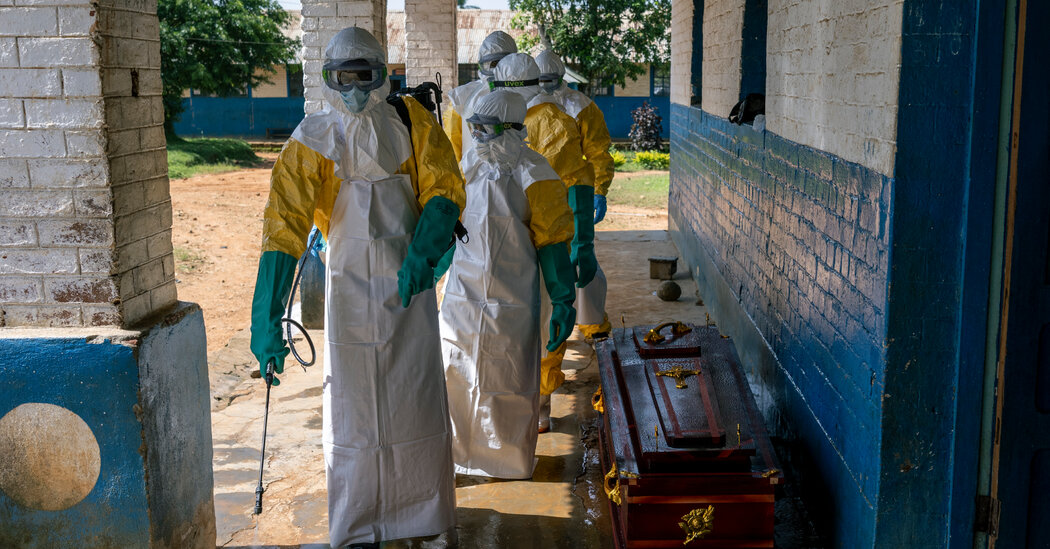
As the Ebola outbreak spreads in the Democratic Republic of Congo and Uganda, health workers are rushing to provide supportive care, hoping that some patients will recover on their own, while isolating the sick and tracing contacts of the infected.
Missing from the fight? Vaccines and drugs that might stop the virus. Dismayed by the scale of the burgeoning epidemic, scientists are scrambling to find them.
On Monday, two major nonprofit vaccine organizations announced tens of millions of dollars of funding to develop vaccines. Experts from the World Health Organization have also recommended testing a handful of monoclonal antibodies and other drugs as potential treatments.
Researchers said that it would take months find out whether these measures work. But the treatments will probably still be valuable at that point, because the outbreak is likely to continue raging.
“It’s going to take a long, committed response to bring this outbreak under control,” said Richard Hatchett, the chief executive of CEPI, a nonprofit that supports the development of vaccines and other pandemic countermeasures.
One reason that Ebola disease is so hard to fight is that it is not caused by a single kind of virus. When scientists refer to “Ebola virus,” they mean a species first discovered in 1976, in what was then Zaire.
Since then, researchers have identified five other species of viruses in the same genus, including one called Bundibugyo virus.
Like Ebola virus, Bundibugyo virus causes Ebola disease — producing symptoms such as sudden fevers, muscle pain and vomiting. The infection can lead to uncontrolled bleeding and rapid organ failure, killing a substantial fraction of patients.
Bundibugyo virus is responsible for the current outbreak of Ebola disease. Before now, it had caused only two small outbreaks since its emergence in 2007.
Most of the outbreaks of Ebola disease over the last 50 years have been caused by Ebola virus. As a result, there are two licensed treatments and one vaccine specifically for it, and nothing specifically for Bundibugyo virus.
These two species of viruses split from a common ancestor long ago — probably millions of years ago — and have been evolving in different directions ever since.
So maybe it’s no surprise that doctors were confused when patients started coming to clinics in Africa with symptoms of Ebola in April. Diagnostic tests were designed to recognize genetic sequences from the more common Ebola virus. Doctors are just now gaining access to tests that can detect Bundibugyo.
Evolution has altered the molecules, known as glycoproteins, that stud the surfaces of these two viruses. Both species use glycoproteins to latch onto cells and slip inside.
When people become infected with either virus, their immune systems start making antibodies that stick to these glycoproteins and block the viruses from infecting cells. If this immune response is strong enough, people can recover from Ebola disease.
To make a vaccine, scientists looked for a way to train the immune system to make those antibodies. Erbevo, the licensed vaccine, consists of a harmless virus, known as VSV, engineered to carry Ebola virus glycoproteins that prompt the production of protective antibodies. In 2014 trials, the vaccine provided 100 percent protection against Ebola virus.
But experts doubt that it will provide strong protection against the Bundibugyo virus. About a third of the building blocks in Bundibugyo glycoproteins differ from those carried by Ebola virus.
“It’s just different enough on the surface that your immune system finds it to be a different thing,” said Erica Ollmann Saphire, a virologist at the La Jolla Institute for Immunology in San Diego.
To halt the current outbreak, doctors would need to give people a vaccine proven to work specifically against Bundibugyo virus. That doesn’t yet exist, even though scientists have been researching the species since it was first discovered.
That’s the gap that CEPI is hoping to help fill. The group will offer up to $61 million to prepare three candidate vaccines for clinical trials.
IAVI, a nonprofit organization that develops vaccines, will receive up to $3.2 million for a VSV-based vaccine. The group already has experience in creating these vaccines for other viruses, including Sudan virus, another species that has caused Ebola disease.
Another reason to try this approach is a 2014 study in which scientists tried out a VSV vaccine against Bundibugyo virus on monkeys. It provided 100 percent protection.
While VSV vaccines have a long track record, they have a downside: Scientists have to grow the carrier viruses to make the vaccines, a process that can take several months.
A second vaccine is being developed at the University of Oxford, based on a different viral vector called an adenovirus. In 2020, the Oxford team used these adenoviruses to create a Covid vaccine manufactured by AstraZeneca, which is estimated to have saved over six million lives in the first year of their use.
The researchers have made vaccines for other pathogens, including Sudan virus. “In essence, we are building on what we have done before,” said Teresa Lambe, who is leading the Bundibugyo effort.
CEPI has awarded Dr. Lambe’s team up to $8.6 million to develop an adenovirus vaccine carrying Bundibugyo glycoproteins. The vaccine is already being manufactured by the Serum Institute of India.
Thanks to the institute’s manufacturing capacity and the speed at which adenoviruses grow, the researchers say they could have vaccines ready for clinical trials in humans in one to two months.
But the Oxford researchers have never tested an adenovirus vaccine against Bundibugyo virus in animals before. So they’ll also have to carry out those studies in the months to come.
CEPI is also awarding up to $50 million to Boston-based Moderna to create an mRNA vaccine for Bundibugyo. Moderna produced one of the two authorized mRNA vaccines for Covid during the pandemic.
The company has investigated mRNA vaccines for a wide variety of other diseases. In 2018, Alexander Bukreyev, a virologist at the University of Texas, and his colleagues reported that a Moderna mRNA vaccine provided guinea pigs with 100 percent protection from Ebola virus.
Moderna’s mRNA vaccines deliver instructions to our own cells to make proteins that cause the immune system to produce antibodies. To make a vaccine for the current outbreak, scientists are creating new mRNA molecules that will lead to the production of Budingbugyo glycoproteins.
Like adenovirus vaccines, mRNA vaccines can be produced quickly. CEPI will support Moderna’s manufacturing of enough doses for a large-scale clinical trial, should it prove safe in smaller studies. “In terms of rapid development of a real countermeasure, this is the best step CEPI could take,” Dr. Bukreyev said.
Gavi, another vaccine nonprofit, also announced on Friday that it would provide $40 million to support the manufacture of leading Bundibugyo vaccine candidates.
There is already an effective treatment for people battling infections of Ebola virus. Doctors can inject high doses of especially potent types of antibodies, known as monoclonal antibodies.
As it turns out, some of those monoclonal antibodies can also cling to the glycoproteins on Bundibugyo viruses. On Thursday, a panel of experts convened by the W.H.O. recommended that two monoclonal antibodies go into clinical trials.
One, called maftimivab, is part of a three-antibody cocktail manufactured by Regeneron. The other, MBP-134, is an experimental drug developed by the San Diego-based company Mapp Bio.
In 2017, researchers discovered a pair of antibodies from survivors of an outbreak of the Ebola virus. Remarkably, these antibodies can also bind tightly to glycoproteins on Bundibugyo and on Sudan virus.
The researchers then went on to test MBP-134 in animals. It cured mice and guinea pigs of lethal infections of Ebola virus. That success led to a preliminary clinical trials that demonstrated that the antibodies are safe for people to receive.
But Mapp Bio has yet to run studies to show that MPB-134 cures animals, let alone people, of Bundibugyo virus.
Dr. James Crowe, a virologist at Vanderbilt University Medical Center who has developed monoclonal antibodies against Covid and other diseases, questioned the decision to focus on these particular treatments. “I don’t think they’re ideal,” he said.
Dr. Crowe and his colleagues found extremely potent antibodies in blood samples from survivors of the first Bundibugyo outbreak in 2007. In a 2018 study, the scientists found that injecting the antibodies into monkeys provided them with 100 percent protection against the virus.
But Dr. Crowe has not been able to get funding to move the antibodies forward to the point that they could go into clinical trials. “I’ve fielded a lot of calls, but nobody has licensed them,” he said.
The world would be better prepared for outbreaks of pathogens like Bundibugyo if scientists could push forward research when there isn’t a public health emergency raging, Dr. Saphire said.
And rather than try to make vaccines and drugs that work only against the pathogen that’s suddenly killing people, researchers could look for treatments that are effective against many related species.
“It’s straightforward to do,” she said. “It just takes leadership, will, and the funding to do clinical studies.”


