
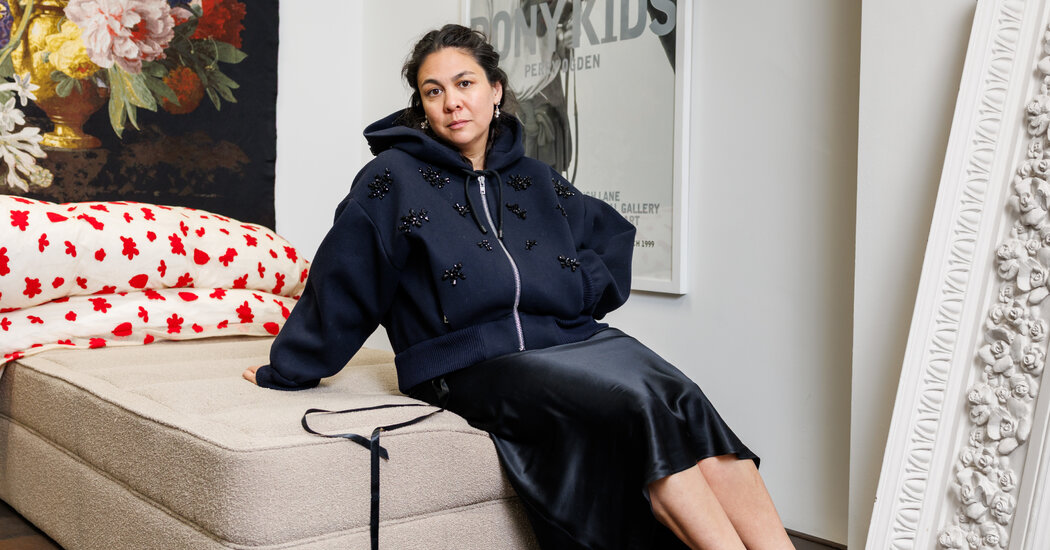
As a designer of women’s clothing for 15 years, Simone Rocha has been committed to presenting a version of womanhood that subverts traditional feminine tropes, a practice she calls “pretty and perverse.”
But as the culture reaches its peak “masculinity crisis” moment, Rocha, 39, is now turning more of her attention to men’s wear — focusing more on men’s softer side.
“When I started thinking about the men’s very seriously, I wanted it to feel grounded but also quite tender,” Rocha said.
Rocha has been designing men’s clothing since 2022, though until now, they have mostly served as counterpart to the women’s collections. Recently, Rocha has seized an opportunity to build it up and give it its own space.
This week, she will present her first solo men’s show at Pitti Immagine Uomo, the biannual Italian trade show for men’s clothing. Her participation at Pitti Uomo, where she was named guest designer earlier this year, follows other celebrated designers like Giorgio Armani and Vivienne Westwood, as well as men’s wear heavyweights like Virgil Abloh and Grace Wales Bonner.
At a runway show staged at Teatro della Pergola in Florence on Thursday, Rocha’s take on masculinity came into focus. Her work often brings a sense of délicatesse to sharp tailoring and evokes naïveté through rugby jerseys. The collection, a confection of lace, nappa leather and satin, is inspired by one of Rocha’s favorite films, “A Room With a View,” and the journey it depicts from the British Isles to Florence.
Will men bite?
They have in the past: Simone Rocha found early adopters for her men’s wear before the label even had an official line, according to Isla Lynch, a buying director at Ssense. Now, Rocha’s ever-widening array of male fans come from the world of sports (Tyrese Haliburton and James Harden), film and theater (Jonathan Groff, Paul Mescal, Josh O’Connor and Andrew Scott), music (Bad Bunny), art (Antwaun Sargent and Quil Lemons) and media (Blake Abbie).
“I think this is what masculinity always was and was never able to break free of because there was such a hypermasculine narrative globally, and, like, expectations of what men should be instead of what they actually are,” said Lemons, an artist and photographer based in New York. “And I think Simone is tapping into that.”
The Family Business
From age 13, Rocha was learning to crochet and screenprint, and helping her father, John Rocha, the renowned designer, by bagging up clothing or assisting with castings and fittings for his runway shows. The elder Rocha, now retired from working on his own brand, was once a mainstay on the London and Paris Fashion Week calendars, and operated his business out of Dublin. There, Simone began to experiment with upcycling garments from the discarded rail.
Despite her lifelong passion for clothing, Rocha initially resisted following in her father’s footsteps. She enrolled at the National College of Art and Design in Dublin to study fine art, but struggled when she realized that “what was in my head, it was just not on the page.” She switched to the language she knew best: fashion.
Her father, though ultimately encouraging, had some reservations.
“It’s not an easy business, you know,” said John Rocha, who oversees business and strategy at Simone Rocha, working alongside his partner and Rocha’s mother, Odette, who oversees retail and wholesale. “You have a calendar that is quite antisocial season after season. But it’s something she loved.”
Her father suggested she further her studies in London, so Rocha pursued a master’s degree at Central Saint Martins. There, she studied under Louise Wilson, who worked “so hard to bring out the best in you and really try to prepare you for a very difficult gig,” Rocha said.
Moving to London proved to be a smart move. It was there that her design sensibility began to take shape.
“I always found it quite powerful as a woman to be able to take up space and not have to shout about it,” she said. “That’s why a lot of my collections, especially at the start of my career, had a huge amount of volume.”
Simone’s World
Rocha’s designs are often rooted her in personal experience. In 2021, she released a collection called Baby Teeth, which made reference to her pregnancy with her second daughter and included dresses inspired by traditional christening gowns, nursing bras and pearl earrings in the shape of baby teeth. Despite their specificity, these designs resonated with her shoppers, including men.
“Simone’s world is incredibly defined and very clear to her and I think very clear to those of us who are admirers of her work,” said Abbie, an actor and the editor of A Magazine Curated By. “She makes clothing that kind of works on many different body shapes and body types, even when it’s a sample size.”
Rocha’s design perspective also impressed Adrian Joffe, the president of the multibrand retailer Dover Street Market, which began carrying Rocha’s designs at its boutiques, where the brand sat alongside Comme des Garçons, Rick Owens and Maison Margiela. “It’s hard to find true authenticity these days,” Joffe said.
The partnership with Dover Street Market helped introduce Simone Rocha to new markets including in Asia and the United States, where the brand also owns its own stores.
The concerted effort to focus on men’s wear, which includes joining the men’s fashion calendar and staging the collection for sales during Paris Fashion Week, is also a business decision. Rocha sees it as a way to reach new customers who may have been intimidated by the brand’s initial offering and to better serve the men who were already her consumers.
That Rocha’s feminine take on men’s wear, which makes up 30 percent of the business, has found a strong consumer base flies in the face of the masculinist surge exemplified by figures like Mark Zuckerberg, who trains in mixed martial arts; President Trump, who recently hosted a bloody UFC fight on the White House lawn; and members of the manosphere, who discuss He-Man workout routines at length and dress in tight black T-shirts to show off their biceps.
“She sort of has this idea of pageantry that is super sophisticated and in a way that I’ve just never seen before,” said Sargent, a director at Gagosian who frequently wears Rocha’s designs, including a button-down shirt with pearl details at the collar. “I love a designer who is independent in their thinking and who is creating their own understanding of what fashion is, and what it can be.”
Even as Rocha builds out her profitable, independent business with a fuller men’s assortment, she still feels as though many in the industry see her as an “emerging designer.”
“I don’t feel as young as I used to. It’s been brilliant to build a business that feels organic to me, but can really stand on its own two feet now,” Rocha said. “That’s what’s so great about fashion. There’s opportunity for younger designers to come up and have that opportunity.”


