
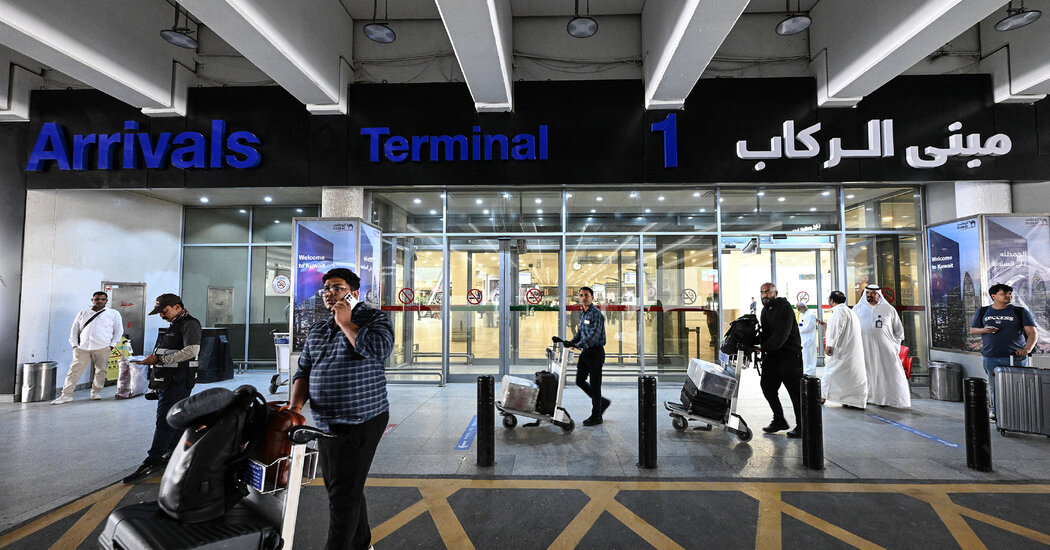
Iranian forces targeted Kuwait’s primary airport with a wave of attack drones that killed one person and injured more than 60 others, including passengers and airport workers, Kuwaiti authorities said on Wednesday.
The attack also closed a terminal that had only just reopened, the latest example of the war in the Middle East upending aviation.
Kuwait’s military said Iranian drones inflicted material damage to Terminal 1 of the Kuwait International Airport complex, which has recently hosted the Kuwaiti and U.S. air forces as well as being a civilian transportation hub.
In a statement on Wednesday, Kuwaiti health officials said the Iranian attack had turned the airport into a major emergency scene, with over 25 ambulances attending and doctors performing at least seven emergency surgeries. Video footage verified by The New York Times showed the interior of the terminal building filling with flames and smoke.
The terminal, which was hit at the end of the busy travel period over Eid al-Adha, had reopened to travelers on Monday after being closed for months because of the conflict. On Wednesday, officials said that a different terminal would reopen to passengers.
The Kuwaiti airport, which was also struck by drones earlier in the war, is one of many civilian airports to be hit and disrupted, including some that have also hosted military bases.
In Iraq, Iran struck military bases at Erbil International Airport in February and March. The airport also hosts U.S. forces, according to an analysis of visual evidence at the beginning of the war.
In the months since, civilian airports in the region have been struck by missiles and drones, including Baghdad International Airport in Iraq and Bahrain’s International Airport.
In the United Arab Emirates, the Dubai International Airport and Abu Dhabi’s Zayed International Airport have also been struck.
And Tehran’s Mehrabad Airport, Iran’s primary international hub, came under fire by Israeli strikes in March, according to Iranian state media.
The conflict has caused havoc for passengers traveling through the Gulf region, forcing airlines to significantly cut their schedules and suspend certain routes. They have also hiked prices to account for the rising cost of jet fuel resulting from the closure of the vital Strait of Hormuz shipping route.
On Tuesday, British Airways extended a pause of all flights to Dubai, Tel Aviv, Bahrain and Amman until Oct. 25.

