
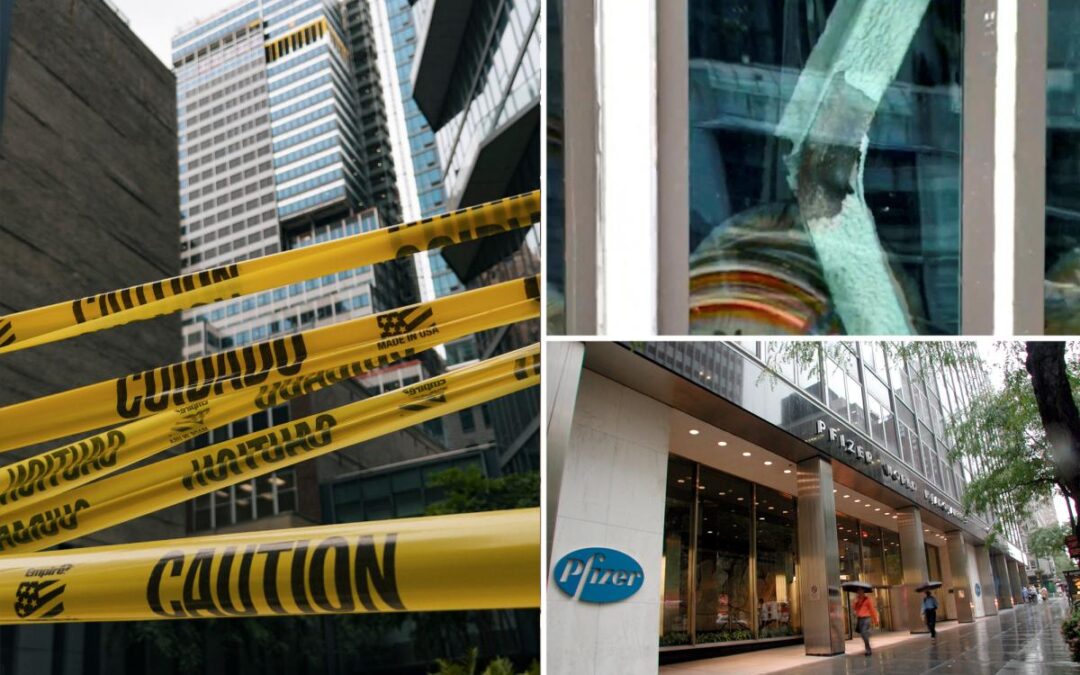
The Midtown high-rise that dangerously buckled Tuesday will need to be partially demolished — although stabilizing it to even attempt the risky move could prove extremely harrowing, experts told The Post.
The 37-story former Pfizer headquarters at 235 E. 42nd St. near Second Avenue will first need to be stabilized as soon as possible to prevent a possible localized collapse, they said.
Without intervention, it poses a “significant danger” and “could collapse,” said Ronald Hamburger, a structural engineer with five decades of experience and who served on the federal team that investigated the World Trade Center catastrophe.
He noted that the under-construction building’s buckled columns on several of its floors are now only holding about a third of the load they were designed for — leaving the intact other beams and columns “highly stressed.”
Engineers will need to install brackets on the columns in the floor below the failed columns to re-level the structure and ease the load on the intact infrastructure, he said.
Workers also will have to replace the failed columns — though the stabilization can only be done after experts assess the safety of the building, as well as the design of the new columns.
“It should be done rapidly, it can’t be done immediately,” he said. “Engineers are going to need to go in and assess just how far the damage has progressed.
“It should be possible to do the repair within a week, stabilizing it, then going about the structural repair,’’ he said.
But Emily Guglielmo, a structural engineer and principal at Martin/Martin, noted that even getting engineers inside the building for stabilization will prove to be a risky effort.
“If it’s possible, in order to limit further evacuation life safety concerns, the quickest fix is to try to get that temporary bracing and shoring in there,” she said, adding it will be a “balancing act” of whether personnel can safely get inside to put supports in “or it’s just too risky of a situation.”
Structural engineers will determine if the building is safe to enter by inspecting the conditions compared to the original drawings to understand how the building was constructed — and determine what, if anything, crews might have done to trigger the destabilization, experts said.
Both experts noted that the building will “definitely” require at least a partial demolition before a rebuild can start.
“The images we have seen show … a buckled column, you can see cracking, you can see floors that are sagging, those generally are damage that is not reversible,” Guglielmo explained.
“It’s not like we can just push a cracked floor up and it can maintain its capacity, so there will absolutely be removal and replacement of some of these elements.”
The high-rise commercial-to-residential conversion — slated to be currently the largest of its kind in New York City with about 1,600 units — was cleared of hardhats Tuesday when panicked construction workers spotted two faulty support beams bending and starting to give way on its 21st and 22nd floors, according to the NYPD and FDNY.
Nine city blocks were quickly cleared and locked in a “frozen zone” amid the drama.
Only construction workers were in the building at the time and made it out of the building safely, and no injuries were reported.
Tuesday’s scare wasn’t the first time the tower was flagged for safety issues, according to a Post review of Department of Buildings records, 311 complaints and a slew of lawsuits filed by former workers.
The construction site was issued seven violations between July and December 2025, resulting in a total of more than $32,000 in fines, agency records show.
“This raises some flags,” Hamburger said when asked about the violations.
The instability issue found Tuesday appeared to stem from ongoing construction involving the addition of 11 floors to the building, sources told The Post.
“There’s a couple of credible scenarios,” Hamburger said of the cause for the destabilization, including potentially overloaded columns from an unanticipated load placed somewhere above the 21st floor.
Another scenario involves construction crews damaging or removing vital components of the building that were providing support to the columns that buckled.
“It’s hard to diagnose at this point in time, but it’s very likely that there were heavier loads placed on this column than it was anticipated to support,” Guglielmo said. “It’s likely that potentially the incorrect member size is there, whether by design or construction.
“Oftentimes when something as catastrophic as this happens, it’s a combination of a variety of factors,” she continued.
“Sometimes it doesn’t show itself immediately. It’s only when enough of the building has gone up, or enough loads have been added.”


