
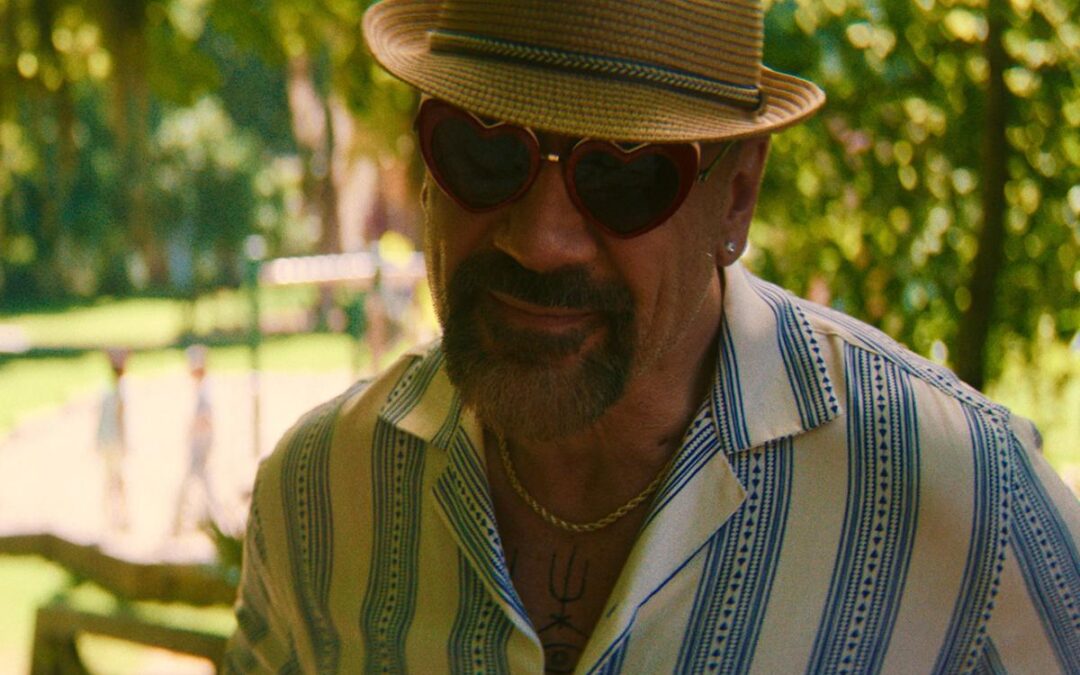
Cape Fear is overripe. Its colors are too rich — and rewardingly so. The skin tones glowing pink to the point of redness, the foliage so green it looks like something might descend from the canopy to eat you, the air itself seemingly tinted aquamarine, as though you could as soon swim in it as walk through it, like the humid air of a late summer afternoon before an evening storm. When Max prays in front of his Santería altar at home, his face is so red he looks like he’s inside one of the candles.

A lurid show in terms of its color palette, Cape Fear follows suit with its subject matter. Putting the plot aside for a moment: As a practical matter, this show is about — let’s not kid ourselves here, we’re all adults — the tremendous sexual charisma of Javier Bardem, despite (or maybe because of) the fact that he’s playing a cackling psychopath. When his dapper Max Cady plants a surprise kiss on Anna Bowden in the middle of a park, you can tell she’s feeling a lot of ways about it; “Ewww” is not one of them. Nor does it appear to be the first time their lips have met, either. Amy Adams makes Anna look like she’s ready to vibrate out of her skin as she walks away; I half expected her to rub one out in the parking lot before she drove home.
The kavorka doesn’t fall far from the tree, apparently. At the end of the episode, Anna’s P.I. buddy Ray reveals that Nevaeh Valentine, the teenager currently making time with both of Anna and Tom’s kids, is Max’s daughter via an illicit relationship with a prison nurse. She spends most of the episode in her “Amber” identity, topping the Bowden’s lesbian daughter Natalie like she’d been selected for the task via her Feeld profile.
In a pair of powerfully erotic sequences that play with taboo, “Amber” first whisks Natalie away from soccer practice to personally pierce her nipple and make out with her afterwards. Then she jams a house alarm system (like she’s been doing at the Bowdens’, clearly) and breaks into Natalie’s ex-friend and crush Callie’s house. Inside, she puts on Callie’s clothes and fucks Natalie on Callie’s bed — she must have dreamed of this before, “Amber” says. This kid is a surprisingly sophisticated operator, if absolutely blowing an undersexed, semi-closeted teenager’s mind is the goal. (She’s fully ready to stab Callie’s dad to death when he comes home unexpectedly, however, so she may not be good girlfriend material.)

But when Natalie’s brother Zack needs someone he can lean on, Nevaeh is there for him, too. Zack is one of the most challenging characters on the show. Perhaps he is impossible to love, as Natalie speculates she might now find him to be, but he’s not unsympathetic. He’s wrestling with the disconnect between the lack of serious intent behind his leaking of his ex-girlfriend Sophia’s (Piper Collins) nudes and the incredibly serious effect that resulted. He knows he’s not a Bad Person. Surely, surely, he can make her see this!
But he can’t, not even when he tricks Tom into taking him to an art show at the Savannah College of Art and Design so he can apologize to Sophia in person there. The resulting scene with her and her family leaves Tom, whom Zack tricked into driving him to SCAD, suspecting Zack has attempted suicide in the pool afterwards. (He was just doing breathing exercises prescribed by his therapist, whom Tom fires when she asks about Tom’s late brother.) Sophia unblocks Zack’s phone just long enough to tell him she’ll never forgive him and that he is a bad person.
This sends Zack into a fit of sobbing despair. How can he come to terms with committing an unforgivable crime? The episode is constructed to make us think his answer will be suicide: Tom is actively hiding his own brother’s suicide, which he himself discovered, from Zack every time he claims the brother died in a car crash. When Zack trudges into his closet after Sophia’s call, we have every reason to believe he’ll produce a noose or a gun or a bottle of pills.
Instead he pulls out a secret phone and texts Nevaeh. Sex and drugs provided by the daughter of the murderer currently destroying his parents’ lives are apparently the cure for what ails him.

Max’s next step in insinuating himself into the Bowdens’ lives involves wearing down Anna’s morality in more ways than just kissing her in the park. Her and Noa’s client Ruben Ramírez (Roberto Sanchez) is on the verge of abandoning his attempts to get off death row, just two weeks prior to his execution date. There’s a witness, the aptly named snaked collector Smiley (Peter Macon), who can exonerate him just by telling the truth. He proves reluctant to do so — to the point of pulling a gun, stealing Anna’s phone, and dumping it in one of his snake tanks.
So Anna accepts Max’s offer of help. She knows full well what this means. Yes, Max says that both he and Smiley practiced Santería in prison, and thus he’ll have to accept him as a brother. Failing that? Well, when you can’t persuade, you can “compel.” So Anna walks away from Smiley’s home as Max kills at least one of his snakes and “compels” an exonerative statement out of him. (He also gets her phone back.)
The issue here isn’t just Max’s ever-deepening involvement with Anna and her colleagues on a professional level, though that’s a major concern. Elsewhere in the episode, he “clears the air” with Ray in a manner so intimidating that director Reed Morano films it with a Dutch tilt, like we’re watching a villain from the 1966 Batman TV show. Meanwhile, Noa belatedly realizes that putting Max front and center in their campaigns attracts gossips and groupies, diverting attention from the cause.
No, the real issue is that Max has made Anna more like him. He’s degraded her as a person by involving her in torture and coercion; he put the temptation in front of her, and however noble her intentions — this does save Ruben’s life — she succumbed to that temptation. Again, there’s every reason to believe they’ve been down Temptation Road before in a very different way.
Consider what Max says to Tom earlier in the episode, when the Bowden family’s self-harming patriarch — we learn that like his son Zack, he hits himself when he’s upset —is drinking alone at a bar and last round paid for by Max. Cady presents Tom with what Zack gave to him on the security camera footage, not the other way around: a drawing of the AI simulation/dream version of Max’s unborn son. Why, he’d do anything to know his child — and for his child to know him. This feels like a threat to me.
Anna’s not the only woman in Max’s past. When a car salesman (Judd Lormand) refuses to sell to Max because their wives knew each other and he’d heard tales of Max’s infidelity and emotional abuse, Max replies that well, yeah, his wife would know about his infidelity, because he was fucking her. He goes into humiliating detail about the man’s own bedroom to prove his point. Later, he’s seen stalking the guy while wearing heart-shaped sunglasses. I don’t like the man’s odds.

Later, the other mystery woman from Episode 3 is contextualized for us, if not quite as much. Juliette Lewis’s character twice surprises Anna, strongly implying she was an ex-girlfriend and a victim of Max’s abuse before his wife and mistress became “his whores” — as has Anna, according to the hooded woman, who may have seen them kiss in the park. She then scampers away like a woodland spirit. But before she leaves, she clears up enough to put a lot of my concerns about the show devolving into mystery-box nonsense to bed. We now have pretty clear pictures of both of last episode’s mystery women.
I’m glad to be back on terra firma again. I don’t mind baking some mystery into Cape Fear’s premise: “How close did Anna and Max get?” “What was it that Anna and Tom did to Max that they don’t want him to know about?” “Why does Max have a shrine to the unborn son he himself, presumably, killed?” — these are all compelling, rewarding questions. “Who the hell is that?” is not as interesting a topic for debate, generally speaking, so it’s good that issue is mostly settled. The main thing I want to spend Cape Fear wondering is exactly how this smiling psycho in the heart-shaped sunglasses will have his pound of flesh.

Sean T. Collins (@seantcollins.com on Bluesky and theseantcollins on Patreon) has written about television for The New York Times, Vulture, Rolling Stone, and elsewhere. He is the author of Pain Don’t Hurt: Meditations on Road House. He lives with his family on Long Island.


