
Before the opening credits of this episode of DTF St. Louis roll, Floyd Smernitch is dead again. This time, he dies inside.
In the flashback that kicks things off, we see Clark in the closet at the Quality Garden Suites (a made-up name of perfectly meaningless blandness) while Floyd and Carol are in bed. Most of Floyd’s loving patter with Carol is borrowed from Clark: complementing her back, her voice, things he knows Clark finds attractive about her and is reawakening himself too. He’s even wearing his reading glasses per Clark’s advice.
But when he tries to mount her from behind, their bodies are arranged uncomfortably, his penis can’t get “full on,” and she winds up calling the whole thing off. “I don’t have the feeling,” she says. When he’s on top of her? “I feel like I wanna squirm out.” Squirm is a word that gets to him. And she makes it clear that this new feeling is pretty permanent. She gets up and gets dressed, as does a devastated, silent Floyd. They leave separately.
All this takes place while Clark watches silently from the closet. Cue the opening credits.

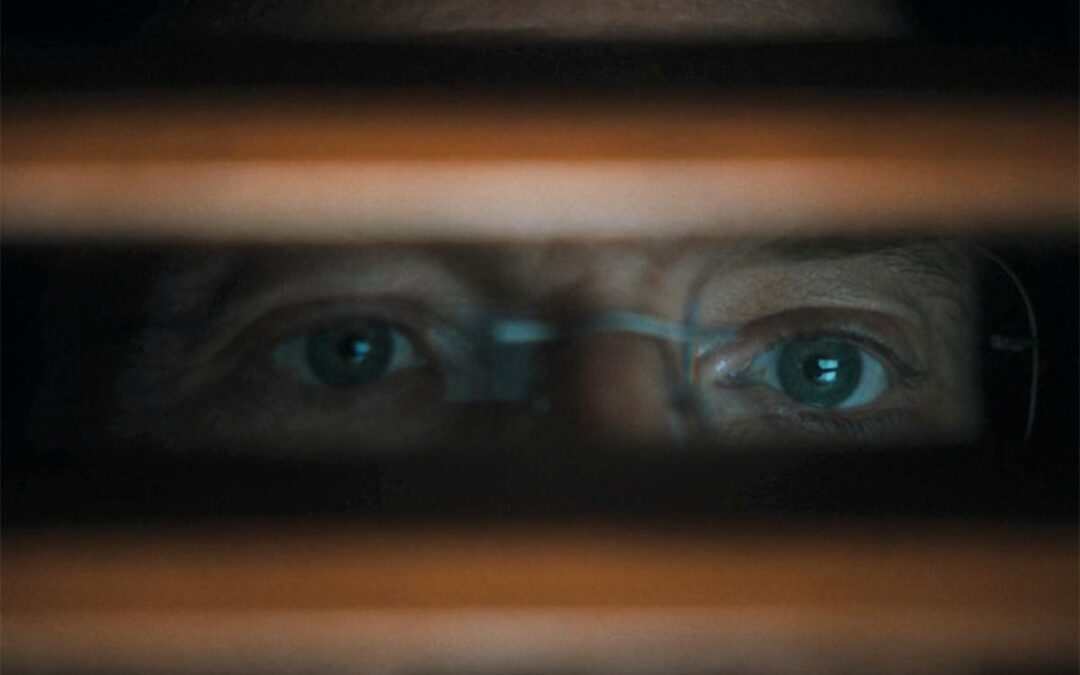
It’s devastating moment, and a backbreaking cut — the awful emotional three-car pileup we just witnessed, cutting to the Fifth Dimension singing the living shit out of “Let the Sunshine.” And there are our three heroes as we’ve seen them all season: Floyd giving his all as the ASL interpreter at that music festival, Carol lingering diaphanously in the sunlit blinds at the hotel, and Clark…doing karate while delivering the weather forecast? That part has never been clear, actually.
Until now. During another interrogation with Homer and Plumb, this time with his very good and very unhappy lawyer (Chastity Dotson) present, Clark reverses course on his decision to stop talking to them when they finally confront him with what they already know: Floyd was a participant in Clark’s affair with Carol.
After that, Clark rolls out the whole story, and its unusual origin point. In the middle of a forecast, the kind he’s done thousands of times before, he suffers some kind of panic attack or nervous episode or something. He shouts “BEWARE!”, performs some karate moves, then assumes a yoga pose before resuming the forecast.

That night, grimacing his way through “hair-braiding night” with his daughters, he fixates on the episode, trying to figure out what brought it on. Part of it is feeling his job is superfluous in an era of ubiquitous weather apps on everyone’s smartphones, but that’s not really it. It’s that he’s never fucked anyone underwater before.
“Sex isn’t pleasurable underwater,” Plumb informs him, interrupting the rapturous score playing during his daydreaming. “Water creates friction. I learned that the hard way.”
But that’s just it, Clark says. He’d like the chance to learn that sex underwater isn’t pleasurable, to discover that for himself. “It means you’re still growing and learning about the world,” he says. “You’re still alive. I wanted that.” It’s the same thing all of them seem to want…well, except Clark’s wife, who isn’t factored into the equation when he decides then and there to cheat on her and then meets Carol the next day. The rest is history.
Unfortunately, Clark is now facing a dilemma in the form of his completely crushed best friend. Keep in mind that Clark loves Floyd, he really is the guy’s best friend, at this point it’s clear he prefers him to Carol all things considered. Her callousness toward Floyd that afternoon in the Quality Garden Suites, however justified she is in no longer feeling attracted to a man she feels has in some ways ruined her life, has almost certainly driven Clark even closer to Floyd as opposed to her at this point.
Now his heart has gone out of everything. He no longer does his daily gymnastics routine on the park bench, disappointing his beloved stepson Richard. His lively, thoughtful ASL interpretations are now flat and lifeless, like he’s been forced to do them at gunpoint.
So what’s a best friend to do? Concoct a DTF St. Louis profile, of course, to contact Floyd’s completely ignored profile and make him feel better about himself. Since Floyd’s heterosexual, Clark decides to pose as a man. After hearing all about the meet-up with Modern Love, Clark assumes Floyd will once again be flattered and gratified by the interest, but this time he won’t go through with the meeting.
Whoops!
Floyd, you see, has been thinking about boners. (As you might, if your life is driven in large part by your own mangled dick, and if you’re watching your best friend fuck your wife on a routine basis.) Floyd admires erections for how “honest” they are. And it’s true, when you think about it: Is there a more sincere compliment you can pay someone than your body uncontrollably reacting to his or her beauty? What is a boner, really, if not the simple statement you’re looking quite well today?
Floyd’s idea is to get together with the guy and see if he can get him to pop a boner. If so, he’ll feel people still desire him. He doesn’t need it to go any further than that, though he’s open to the possibility. Mostly, he insists the F in DTF St. Louis doesn’t have to stand for “Fuck.” “F can stand for FEELS GOOD TOGETHER,” he says. And that’s all he wants out of life now: Someone to feel good with.
So Clark initiates “the Denny’s plan,” one of the all-time great dumb guy ideas. He goes to Boystown in Chicago, plops himself down in a booth, and orders breakfasts all day in search of a theoretical gay waiter he could pay to meet up with Floyd and, hopefully, get full on for him. He strikes out with a waiter, but just at that moment, out pops the inquisitive head of the man we’ll come to know only by the username Clark gave his bogus profile: Tiger Tiger (Chris Perfetti).

But Tiger Tiger doesn’t follow the Denny’s plan as ordered. He accepts the gig and travels down to St. Louis, alright — but he does so a day earlier, weirdly tailing Clark and Floyd around on his electric scooter. Eventually the purpose of the early visit and scooter-stalking becomes clear: He’s trying to scope out his potential hookup to see if he’s into the guy.
He is not. And when Clark sneaks away on his recumbent bike to try to talk the guy into sticking around, Floyd sees the man make the “nixed” signal. He scoots away — for some “sensory play” at Modern Love’s roller rink, lol — and Floyd and Clark communicate across a distance using sign language as Clark spills the whole sad story.
“You are my best friend and I love you,” he explains with his hands. “You should feel good about yourself.”
“He nixed me?” Floyd replies, unable to get past it.
“Yes,” Clark signs back, seated in his ridiculous bike, as two geese swim by in the background.

This leaves Homer wondering why Floyd would go to the bathhouse to meet with someone, when there was no one to meet. But I have a feeling I know why a severely depressed person who feels no one will ever love him for himself again in a romantic way might take a bunch of medication he knows to be lethal to a remote location, deface a pic of himself while he was still young and beautiful, and wind up dead several minutes later. You don’t really need to be a detective there, do you.
Of course, if Floyd killed himself, there’s still the question of who was on that bike that showed up at the bathhouse, and what they saw and did when they go there. Meanwhile, I still find the absence of Clark’s wife Eimy from the vast majority of the narrative a very noticeable one, perhaps pointedly so. In other words, the case isn’t closed just yet.
Even so, what we’ve been presented for is both an elegant solution to this lethal riddle, and an emotionally powerful one. Did you ever consider, when we started out, that Clark and Floyd would have a relationship this close, this loving, this built on mutual admiration and trust? Once you see it, you understand perfectly why Clark would lie to make his friend feel better, and how that lie would shatter the trust that is so crucial to their relationship while ultimately only making things worse. You can’t even blame Clark for trying!
Sometimes people, well-meaning people, simply make a mistake, and that mistake hurts people, and there’s nothing to be done about it. You, the well-meaning person, now have to learn how to live with what you didn’t mean to do but did anyway.
That said, as much as my heart was going out to Clark and Floyd in this episode, it’s still absolutely hilarious. Homer’s visible dismay with the results of his boomer Google search for “Indiana Jones & dicks” got me good, as did that shot of Tiger Tiger suddenly peering around the booth to involve himself in Clark’s scheme. When Clark, in his finest Jason Bateman deadpan, then tells Homer and Plumb “It was Tiger Tiger time,” I laughed so fucking hard I had to pause the show.
But again, the emotion is real, and raw. This extends to the cops, by the way: As taciturn as the two of them are, you can feel Plumb squirming (sorry, Floyd) about her decision to employ Homer’s quasi-illegal end-run around sealed criminal records. You can feel Homer’s legitimate anger about Floyd’s murder when he slams the photo of his corpse in a body bag down in front of Clark’s face — and both cops’ surprise, and perhaps even shame, when they see Clark is crying. Homer has no real way to know this, but as much as he’s upset with this death, I don’t think it’s the minutest fraction of how Clark feels to have lost the man he loved.
And we can’t neglect Carol. She’s obviously the heel in that opening scene, but only because we’re watching from Clark and Floyd’s perspective, really—literally from Clark’s vantage point in that closet at several points. But everything that has driven her heart away from Floyd is still present. Why should she put up with having sex with someone to whom she is no longer attracted? Even the sweetness with which her long-haired teenage umpire colleague (Asher Miles Fallica) invites her to the post-season party feels desperately needed by her.
Not to devolve into just rattling off superlatives, but this really is that kind of episode of television, where everything works, everything fits, everything elevates the story from where it is. Clark’s brief monologue about how sexual experimentation reminds him he’s alive, and Floyd’s similar speech about how physical arousal is validating even if you don’t reciprocate it, are two of the most sophisticated examinations of human beings’ messy sexuality I’ve seen on TV this year. (And I’ve seen plenty!)
DTF St. Louis takes three real goofballs, gives them complicated and unhappy lives, and sits back as they throw themselves at each other in various combinations, hoping that one of them sets off the chain reaction that will free them from their unhappiness. It feels increasingly tragic, knowing that they failed.

Sean T. Collins (@seantcollins.com on Bluesky and theseantcollins on Patreon) has written about television for The New York Times, Vulture, Rolling Stone, and elsewhere. He is the author of Pain Don’t Hurt: Meditations on Road House. He lives with his family on Long Island.

