
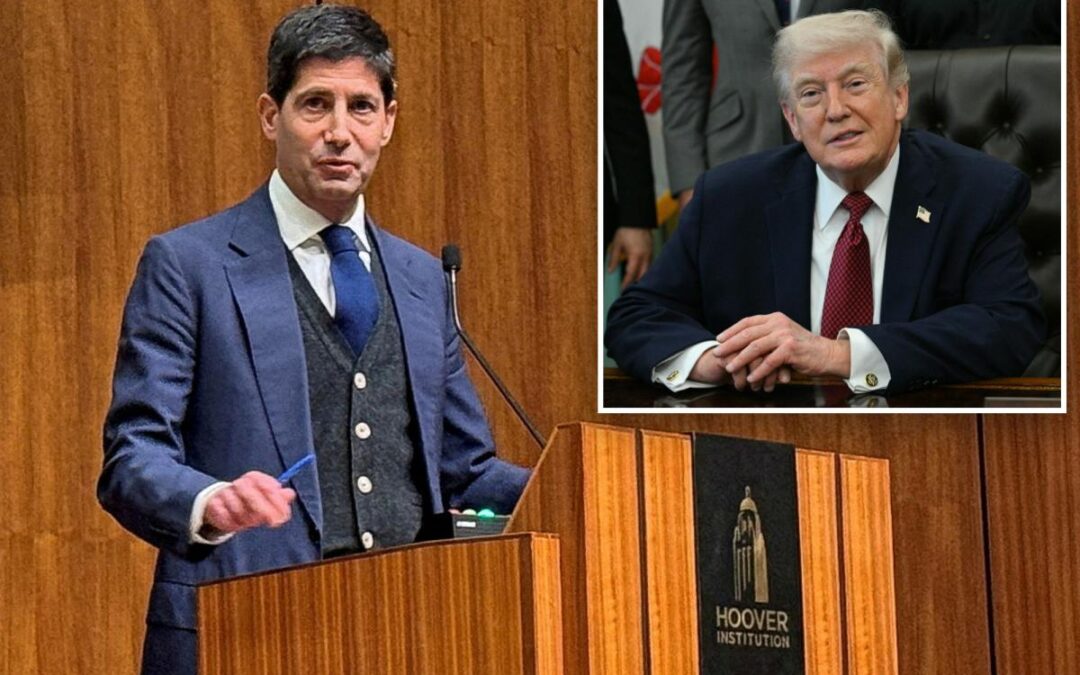
Kevin Warsh, President Trump’s pick to lead the Fed, is expected to face a heated grilling over his commitment to independence and whether he plans to slash interest rates during Tuesday’s Senate Banking Committee confirmation hearing.
The former Fed governor – a longtime inflation hawk who has pivoted to support the Trump administration’s call for lower rates – has been in limbo as Sen. Thom Tillis (R-NC) has vowed to block his nomination, meaning the committee is poised to be deadlocked in a 12-12 vote.
Tillis isn’t the only voting member that Warsh needs to win over, as the committee’s main line of questioning will likely center around whether the 56-year-old financier – who would be the richest Fed chair in history – is committed to the central bank’s independence.
In remarks to be delivered Tuesday, Warsh emphasized the need for independence while also arguing the Fed “must stay in its lane” and not stray “into fiscal and social policies where it has neither authority nor expertise” – a nod to issues like climate change and social inequality.
His speech, posted online Monday, does not aim to dissuade elected officials like Trump from chiming in on interest rates. In it, Warsh maintains that policy decisions must be based on “analytic rigor, meaningful deliberation and unclouded decision-making.”
“He’s going to get a very friendly reception from Republicans and a very unfriendly reception from the Democrats,” Ethan Harris, former head of global economic research at Bank of America, told The Post.
“He’s been a huge critic of the Fed and a huge supporter of the Trump administration. There’s going to be a lot of political positioning around his confirmation.”
Warsh has blasted current Fed officials, comparing them to “pampered princes” and accusing them of “groupthink.”
There’s also a “concern he’d be beholden to the president,” Harris said, since Trump has repeatedly called for interest rates as low as 1% – and deriding current Fed Chair Jerome Powell as “stupid” and “hardheaded” for not easing monetary policy faster.
It’s unclear whether Warsh – who has been campaigning for the position for a decade – will actually take such a dovish position if confirmed.
Tillis – one of the Senate Banking Committee’s 13 GOP members – has promised to block any of Trump’s nominees until the federal government throws out its criminal probe into Powell.
Though Warsh’s confirmation is poised to be delayed by the investigation, his testimony this week could shed light on his approach to policymaking, David Kelly, chief global strategist at JPMorgan, said in a note Monday.
Warsh, currently a fellow at Stanford University’s Hoover Institution, has argued that artificial intelligence will create a productivity boom while keeping prices low, allowing the Fed to lower rates.
The idea is that AI makes workers more productive, so companies can produce the same amount of labor with fewer staffers – reducing inflation in the long run.
But in the short term, “the tsunami of spending dedicated to AI development is likely inflationary rather than deflationary,” as power-hungry data centers spike demand for electricity and construction, Kelly wrote.
Warsh has compared the current economic situation to the Fed in 1996 and 1997 under Alan Greenspan, who held rates steady against colleagues who wanted to hike because he believed the internet would drive a productivity boom that would keep prices low.
However, Warsh is looking to lower rates – not hold them flat – and he still needs to win over his fellow Fed officials.
“I don’t think that Warsh walks in with that level of credibility,” former Fed Chair Janet Yellen said at a conference last week. “I really don’t see the FOMC accepting this in the short run.”
Even if Warsh tries to push rapid rate cuts right away, “the rest of the committee will simply vote against him,” Harris told The Post.
“I’ve always felt people put too much weight on this change in power,” he added. “The rest of the committee is probably on hold for a long time.”
The concept of a high-growth, low-inflation economy focuses on the benefits of artificial intelligence, deregulation and tax cuts under the Trump administration.
Fed officials, however, are also concerned about how tariffs, economic uncertainty, big budget deficits and immigration policy are distorting the economy, Harris said.
Banking Committee Chairman Sen. Tim Scott (R-SC) applauded Trump’s choice of Warsh.
“The American people deserve a Fed that is free from political influence,” the pol recently wrote on X. “Under Kevin Warsh’s leadership, the @federalreserve will remain independent and will be focused solely on strengthening the American economy.
Sen. Elizabeth Warren, the top Dem on the Senate Banking Committee, has bashed Trump’s nomination of Warsh, nodding to his stint at the Fed from 2006 to 2011 during the US housing crisis.
“In the lead-up to the crisis, Mr. Warsh failed to meaningfully identify or address the risks associated with subprime mortgages and derivatives,” the progressive senator wrote in an April 15 letter to Powell, demanding documents detailing Warsh’s previous role at the Fed.
“Since 2008, it has been well-documented that Mr. Warsh, in his role as (a) Fed Governor, failed to take seriously the risks posed by the subprime mortgage market and played a central role in helping to arrange numerous multibillion-dollar, taxpayer-funded capital infusions to financial institutions involved in the crisis,” Warren added.
Powell’s term as Fed chair ends May 15, though he has said he will stay on as “chairman pro tem” if a successor is not confirmed in time.
He also said he plans to remain on the board at least until the DOJ’s investigation is fully resolved. He could remain at the central bank through 2028.
Trump has threatened to fire Powell if he does not step down, while Treasury Secretary Scott Bessent has said he is confident that Warsh will be confirmed in time.


