
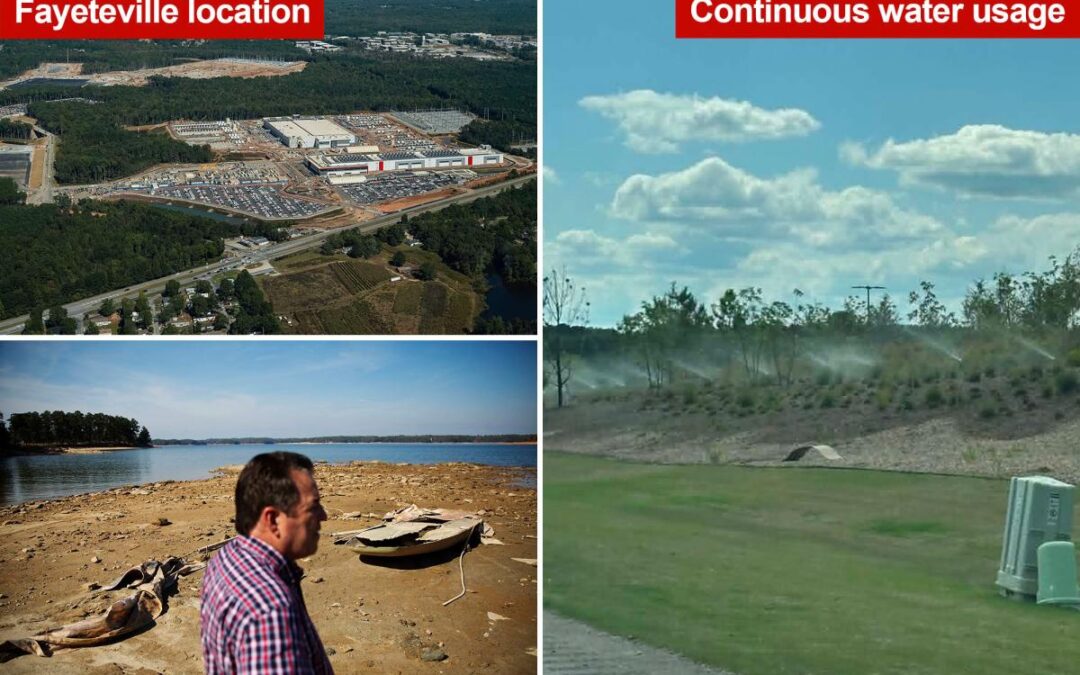
Residents of a suburban Georgia town were reportedly furious to discover a massive new data center had guzzled up 30 million gallons of water without initially paying for it – leaving members of the the populace with weak water pressure during a drought.
Georgians living in Annelise Park, a mansion-packed neighborhood in Fayetteville with a roughly 20,000 population, noticed last year that their water pressure was unusually weak, Politico recently reported.
A county investigation found a nearby 6.6 million-square-foot data center project by Quality Technology Services, a Blackstone-owned developer, was to blame, according to the publication.
Two industrial-scale water hookups had been connected to the campus – but one was installed without alerting the local county utility, and the other was not linked to QTS’s account, so neither were being charged, according to a May 15, 2025 letter from the Fayette County water system to QTS.
QTS owed nearly $150,000 for draining more than 29 million gallons of water, the letter stated. That’s enough to fill 44 Olympic-size swimming pools, or roughly three times the amount used daily to water lawns across the entire country, Politico noted.
The developer told the outlet it paid all retroactive charges after it was notified by the county. The county’s water system said the billing lapse was caused by a procedural slip-up, adding that the data center’s meters are now fully integrated and tracked.
But tensions heated up after local officials encouraged Fayetteville residents to cut back on watering their lawns amid a state of emergency from Georgia Gov. Brian Kemp, as Georgia faces state-wide droughts and the worst wildfire outbreaks in years.
James Clifton, an attorney who is running for a seat on the Fayette County Board of Commissioners, obtained the 2025 letter to QTS and posted it on Facebook last week, prompting outrage from residents.
On Sunday, he posted a photo that appeared to show sprinklers watering the lawns near the QTS Fayetteville site, claiming there has been “nearly continuous watering of the landscape … despite the State of Georgia being in a Stage 1 drought.”
“We get this notification from Fayette County water system saying you need to stop watering your lawns to help conserve water,” Clifton told Politico.
“So the first thing they do is lean on the individuals and the citizens to stop water consumption when we have QTS that’s just absolutely draining us – most months it’s the No. 1 consumer of water in the county,” he added.
Clifton, QTS and the Fayette County water system did not immediately respond to The Post’s requests for comment.
Local officials have defended the project, saying the QTS site, which is one of the largest in the country, will generate tens of millions of dollars in annual property taxes.
But it’s just the latest instance of Americans revolting against data center projects in their neighborhoods — growing frustrated with the environmental impact, the potential to hike their utility bills, the drain on the local water supply, and noise and light pollution.
In nearby Coweta County, Ga., residents are fighting against another site known as “Project Sail,” a proposed 800-acre data center.
“Coweta County … think Fayetteville is loving their data center? This is what we have to look forward to,” a member of a Facebook group with 5,500 members opposing the site wrote in a social media post.
Last week, hundreds of furious Utah residents packed a local gymnasium and erupted in chants of “Shame! Shame! Shame!” as county commissioners pushed through a colossal data center project from “Shark Tank” star Kevin O’Leary.
The complex is expected to consume more than twice the electricity currently used by the entire state of Utah, but locals have decried what they called a rushed approval process that gave locals little say in the matter.
Small-town Missourians last month grew so outraged over a $6 billion data center project that they ousted several councilmembers who backed the site.
In Fayetteville, QTS has argued that it uses a “closed-loop” cooling system that allows it to avoid using tons of water – saying its consumption was unusually high last year because of temporary construction-related needs.
Once the site is operational, it will only need water for bathrooms and kitchens, which will total roughly the use of four households a month, the company added.
But the project is still in development, meaning the county could see higher water usage for another three to five years, according to Politico.
Residents are also furious that the data center developer is not being charged a fine for initially skimping out on water payments.
“It’s just frustrating to see them come into our community and run all over us like the citizens don’t matter, and then they’re above the law when they do break it,” Clifton told Politico.
Gregory Pierce, director of the UCLA Water Resource Group, said it’s unusual the county utility isn’t fining the site – but that it could be a business decision meant to placate the developer.
“I don’t know exactly what’s happening here, but they probably don’t want to upset one of their new and largest customers,” Pierce told the outlet.
Vanessa Tigert, director of the Fayette County water system, defended the decision, saying QTS is “our largest customer, and we have to be partners. It’s called customer service.”
Tigert said the water hookups went unnoticed because the connection process “got mixed up” as the county transitioned to a new cloud-based system, and that her division is short-staffed.
“Just like any water system, we don’t have enough staff. We can’t keep staff,” she told Politico. “I’ve got one person that’s doing inspections and plan review, and so he’s spread pretty thin.”
She also said it’s possible that her staff did know about the hookups, but that she just wasn’t able to locate the inspection report.


