
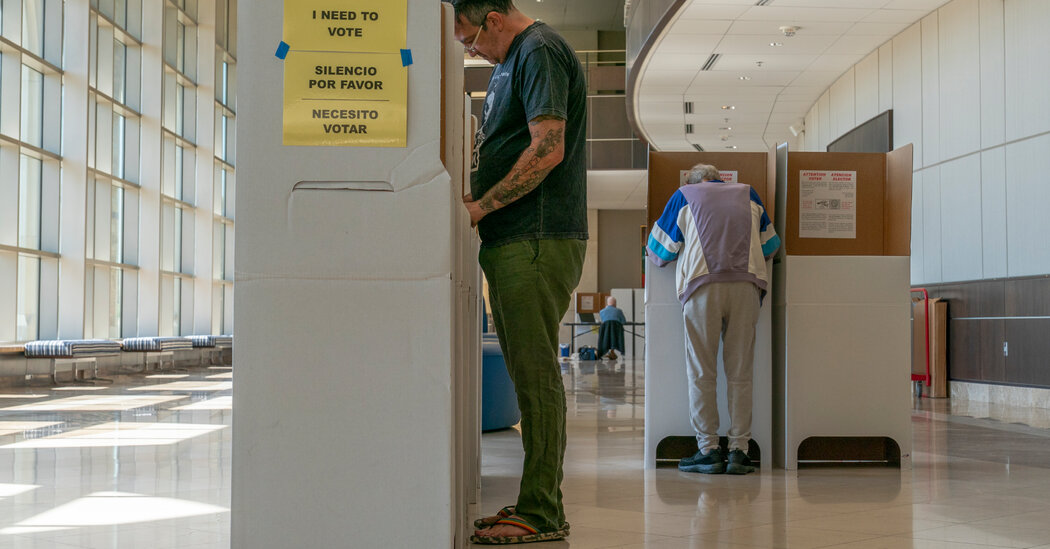
President Trump’s grip on the Republican Party in the South, where he has enjoyed perhaps his greatest success lifting his chosen candidates over those he has perceived as disloyal, will be tested in Tuesday’s primaries and runoffs.
The top race of the day is in Georgia, where Republican voters will pick a nominee in a primary runoff to challenge Senator Jon Ossoff, who had been considered the most vulnerable Democratic incumbent going into the midterm elections but has proved to be a formidable fund-raiser and popular candidate.
Georgia Republicans are still stung by losing Senate contests to Democrats in 2021 and 2022. Both candidates have pitched themselves as the more electable choice against Mr. Ossoff. The race has pitted Mr. Trump, who made a late endorsement on Sunday, against Georgia’s most popular Republican, Gov. Brian Kemp.
In deeply Republican Alabama, the G.O.P. primary runoff will almost certainly decide the contest to succeed Senator Tommy Tuberville, a Republican who is running for governor. Mr. Trump’s chosen candidate is in a surprisingly tough race against a former Navy SEAL running as an anti-establishment outsider.
In the Oklahoma governor’s race, Mr. Trump backed Mike Mazzei, a wealthy outsider who has spent around $11 million of his own money on his campaign. The crowded race, which includes the state attorney general, Gentner Drummond, could go to a runoff.
Will any Trump-backed candidates lose in the South?
Mr. Trump’s endorsement has been imposing in primary contests across the country this year, but nowhere has that been more true than in the South, where he backed Republican challengers who defeated Senator Bill Cassidy of Louisiana, Representative Thomas Massie of Kentucky and Senator John Cornyn of Texas. Still, a couple of the president’s chosen candidates are in difficult races on Tuesday.
In the Alabama Senate runoff, Mr. Trump has backed Representative Barry Moore, a third-term congressman and longtime loyalist, since early in the campaign. But the outsider candidacy of Jared Hudson, a former Navy SEAL, caught on with Republican voters after Mr. Hudson’s surprise, second-place finish in the May primary.
A similar insider-versus-outsider dynamic is at play in Georgia, where Mr. Trump has long backed Lt. Gov. Burt Jones for governor. Mr. Jones has been locked in a hugely expensive campaign filled with negative TV ads against Rick Jackson, a wealthy health care executive who has embraced Mr. Trump and his policies, even without receiving the president’s endorsement.
The winner will take on Keisha Lance Bottoms in November. Ms. Bottoms is a former Atlanta mayor who won the Democratic nomination outright last month.
Will late Trump and Kemp endorsements matter in Georgia?
Mr. Trump made a late endorsement in the Georgia Senate runoff on Sunday morning, backing Representative Mike Collins, an immigration hard-liner, over Derek Dooley, a lawyer and former football coach, who is a longtime friend of Mr. Kemp. By the time the president’s endorsement arrived, Republican voters had been casting ballots early in Georgia for five days.
But Republicans expect most of their voters to go to the polls on Tuesday. And Mr. Collins has styled himself throughout the race as the MAGA candidate, so Mr. Trump’s backing likely only sharpened the race’s existing contours.
It was a different story in the Georgia governor’s race, where Mr. Kemp, who is term-limited, made a surprising endorsement on Sunday night for Mr. Jones over Mr. Jackson. Mr. Kemp had stayed neutral in the race, saying he was focused on campaigning for Mr. Dooley for Senate. The Jones campaign, which has touted Mr. Trump’s endorsement nonstop in TV ads, quickly cut an ad about the Kemp endorsement on Monday.
Who will Oklahoma Republicans choose to succeed Markwayne Mullin in the Senate?
Mr. Trump picked Senator Markwayne Mullin to be his homeland security secretary in March, creating a vacancy in the Senate in the solidly Republican state. Then, Mr. Trump endorsed Representative Kevin Hern, giving him a clear advantage in a G.O.P. primary with four other competitors.
Another member of Congress, Representative Stephanie Bice, had been considering a run for Senate but said after Mr. Trump backed Mr. Hern that she would remain in the House.
Mr. Hern was first elected to the House in 2018 after a career as a McDonald’s franchisee. Gov. Kevin Stitt, who cannot seek a third term in office this year, also decided not to run for the seat.
Who will voters in California pick to serve out Swalwell’s term?
Voters in California’s heavily Democratic 14th Congressional District will go to the polls for a special election to choose who should serve out the remainder of Representative Eric Swalwell’s term.
Mr. Swalwell, a Democrat, resigned in April after allegations that he had engaged in sexual assault and misconduct. He denied the accusations but said they distracted from his congressional duties.
Mr. Swalwell had been running for governor at the time, so candidates were already campaigning to succeed him in the next term, which begins in January. Those candidates faced off in the California primary on June 2.
Tuesday’s election will determine who should finish the final months of Mr. Swalwell’s current term.
The candidates on Tuesday’s ballot include many of the same names from the June 2 ballot, including the top two vote-getters in that race, both Democrats: State Senator Aisha Wahab and Melissa Hernandez, a former mayor of Dublin, Calif.
If any candidate wins a majority of the votes Tuesday, that person will be declared the winner and begin serving immediately. If no one reaches that threshold, the top two vote-getters will advance to an Aug. 18 election.
Will Georgia voters choose an election denier to run state elections?
Both Republicans vying to become Georgia’s next secretary of state — and oversee the state’s elections — are aligned with the MAGA wing of the Republican Party. Vernon Jones, a former DeKalb County chief executive and ex-Democrat, has falsely claimed that the 2020 presidential election was stolen, while State Representative Tim Fleming, a former aide to Mr. Kemp, has said there were irregularities.
The winner will compete in a November election that could become a referendum on the 2020 vote in Georgia, which both Mr. Kemp and the current secretary of state, Brad Raffensperger, have declared emphatically that Mr. Trump lost. Mr. Raffensperger ran for governor this year but did not make the runoff. Should Mr. Jones or Mr. Fleming succeed him, they are likely to take the management of Georgia’s election infrastructure in a very different direction.


