
The push by New York’s public-employee unions to slap taxpayers with over $100 billion in new pension debt may finally be colliding with reality.
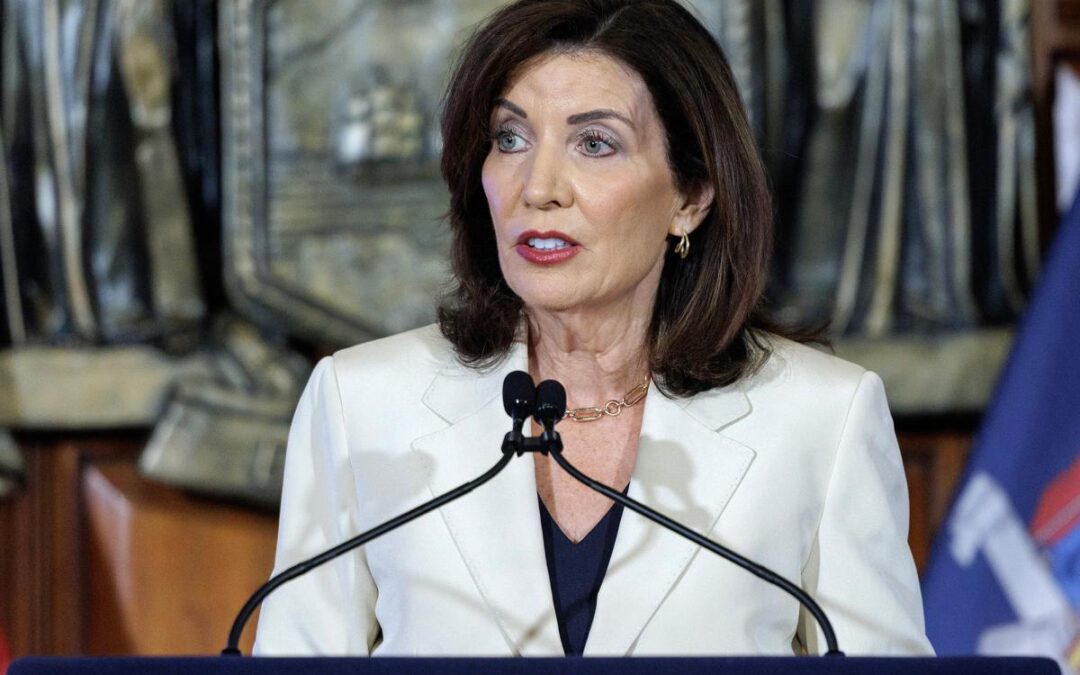
Speaking at a budget-focused press conference in Albany Thursday, Gov. Kathy Hochul acknowledged that granting even part of labor’s demands — for full pensions at age 55, lower employee contributions and bigger benefits — would be “a big hit” for taxpayers.
The changes being demanded behind closed doors would, Hochul said, add $1.5 billion per year to state and local taxpayer costs.
Instead, she said, she’s negotiating “much more scaled-down” changes to the rules about what public employees — including teachers, whose unions have been the primary driver of this year’s push — pay into, and get from, the pension system.
The governor, like most Albany pols, has been exceedingly deferential to the state’s public-employee unions.
She’s declined to challenge their bogus claims that New York City’s underfunded pension systems are in good shape, or their narrative that the state’s 2009 and 2012 pension reforms are, somehow, measurably harming recruitment and retention in state government today.
But the governor should know better.
Hochul often mentions her private-sector union roots: Family members, she loves to remind us, worked in an Erie County steel mill.
But the steelworker union understood it couldn’t demand a share of profits that didn’t exist, or saddle the mill with operating rules that would make it unprofitable.
The public sector is different, and New York’s unions have gotten accustomed to squeezing taxpayers for more.
They have willing accomplices in the Legislature, both Democrats and Republicans, who will say or do virtually anything the unions request to hold on to their $142,000-per-year part-time gigs.
What’s worse is that more than a third of sitting state lawmakers stand to personally benefit from the pension changes being discussed.
One modification, cutting employee contributions from 6% to 3%, would boost those legislators’ paychecks by more than $4,000 a year.
Meanwhile, the governor has been getting an earful from local officials who recognize that Albany’s pension giveaways will translate into higher property taxes upstate and on Long Island.
Some of them lived through the last big pension giveaway in 2000, which caused pension costs — and with them, property taxes — to balloon a few years later.
School taxes outside New York City surged almost 50% on average between 2001 and 2008, an experience so painful that it spurred Albany to a create a property-tax cap in 2011.
Hochul was serving as a town councilwoman in Hamburg, NY, at the time.
She saw how the swollen pension invoices from Albany left the board with little choice but to hit up families and businesses for more cash.
Armed with that knowledge, she likely recognizes that she’ll have a hard time maintaining her “affordability-focused” persona if she purposefully pushes up property taxes on families and businesses.
It also goes without saying that New York City’s own budget mess will get exponentially worse if Albany slams City Hall with bigger pension costs.
And never mind the effect it would have on the perennially challenged finances of the New York City subway system.
Hochul, who has held a commanding lead in every gubernatorial election poll, should recognize the extent to which she can, today, control what her next four years as governor could look like.
In this case, she can avoid property-tax hikes by choosing not to cause property-tax increases.
The unions have dropped the fig leaf: They’ve shown how unreasonable their demands are, how much economic harm they’d cause, and the scale of the sacrifices that schools and municipalities would have to make to pay for them.
The governor sees that — and now it’s up to her to decide what she’ll do about it.
Hochul and state lawmakers are more than five weeks past New York’s (bizarre and unique) April 1 budget deadline, but state operations remain unaffected as lawmakers vote to keep agencies open and budget talks continue.
One of the cardinal rules of negotiation is to be willing to walk away from a bad deal.
Taxpayers should hope the governor is ready to do just that.
Ken Girardin is a fellow at the Manhattan Institute.


