
Speed kills. Speeding ruins lives. New York drivers constantly hear this message from government.
Why, then, does the city accept the proliferation of illegal motorized electronic “devices” like the 53 mph scooter whose driver killed himself and a bicyclist Thursday on the Queensboro Bridge?
And why does Gotham accept dangerous behavior from the operators of legal e-scooters and e-bikes, too?
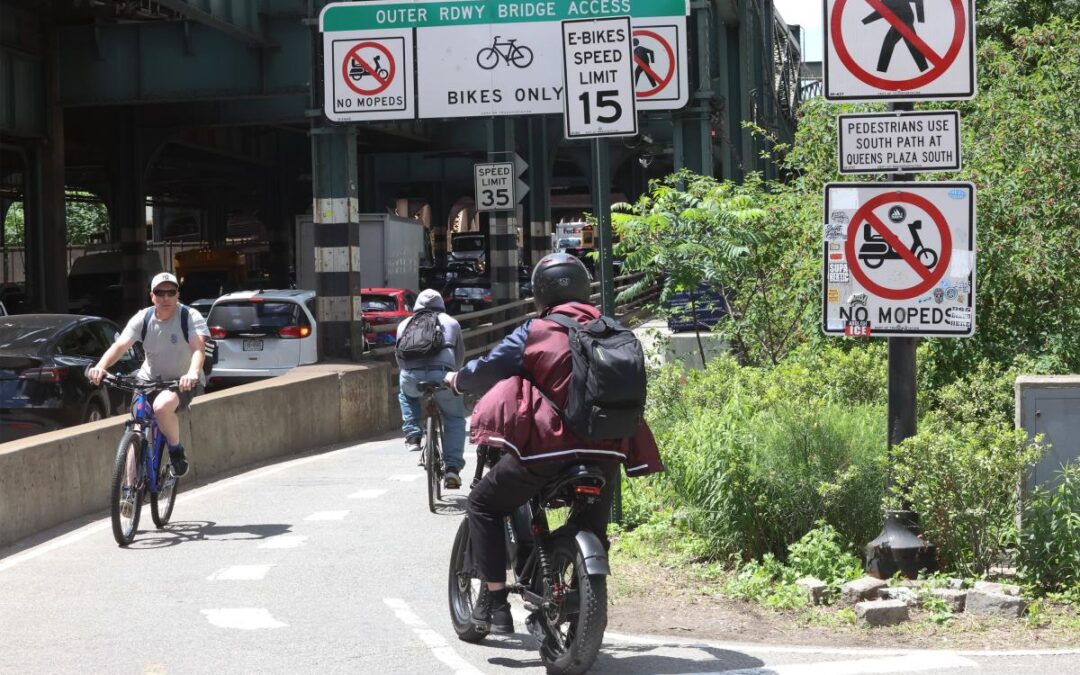
Thursday morning, a 35-year-old cyclist was using the Queensboro Bridge’s new bike-only path to travel from Manhattan to Queens.
A 39-year-old man driving an illegal stand-up e-scooter capable of reaching highway speeds smashed into the cyclist head-on, obliterating both lives.
Why was this individual driving a dangerous device on a path meant for slower-moving cyclists?
Lack of effective rules and enforcement.
E-bikes and stand-up e-scooter drivers must follow the rules of the road.
Theoretically, they can’t go over 15mph on city roads — and they can’t be capable of going more than 20.
But because their drivers don’t need a license, registration, or plate, those rules are hard to enforce.
Much enforcement of motor-vehicle rules is based on a repeat-offender system, under which drivers have an incentive not to rack up violations, or they’ll lose their license.
Lawmakers expanded this system in the state budget, requiring the owners of vehicles with 16 (!) or more speed-camera tickets in a year to install speed-limiting technology in their vehicles.
In 2020, though, the state and city legalized e-bikes and e-scooters without creating any enforcement regime.
So e-bike and e-scooter drivers who repeatedly violate speeding and other laws — like riding the wrong way or on a sidewalk — have no incentive to change their behavior.
There’s no mechanism to ensure they pay their fines when cops issue them tickets.
Last year, the Adams-era NYPD Commissioner Jessica Tisch started giving e-cyclists low-level criminal summonses for breaking the law, forcing them to show up to court.
But the Mamdani-era Commissioner Tisch stopped that.
The mayor and the commissioner did so, despite having failed to come up with a different policy to deter reckless e-cycling and e-scootering.
Mamdani’s ideas are “enhanced safety training” for delivery workers and maybe, someday, working with council members to “develop legislation addressing the root causes of unsafe e-bike and cycling delivery practices.”
We don’t have time for “root causes,” and not all reckless e-device drivers are delivery workers, anyway.
The council has a bill to ban the sale of e-devices that exceed speed limits — fine, good, but who’s going to enforce that law against a direct-to-consumer Chinese supplier?
So the carnage will continue.
Yes, cars and trucks still kill more people.
But those deaths have fallen in New York City for decades.
By contrast, before 2020, pedestrian and cyclist injury and death by motorized e-devices was non-existent.
Since then, they’ve become a regular occurrence.
In 2024, the last year for which full data are available, seven pedestrians were killed in crashes with either a bicyclist or a motorized two-wheeler.
Before 2020, New York could go years without a cyclist-on-pedestrian death.
And e-device operators are themselves in danger: This year, 11 people have died on e-bikes or stand-up e-scooters, matching a 2023 record.
Between 2017 and 2019, only four people in total died in such crashes.
Yes, some e-bike drivers were hit by car and truck drivers — but many e-bike operators don’t understand the danger of what they think of as “bicycles.”
Mamdani needs to push for three things: first, licensing, registration and insurance for all e-devices, starting with commercial and app delivery fleets.
The licensing process could be less onerous than getting one for driving a car, and insurance for non-commercial e-device drivers could be a cheaper add-on to homeowners’ or renters’ insurance.
Old-fashioned bicyclists should favor these measures: The takeover of bike lanes and paths by e-bikes and e-devices has made cycling unpleasant and anxiety-producing, especially for women.
For persistent antisocial actors who won’t comply, we need to revert to criminal enforcement against dangerous behavior.
The e-scooter driver who just lost his life on the bridge could have received a summons to court instead.
Ultimately, restoring order is up to Gov. Kathy Hochul and lawmakers.
The state, not the city, creates most motor-vehicle laws — and e-bikes and e-scooters are nothing but motor vehicles.
Nicole Gelinas is a contributing editor to the Manhattan Institute’s City Journal.

