
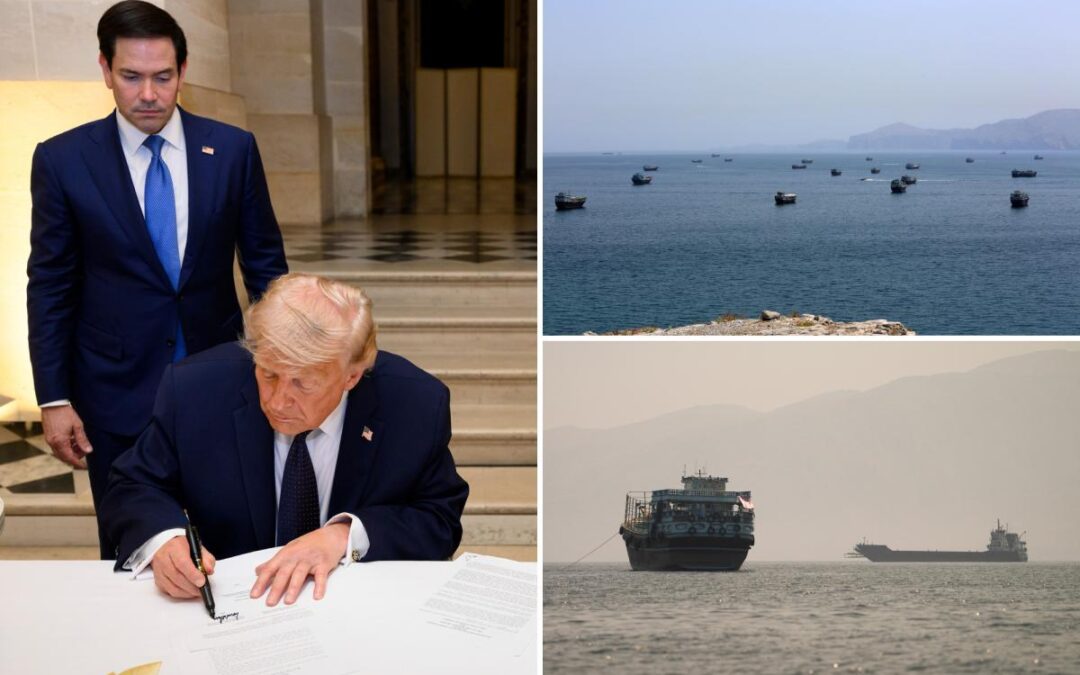
As high-stakes negotiations to end the Iran war continue in Switzerland, the maritime industry’s message to the White House is clear: Don’t allow Iran to formalize its tolling racket over the Strait of Hormuz.
Iran wants all commercial shipping vessels to register with a newly formed Iranian agency in order to pass through the narrow entry to the oil-rich Persian Gulf — but Western insurance underwriters are refusing to comply, slamming the mandate as a sanctions trap, The Post has learned.
Senior sources say unless US negotiators force Iran to completely dismantle its unilateral insurance mandates and fully clear international waters of underwater mines, trade in the region will never truly recover.
“The current Iranian proposal or directive is unacceptable and not workable for commercial shipping,” one insider told The Post. “No country can unilaterally assert its jurisdiction over international waters. That has to be respected. If it isn’t, you will not get transit back to pre-war levels. It’s not possible.”
Under the guise of a 60-day truce, Tehran’s newly formed Persian Gulf Strait Authority (PGSA) declared that all traditional shipping channels through the international waters of the strait are “prohibited.” To force compliance, Iran wants all commercial vessels to register with the PGSA and carry Iranian-approved insurance.
But insiders told The Post that insurance firms are refusing to comply with a system they say is completely unworkable for the private sector.
“They’re using the strait and their perceived control of the strait as an economic weapon against the United States and their allies,” a senior source briefed on the matter said on the condition of anonymity. “It’s basically an attempt to vandalize the global economy.”
Tehran is dangling “free” insurance during the initial 60-day window, but the mandate explicitly reserves the right to levy steep premium fees down the line.
Global firms warn that signing on the dotted line would violate stringent US Office of Foreign Assets Control (OFAC) sanctions once premiums are paid. It also would force companies to rely on an Iranian legal system in which the West has “absolutely zero” confidence.
“No real legitimate shipping company internationally is going to buy insurance for their vessels from an insurance company they don’t know, and with the law and jurisdiction of over that insurance in Iran,” said one insider.
“You contract with an Iranian entity, you undermine your relationship with the United States,” they added. “I think that anyone doing that would do so at their peril, quite honestly.”
Instead, companies will likely continue to opt for shipping their goods through Oman under protection of the US military. Roughly 55 ships successfully navigated the Omani narrower Omani channel over a recent weekend alone.
However, traffic remains severely bottlenecked compared to pre-war levels of more than 130 ships per day, primarily because the wider international waters remain littered with Iranian mines.
In the interim, Lloyd’s of London recently launched a massive new insurance consortium led by American underwriting giant Chubb.
The facility provides up to $200 million for hull risk, $200 million in liability, and $200 million for cargo, and covering roughly 80% of the world’s merchant ships transiting through the US-protected Omani channel.
“There is one urgent matter now: mine clearance,” warned a senior EU diplomat. “Otherwise, there will be no benefit from the agreement — shipowners, ships’ captains and insurance companies are not going to arrange a transit of the strait if they run the risk of seeing tankers blow up.”
At its narrowest, the Strait of Hormuz is a mere 21 miles wide, yet it serves as the single most critical artery for the global energy market.
Roughly a fifth of the world’s total oil consumption, more than 20 million barrels per day, squeezes through the waterway separating Iran and Oman.
The strait is the only path to the open ocean for crude oil from major producers including Saudi Arabia, the United Arab Emirates, Kuwait, and Iraq, while it also serves as the primary export route for the liquefied natural gas (LNG) produced by Qatar, accounting for roughly 20% of global LNG trade.
A March 2026 Congressional Research Service (CRS) report said Iran’s extensive coastline and asymmetric military capabilities enable significant power projection over this energy trade.
By using threats to selectively disrupt commerce by country or carrier, Tehran has historically created closure-like conditions without requiring full military action.
Because the designated shipping lanes are just two miles wide, any threat immediately sends shockwaves through global commodity markets.
While Chinese vessels allied with Iran are currently utilizing the Iranian-controlled channels toll-free, the rest of the global fleet is actively shutting Tehran out.
Compounding the crisis, the US military currently possesses no immediate local mine-clearing capability in the strait, as American operational planning historically delegates demining duties to European allies.
The lack of cleared lanes threatens the very benchmark some inside the Trump administration had set itself.
“What constitutes success for this mission is maritime trade resumes to pre-conflict levels, and the industry is restored across the board to those levels,” a senior US administration official said.
A reopened Hormuz is expected to drive global crude prices down, with oen EU official claiming that the US and its G7 allies will have the economic cover it needs to clamp tougher sanctions on Russian oil and gas in response to Moscow’s full-scale invasion of Ukraine without slamming Western consumers with a price spike.
“Why did *G7) leaders decide (last week) to step up pressure on Russia through oil-and-gas sanctions? Because, obviously, prices are falling as a result of the Hormuz deal,” the official said. “That is why, for us, this Hormuz deal is so important.”

