
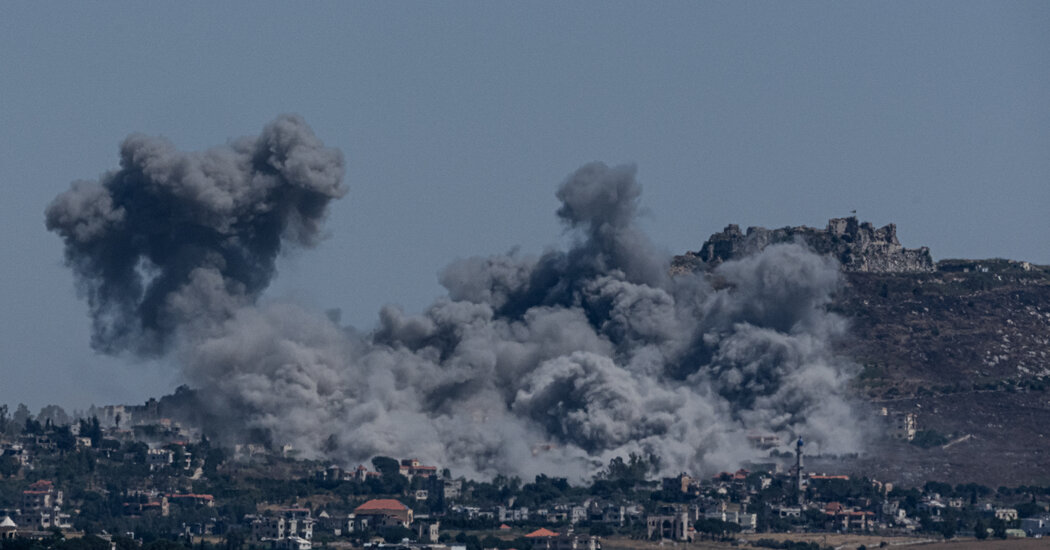
For all the diplomatic fanfare surrounding the newest cease-fire agreement in Lebanon, the reality on the ground on Thursday was grimly familiar: Israeli airstrikes, Hezbollah rockets and little sign that the war had stopped.
The continued fighting exposed the fragility of the latest deal brokered by the Trump administration a day earlier, before it had even taken effect.
That cease-fire is contingent on Hezbollah, the Iranian-backed armed group, first pulling back from the Lebanese region bordering Israel, and on a “complete cessation” of the group’s attacks. But Israel is not required to make any immediate concessions in parallel, and Hezbollah did not take part in the cease-fire negotiations, leaving Lebanon’s government with little power to force it to comply.
Within hours, those limits were on full display.
In a statement on Thursday, Hezbollah’s leader, Naim Qassem, rejected the U.S.-brokered agreement, saying it amounted to a demand that his group surrender while Israel continued its offensive.
Mr. Qassem said any cease-fire must be comprehensive and include an end to Israel’s military campaign and its withdrawal from Lebanon, where Israeli forces have occupied broad stretches of territory since invading in March.
“As long as the occupation continues, the resistance will continue,” Mr. Qassem said.
Hezbollah said on Thursday that it had carried out rocket and drone attacks on Israeli troops in the border region, and Israeli airstrikes continued to pummel southern Lebanon on Thursday — underscoring how little the cease-fire deal had shifted either side’s military posture, and how little it has changed life for civilians on the ground.
Israel’s defense minister, Israel Katz, said on Thursday that Israeli forces would continue operating in Lebanon “at this stage,” adding that the hundreds of thousands of people displaced from southern Lebanon would not yet be allowed to return.
Mohanad Hage Ali, a senior fellow at the Carnegie Middle East Center in Beirut, said the agreement announced on Wednesday was another “performative cease-fire” — one with “all the packaging for a great declaration, but no commitment.”
“This is a one-sided cease-fire,” he said.
The new agreement follows an earlier U.S.-brokered cease-fire that took effect in April but did little to stem the fighting. Under that deal, Israel said it retained the right to act in self-defense but would not carry out “offensive operations” against Lebanese targets by land, air or sea.
Since then, Israeli ground forces have pushed deeper into Lebanon, and Prime Minister Benjamin Netanyahu of Israel ordered the military to escalate the offensive against Hezbollah, even as truce talks continued.
Before Mr. Qassem’s speech, President Joseph Aoun of Lebanon had signaled that the cease-fire was not yet in effect, telling reporters on Thursday that the Lebanese government was still waiting for a response from Hezbollah before informing Washington of Lebanon’s position. Mr. Aoun said the cease-fire could begin within 24 hours of Washington being notified that all sides had agreed, adding that it was “the final opportunity” to reach a comprehensive cease-fire.
But Mr. Qassem’s rejection of the agreement made that timeline look increasingly unlikely.
Without naming Hezbollah, Lebanon’s prime minister, Nawaf Salam, warned on Thursday that anyone who rejected or delayed the process would bear responsibility for what followed.
“Every hour that passes without implementation is an hour paid for by the south and its people,” he said.


