
A Trader Joe’s can come cheap — but not a Trader Zo’s.
Mayor Zohran Mamdani’s $30 million city‑owned East Harlem grocery store is going to cost taxpayers roughly four times what rival markets spend on construction, industry sources told The Post — and will likely run at a loss in perpetuity.
At $30 million, Mamdani’s 9,000-square-foot East Harlem grocery store would cost more than $3,000 per square foot to construct.
But when it comes to building a new Whole Foods or a Trader Joe’s from the ground up, the costs are much lower, according to a real estate broker who works with prominent grocery chains. Those costs would run at about $800 per square foot, or $7.2 million, for a 9,000-square-foot location.
Under normal circumstances, according to a grocery store consultant with knowledge of New York development, “no supermarket operator would pay that number.”
“Over $3,000 psf?” the broker emailed. “Someone is making extra vacation money!”
What’s more, the market would have to bring in a whopping $137,000 in daily sales (equivalent to $50 million a year) — which would convert to a roughly $13,000 daily profit — to recoup the $30 million outlay in six years.
That’s an astonishing annual sum, especially because the top five city supermarkets — often with larger footprints — roughly earned between $16 million to $27 million in annual sales in 2025, according to Food Trade News.
The ranking of the top 20 city markets overall for annual sales included familiar names. Key Food notched about $11 million per store, Krasdale scored about $9.4 million per location, ASG Stores — with brands like Associated — also did about $11 million per store. Fine Fare brought in $6.5 million per locale, and Food Bazaar averaged about $20 million per store.
Mamdani said Sunday that the $30 million outlay for his East Harlem grocery store is just part of a $70 million initiative for five city-owned grocery stores — one in each borough. But supermarket magnate John Catsimatidis bit back, saying, “I could probably open up 10 stores with $70 million.”
Catsimatidis, owner of Gristedes Supermarkets, declined to say anything more because he wants to “advise” Mamdani on the project, which requires City Council approval. The mayor’s office didn’t respond to a request for more information on what the $30 million figure includes.
The taxpayer-funded stores, offering discounts on basic groceries, are all slated to open during Mamdani’s first term — and were a central plank of his campaign last fall to cut grocery prices for low-income residents.
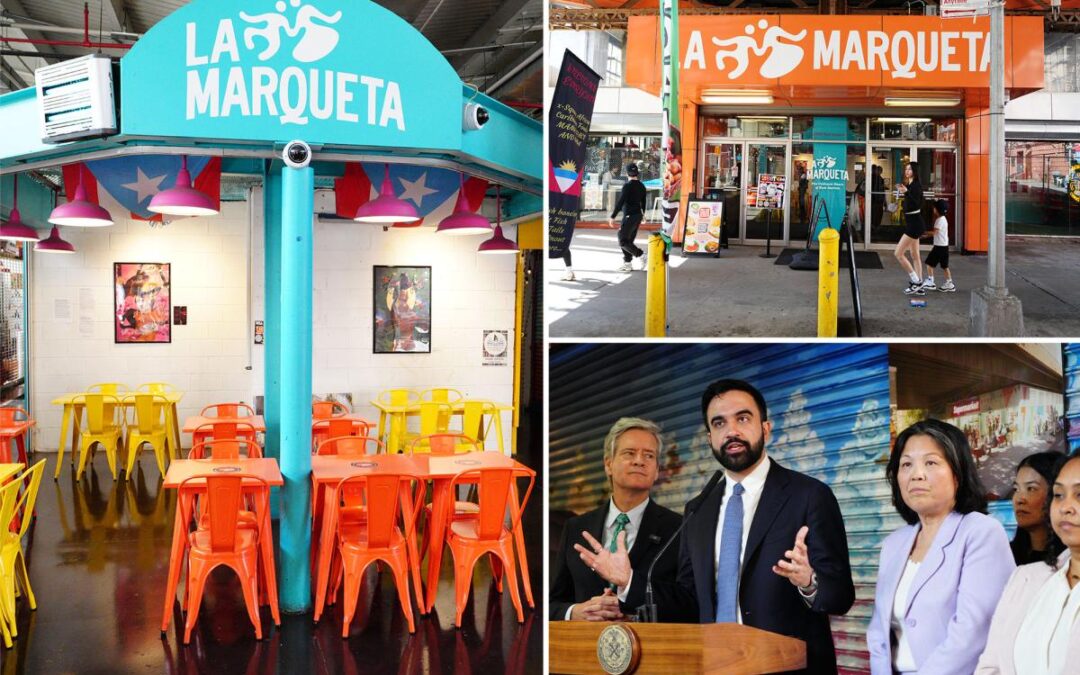
The new Mamdani market in East Harlem would rise at a vacant lot at the Park Avenue site under elevated train tracks of the city-owned La Marqueta — home to more than 20 small businesses.
One commercial real estate consultant who spoke to The Post was critical of the small footprint of the store to serve an entire community, especially in a large neighborhood. He said Big Apple supermarkets average 25,000 square feet — though many markets have embraced the smaller format as of late.
Whole Foods, when accounting for its new small-format locations, run from 7,000 to 14,000 square feet, though the Bowery location spans a mighty 71,000 square feet. Trader Joe’s tend to occupy 10,000 to 15,000 square feet, while Key Foods tend to be from 15,000 to 17,000 square feet.
“The East Harlem store would, at best, generate annual sales of $8 million — roughly $150,000 per week — initially,” the consultant said. “To repay $30 million, we should be looking at cash flow, not sales. Sales are not profits.”
Because grocery retailing is a slim-margin business in the best of times — 12% gross margin — the municipal market will likely always lose money, said a partner in a brokerage firm that has closed dozens of deals with grocery stores.
“It seems like profits are not [the mayor’s] primary objective,” he said.
The store will likely lose at least $300,000 a year, possibly in perpetuity, despite the store being rent-free, according to the consultant, a cost that will have to be borne by the taxpayer.
The La Marqueta store wouldn’t open until 2029, with other municipal grocery store sites selected and opened sooner, officials said.
It wasn’t immediately clear why it would require so many years for the store to open. Typically, upon taking possession of a space, it would take six to 12 months to construct a grocery store, the firm partner said.
A yet-to-be-selected private operator would manage daily operations there with New Yorkers picking up the tab for construction, rent and property taxes, City Hall officials previously told The Post.
The majority of the city’s grocery stores rent their spaces, per sources. The space in Harlem likely would rent for $250,000 a year, the brokerage partner said.
The city will issue a request for proposals for the operator, but “no one’s gonna want to do it because they won’t make any money or they don’t want to get involved with the city,” the broker said.
With additional reporting by Craig McCarthy


