
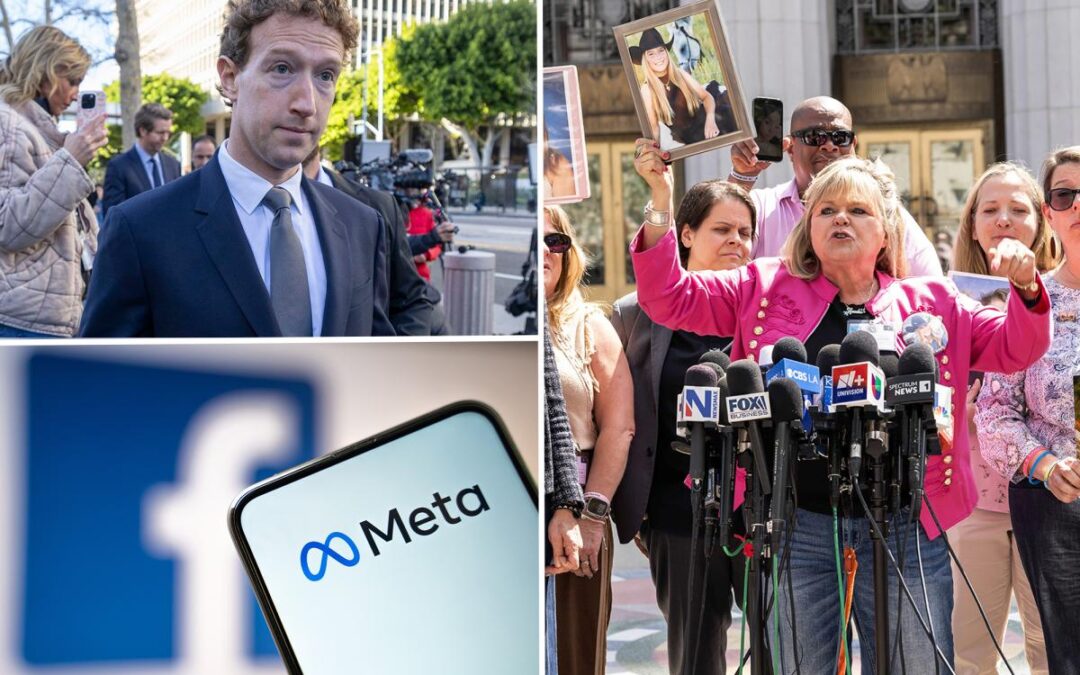
Mark Zuckerberg’s Meta tried to delay posting bond for millions of dollars in damages after it was found liable for teen social media addiction in a landmark California court verdict last month, according to legal documents reviewed by The Post.
In what experts called a “Big Tobacco” moment for social media, a California state jury ordered Meta and Google to pay a combined $6 million in damages to a woman identified as KGM, who alleged Instagram and YouTube fueled her downward spiral of anxiety and depression.
Meta, which boasts a staggering $1.7 trillion market capitalization, nevertheless asked the court for a free pass on the payment – arguing it shouldn’t have to put up a bond for the full amount while it fights the ruling with post-trial motions, according to an April 7 filing.
Judge Carolyn Kuhl rejected Meta’s request “given the size of the judgment and the substantial financial resources of defendants,” according to court papers. Zuckerberg’s massive war chest was boosted by more than $200 billion in revenue in fiscal 2025 alone.
Meta’s chastised legal team submitted a bond covering the full amount two days later on April 9, just one day before a court-ordered deadline.
“Dragging out this process is just another way for Meta to inflict pain on a brave young woman who stood up to one of the most powerful companies in the history of the world,” said Sacha Haworth, executive director of the Tech Oversight Project.
A Meta spokesperson said the company’s filings “were standard procedural discussions around timing.”
“Once a deadline was set, Meta promptly posted the bond,” the spokesperson told The Post.
It’s possible that Meta’s attempt to delay posting bond was a “trial balloon” to gauge whether the judge was sympathetic to its position, according to David Levine, a professor at UC San Francisco Law School.
The company’s post-trial motions, often aimed at reducing damages, could pressure the plaintiff to accept a smaller settlement rather than risk having the verdict overturned entirely on appeal, Levine added.
“The leverage is really the possibility of post-trial motions, which then give the defendants more opportunities to have points for appeal, which might change the calculus for plaintiff who says ‘I’m happy with this verdict but maybe it’s going to get overturned or reduced on appeal, so I’d rather take, you know, $0.50 on the dollar or $0.75 on the dollar or whatever,’” Levine added.
The $6 million judgement in the KGM case included $3 million in compensatory damages and another $3 million in punitive damages. Meta was ordered to pay 70% of the damages, or $4.2 million, while YouTube parent Google is on the hook for the other 30%, or $1.8 million.
Meta strenuously denied wrongdoing throughout the trial and argued in part that KGM’s mental health issues were caused by family trouble and abuse rather than its apps.
“In court, Meta dragged Kaley and her family through the mud, blaming her and her parents for the harms a jury found Meta and Google to have caused,” Tech Oversight Project’s Haworth said. “Those arguments were not only vile; they speak volumes about what Meta thinks about every young person that uses their platforms. When they say their products are safe, you cannot believe them.”
Meta was also ordered last month to pay $375 million in penalties in New Mexico after a jury found it failed to protect kids from online sex creeps and misled the public about potential safety risks on its apps.
Meta spokesman Andy Stone downplayed the $375 million judgement, writing on X that it was “just a fraction of what the State sought.”
The second phase of the New Mexico trial begins in May, with a state judge having final say over what penalties Meta must ultimately pay for its conduct.
KGM’s successful case, which is expected to spark a wave of new lawsuits against Meta beyond the thousands that are already pending in court, argued that social media apps were intentionally designed to be addictive while implementing features like an “infinite scroll” and video autoplay.
Both Meta and Google have said they disagree with the verdict and plan to appeal.
Discussion about Zuckerberg’s vast personal fortune of $227 billion was a sore spot for Meta’s legal team during the trial.
As The Post reported, the company tried to block KGM’s lawyers from asking any questions about his wealth when he testified as a witness during the case.
That effort resulted in a partial victory, with Judge Kuhl ruling that questions about Zuckerberg’s compensation and stock holdings were allowed, while specific questions related to his total net worth and assets like property and homes were prohibited.

