
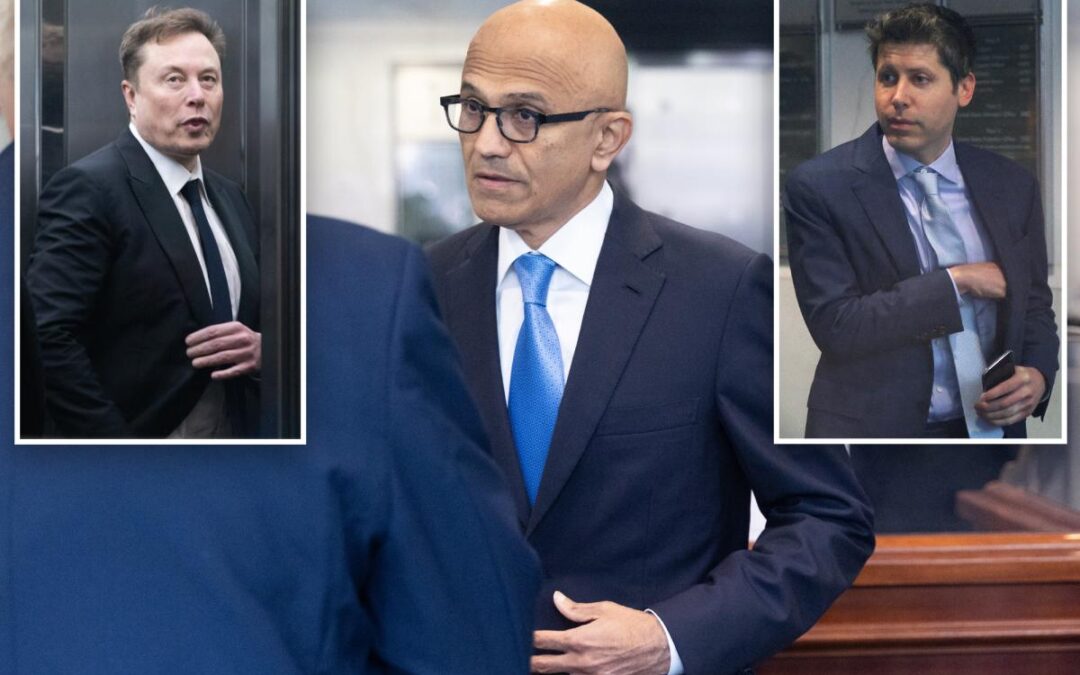
OAKLAND, CALIF. — Microsoft CEO Satya Nadella defended OpenAI’s pivot to for-profit status and discussed his company’s hopes for a juicy return on its investment during Monday testimony in Elon Musk’s suit against the AI giant.
“Without a for-profit entity, it would be hard for OpenAI to pursue its mission,” Nadella said in federal court in Oakland, Calif.
Musk’s attorney Steven Molo hit him with sharp questions throughout his testimony, which came in the third week of the trial over Musk’s allegations that OpenAI betrayed its founding contract by putting commercial gain over developing AI for the benefit of humankind.
As part of his suit, the Tesla titan has accused Microsoft of aiding OpenAI’s alleged breach of charitable trust when it turned into a for-profit.
Microsoft planning documents from 2023 shared in court Monday showed the company hoped to reap a cool $92 billion return on its initial $13 billion investment in OpenAI.
The massive valuation of $852 billion the AI giant reached in March puts Microsoft’s stake in the company at around $135 billion.
“It’s worked out very, very, very well for Microsoft, hasn’t it?” Molo asked, drawing a response in the affirmative from Nadella.
Monday’s testimony also touched on a big theme from last week — the controversial ouster of OpenAI’s CEO Sam Altman in November 2023. He returned to the role days later.
Nadella said he was concerned by the initial firing, explaining that he promised to support possible new leadership but didn’t want Altman to go off and join a rival, either.
“That was obviously very concerning to me,” said the Microsoft maven. “Given all of that competition, I just wanted to make sure we could hang on to the band that created all this technology.”
The Microsoft-OpenAI partnership has seen its ups and downs, with the software giant getting a 27% ownership stake in the startup following OpenAI’s restructuring last year.
Nadella asserted Monday he was “very proud” that Microsoft took the risk to invest in OpenAI when “no one else was willing” to bet on it.
Still, Microsoft executives including Nadella were skeptical about pumping capital into OpenAI as far back as 2018, according to emails shown in court last week. Several Microsoft execs said they had made visits to OpenAI and weren’t seeing imminent breakthroughs in developing artificial general intelligence — considered a holy grail in the AI race.
OpenAI co-founder Ilya Sutskever also testified on Monday. He said he never promised Musk — who’s seeking up to $180 billion in damages and a court order for OpenAI to unwind its for-profit status — that the company would remain a non-profit.
“The mission of OpenAI is larger than a non-profit or for-profit structure,” Sutskever said.
He said he recalled Musk wanted to own more than half of the for-profit entity of OpenAI.
“I found it to be aggressive,” Sutskever said, adding that Musk had obligations in other companies that he thought would distract him. “I found it difficult.”
On Altman’s 2023 ouster, Sutskever said he was “not excited” about the prospect of a merger with other companies including arch-rival Anthropic in the chaotic days following Altman’s firing.
He acknowledged that former OpenAI board member Helen Toner expressed the view that “Allowing OpenAI to be destroyed would be consistent with its mission.”
In video testimony played in court last week, Toner detailed just how close the company came to a shotgun merger with Anthropic in the wake of Altman’s firing.
US District Judge Yvonne Gonzalez Rogers asked Sutskever if he could quantify the growth of OpenAI’s technology during its early years.
The computer scientist paused for a moment and then replied, “It’s the difference between an ant and a cat,” drawing laughter from the courtroom.


