
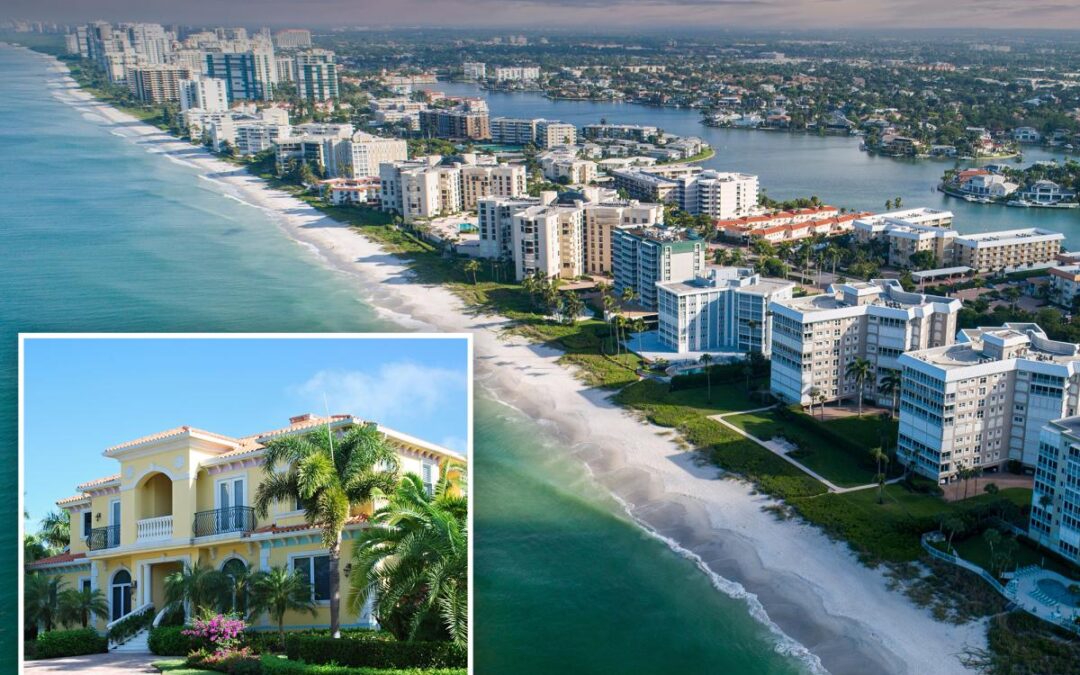
Perched on the edge of the Everglades, Naples has positioned itself as Florida’s capital of quiet luxury, offering an alternative to Miami’s flashier real estate scene—and increasingly drawing a younger cadre of executives alongside its traditional base of deep-pocketed Midwestern retirees.
With a population of roughly 420,000 people, the Naples metro—which also encompasses Marco Island—is a fraction of the size of Miami, but the premier resort city on the Gulf coast punches way above its weight when in comes to high-end properties.
Since the pre-pandemic era, the median price of an entry-level luxury home in Naples has surged a staggering 88%, hitting $3.7 million in May, making it the fourth most expensive luxury market in the U.S., according to the latest housing data analysis from Realtor.com®.
“There were sharp run-ups and recalibrations over those seven years [from 2019], but overall, the region has settled at a much higher price point for the top 10% of the market,” says Realtor.com senior economist Anthony Smith.
During that period, Richard Prebish, an agent at Campbell & Prebish with William Raveis Real Estate who specializes in luxury listings, says Naples successfully competed with high-profile markets like Miami and Palm Beach for the caliber of buyers it attracts, while offering a radically different, much more understated lifestyle.
”We enjoy the same type of weather and all the benefits of being this far south in Florida, but it is much quieter and just a different way of life,” Prebish says. “I can say with confidence that … we are right on par with the most wealthy areas of the nation.”
Naples has been home to an impressive roster of billionaires, business tycoons, and entertainers, including Best Buy founder Richard Schulze, NBA legend Larry Bird, television’s Judge Judy Sheindlin, and former U.S. House Speaker Newt Gingrich.
Yet, what sets the rich and famous residents of Naples apart from their counterparts in high-octane Miami or Palm Beach is a distinct preference for flying under the radar instead of putting their affluence and status on display.
“As the wealth increases, so does their desire for privacy,” explains the agent. “And in fact, that privacy becomes more valuable than the status. Many of the people that I deal with don’t want anyone to know who they are, don’t want anyone to realize what they may have purchased.”
Prebish adds: “The idea is to escape to Naples, enjoy the privacy, enjoy the peace and quiet, and then also be able to create some authentic relationships.”
Inside Naples’ luxury inventory
While Naples is made up of over 100 distinct neighborhoods and developments, the metro’s elite homebuyers tend to gravitate toward ultraexclusive enclaves like Old Naples, Port Royal, and Pelican Bay.
Prebish says the majority of his clients favor beachfront single-family homes on navigable waterways. For those shopping for properties in Port Royal, homes come with access to such coveted amenities as a beach club, a spa, a fitness center, and a tennis facility.
The neighborhood’s other major selling point, according to the agent, is its proximity to downtown Naples—a historic area lined with palm trees, vibrant architecture, and high-end shops.
“The buildings by way of [zoning] code are restricted to the lower heights, so you just don’t have that cavernous, or concrete jungle feeling that you might feel in any big city,” says Prebish.
Naples also offers a wide variety of outdoor recreation opportunities to fit almost any taste, from golfing at award-winning courses to deep-sea fishing and exploring the Everglades.
“I’ve traveled the country,” says Prebish, “and I have yet to find anywhere that’s even remotely close to Naples.”
Asking prices in Naples skew toward the high end, with the typical mid-luxury home starting at $6.3 million, while ultra-premium properties start at nearly $15 million.
Earlier this year, a 22,800-square-foot waterfront megamansion in Naples made headlines when it hit the market with the eye-watering asking price of $271 million. If the sprawling estate finds a sufficiently wealthy buyer, it will become the most expensive home ever sold in the U.S.
Shifting demographics
Historically, Naples has been a magnet for well-to-do retirees looking to swap the cold winters of the Midwest for the year-round sunshine of Florida’s aptly named Paradise Coast.
Even in 2026, the metro remains highly popular with the older set: Naples’ median age sits just above 50 years, while in Miami it’s 44. Additionally, Naples retains one of the largest shares of homeowners 65 years and older in the U.S.
However, since the pandemic, Prebish says Naples has seen its buyer pool expand dramatically to include younger professionals, remote workers, and families relocating from the Northeast and the West Coast in search of a more relaxed pace of life.
“The people that are here in Naples could live anywhere that they want to, and they’ve opted for Naples,” stresses the agent.
Perhaps unsurprisingly, at the end of 2025 Naples distinguished itself as one of the nation’s most fast-paced luxury markets.
Speaking to Realtor.com at the time, Nella DeCesare, SWFL broker and founder at Florida Listing Experts, said of the Naples lifestyle that it “has taken center stage globally as one of the most desirable places to live.”
At the same time, the Midwest still remains a strong feeder market for the Florida metro—a trajectory shared by Prebish himself who grew up in Michigan before making the Gulf Coast his permanent home base.
“I could live and have lived in many different places, and I could live anywhere today, [but] whenever I travel, I can’t wait to get back home,” he says.
Naples vs. Miami
Sitting on opposite coasts of Florida, Naples and Miami share geographic proximity to water, resort-style living, and year-round warmth, yet they draw different buyers.
The Miami-Dade and West Palm Beach areas have pulled in a wave of hedge funds, private equity firms, and wealth management operations that relocated to the area, creating a legitimate financial hub.
“That growing corporate presence has shortened the commute for executives who would otherwise be tethered to New York, and it has transformed the region from a leisure market into a year-round business destination,” notes Smith.
Miami also attracts outsized international attention, with recent quarterly data showing foreign property buyers accounting for 10.3% of demand in Miami, compared with just 1.3% in Naples.
“I continue to view this migration as a multidecade trend rather than a short-term cycle,” Ana Bozovic, a Miami-based real estate agent and founder of Analytics Miami and Miami Deal Sheet, tells Realtor.com
“In many ways, we are still in the early innings. If the last five years represented the beginning of this accelerated shift, I believe there is a strong case that the next 15 to 20 years will continue to reinforce South Florida’s position as one of the world’s leading destinations for globally mobile wealth.
This massive footprint is reflected in the volume of high-priced inventory: Miami’s million dollar listing count in May was over 10,000, nearly five times that of Naples.
Ultimately, experts do not see the rise in Naples as a replacement for Miami, but rather as an alternative where understated luxury and privacy command a premium.

