
By the time Michael Jackson signed a lease on one of the most coveted addresses in Los Angeles, he hadn’t called the infamous Neverland home in four years.
The legendary 2,700-acre Santa Barbara County compound where he’d spent decades and an untold fortune building into a private fantasyland had become a liability — financially, legally and emotionally.
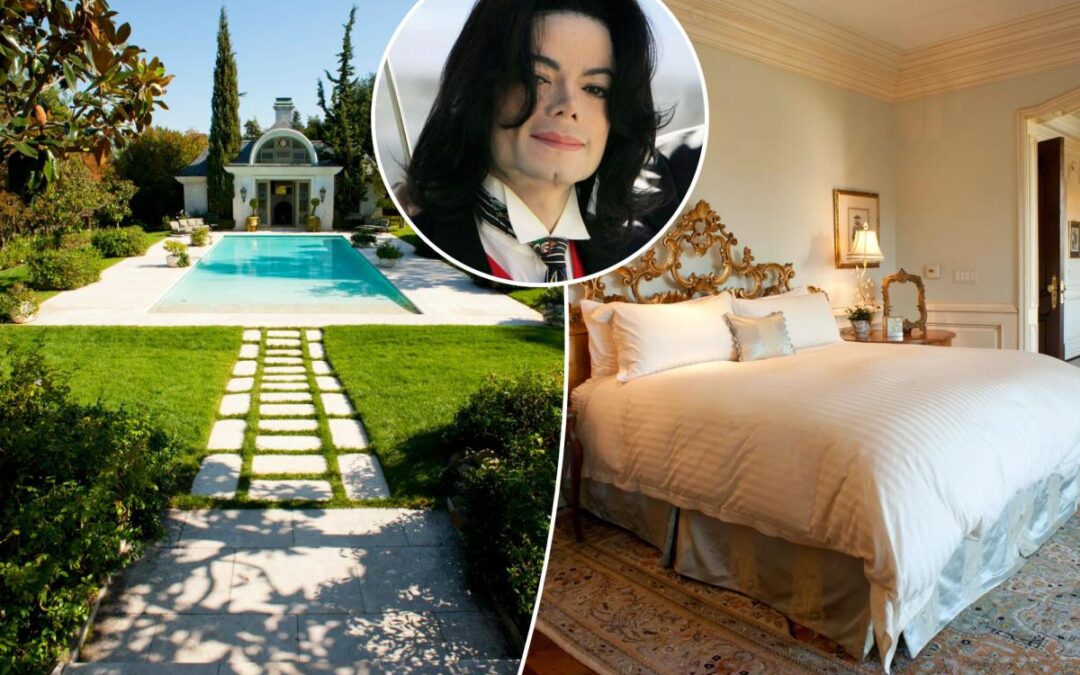
Instead, in December 2008, the 50-year-old King of Pop quietly moved into 100 North Carolwood Drive, a gated French château in Holmby Hills, paying a grand $100,000 a month to rent the estate from clothing manufacturer mogul Hubert Guez and his wife Roxanne.
And now, as the recently released “Michael” biopic continues its buzz, it makes many wonder where he spent his final days. This Los Angeles residence would be his last address. He died there on June 25, 2009.
The property Jackson called home for the final six months of his life was no ordinary rental.
Designed by star architect Richard Landry and completed in 2002, the Carolwood Drive estate is the kind of place where, at the time, it was seen as old-money aesthetics meet modern excess.
Across roughly 17,000 square feet spread over three stories, the mansion offered seven bedrooms, 13 bathrooms and 12 working fireplaces. There was a private theater for screenings, a wine cellar with a dedicated tasting room, a spa and gym, an elevator, and a guesthouse with stained-glass doors opening onto a swimming pool surrounded by mature landscaping.
It was the backdrop for what was supposed to be a triumph. Jackson was deep in rehearsals for “This Is It,” his 50-show comeback tour booked at London’s O2 Arena, a run that was intended to silence the doubters, pay the bills and restore the myth.
Before the house on Carolwood belonged to the Guezes, it was owned by then-couple Yolanda and Mohamed Hadid.
Jackson had been living at Carolwood with all three of his children — Prince, Paris and Blanket — from the day he moved in.
When celebrity auctioneer Darren Julien and his team at Julien’s Auctions toured the property after Jackson’s death, what struck them wasn’t the grandeur. It was a chalkboard still hanging in the sprawling kitchen, where three barstools stood in a row along the center island — the obvious breakfast spot for three children.
Scrawled in childlike handwriting was a note from one of his kids: “I (heart) Daddy. SMILE, it’s for free.”
Julien planned to sell it as-is.
The bedroom shown in evidence photos at Dr. Conrad Murray’s criminal trial was actually described by the Jackson camp as a “medication room.” Murray was convicted of involuntary manslaughter in November 2011 for administering propofol, a powerful surgical anesthetic, to Jackson to treat his chronic insomnia. He was sentenced to four years. Jackson’s true private bedroom, adjacent to the medication room, was considered his inner sanctum.
To understand how Jackson ended up renting at $100,000 a month rather than sleeping in any of the dozens of rooms at his own estate, you have to understand what Neverland cost him — not just in dollars, but in everything.
Jackson purchased the 2,700-acre property in Los Olivos, California, in 1988 for $19.5 million, renaming it after the island in J.M. Barrie’s Peter Pan. He’d first visited the ranch in 1983 when Paul McCartney was renting it during the filming of their “Say Say Say” music video. Jackson was enchanted. Within five years, it was his.
What followed was a transformation unlike anything in the history of private real estate. Jackson installed a full amusement park with custom-built rides — a ferris wheel manufactured by the Eli Bridge Company specifically for him in 1990 at a cost of $215,000, bumper cars, a Sea Dragon, a Dragon Wagon roller coaster and more.
There was a private zoo stocked with exotic animals, a movie theater, a train station with functioning railways and a game arcade. The grounds were staffed around the clock. The overhead was staggering.
The child molestation charges brought against Jackson in 2003 — charges he was ultimately acquitted of in 2005 — effectively ended his life at Neverland. He left after the verdict and never went back. But the mortgage didn’t leave with him.
By 2007, reports of foreclosure proceedings against Neverland were circulating publicly. Jackson’s camp insisted it was merely a refinancing situation, but in February 2008, the reality arrived in black and white: the Financial Title Company, acting as trustee, notified Jackson that unless he produced $24,525,906.61 by March 19, the ranch, its buildings and everything on it — the rides, the trains the art — would go to public auction.
The bestselling solo artist in recording history, was weeks away from losing his home at auction over a debt north of $24 million.
His attorney, L. Londell McMillan, announced in March 2008 that a private deal had been struck with investment group Fortress Investment to prevent the auction. The terms were never disclosed.
Two months later, in May 2008, a separate foreclosure auction was canceled after Colony Capital — the real estate investment firm run by billionaire Tom Barrack — stepped in and purchased the defaulted loan for $22.5 million. Jackson released a carefully worded statement expressing his pleasure at the “recent developments” and his hopes to work with Colony going forward.
In November 2008 — just one month before Jackson moved into Carolwood — he transferred the Neverland title to Sycamore Valley Ranch Company, LLC, a joint venture between himself and an affiliate of Colony Capital. The Santa Barbara County Assessor’s Office indicated Jackson had sold an unspecified portion of his property rights for $35 million, though subsequent reporting suggested Colony’s actual investment was $22.5 million. Reliable accounts pointed to Colony holding majority ownership. Jackson’s exact remaining stake was never publicly confirmed.
The rides were hauled out almost immediately. Neighbors watched flatbed trucks carry off the ferris wheel, the Zipper, the Lolli Swing and the Spider along the highway. Helm and Sons Amusements, which had originally supplied some of the rides to Jackson, bought several back. Butler Amusements of Fairfield, California purchased six more. They began appearing at county fairs and state fairs across California, Oregon, and Washington — sometimes with signage noting their Neverland origins. The Dragon Wagon ended up at Coney Island. The Sea Dragon found a permanent home at Beech Bend Park in Bowling Green, Kentucky. The bumper cars were installed at CalExpo, site of the California State Fair.
After Jackson’s death, his estate’s contents at Carolwood were auctioned by Julien’s Auctions. The queen-size bed where Jackson drew his last breath was among the items offered, along with antique furnishings, sculptures and paintings. The chalkboard from the kitchen, with the child’s note still on it, sold with its memories intact.
The house itself changed hands in November 2012, when Hubert and Roxanne Guez sold 100 North Carolwood Drive for $18.1 million — significantly below its peak asking price of $38.5 million, and even below its more modest listing of $23.9 million. The buyer was Steven Mayer, a senior managing director at Cerberus Capital Management.
Neverland, now legally known as Sycamore Valley Ranch, was eventually purchased in 2020 by Ron Burkle, a billionaire businessman and longtime friend of the Jackson family, for $22 million — roughly the same amount Colony Capital had put in to rescue it from foreclosure 12 years earlier.

